
Sparkle and Grime: Locating the Postfeminist and Postracial Aspirations of Cinderella and Ever After
Eva Fuller
The modern fairy tale adaptation found a home in the pop cultural landscape of the 1990s. Modern fairy tale media of the decade hit a colossal peak in popularity with Disney adaptations of tales such as Beauty and the Beast (ATU 425C) and Hans Christian Andersen’s The Little Mermaid. Despite the Disney adaptation’s release in 1989, its cultural shockwaves rippled into the new decade and molded the public image of the new-wave fairy tale heroine: beautiful and talented with a certain kind of agency, albeit limited. The newfound shape of the fairy tale heroine coincided with the decade’s overwhelming adoption of “girl power” or what Michelle Bae believes to be its “popular cultural version,” which purposely “redirected the representation of girlhood from a strong, proactive, smart heroine to a worshiper of feminine beauty and heterosexuality” (28). Beyond modern adaptations of fairy tales, the archetypal female heroine in the 1990s claimed space in the media landscape in league with male protagonists who had previously taken up center spotlight, but was often trapped within the constraints of postfeminist and ultimately consumerist notions of “girl power.”
Two films that capture the intersection between the modern fairy tale heroine and the trappings of “girl power” are Rodgers & Hammerstein’s Cinderella (1997, dir. Robert Iscove) and Ever After (1998, dir. Andy Tennant). Both films are granted cultural relevance through their leading actresses — Cinderella’s titular character is played by Brandy Norwood alongside Whitney Houston as her fairy godmother, and Ever After’s Cinderella figure, Danielle, is played by childhood star Drew Barrymore. Outside of their roles in their respective films, these women were often cited as role models or aspirational figures for young girls and maintained cultural capital as “girl power” icons. Mary Celeste Kearney links the 90s’ situated girl power movement to the idea of “sparkleification,” or the use of “glittery makeup, clothing, and accessories” by young girls to “affirm their youthful femininity” (1). The latent argument in Kearney’s work is that the boom in popularity of ‘sparkle’ in the 2000s helped mediate the transition from the hidden postfeminism of the “girl power” era to the much more visible “post-girl power” era, where girls are “expected/demanded to be fully self-actualized neo-liberal subjects” (Gonnick et al. qtd. in Kearney 4). In smaller nuanced ways, the two aforementioned films transcend “sparkleification” through Cinderella’s colorblind casting and Ever After’s realism, and yet fall victim to the fundamental trappings of it. Cinderella retains the original tale’s supernatural elements with an extra sheen of whimsy and vibrancy, and its goal is to subvert the viewers’ commonly held ideas of sparkle — that only “white middle-class female youth” (Kearney 1) can exemplify the tenets of sparkle — and grant them to marginalized characters who have been robbed of it. Ever After eliminates Cinderella’s supernatural elements and situates it as historical fiction, standing in opposition to most iterations of the tale in its layer of grime and muck that obscures the sparkle. I argue that the presence of sparkle, as well as its purposeful lack, in Cinderella and Ever After helps construct postracial and postfeminist fantasies in each respective film.
Sparkle and color are intertwined elements in Cinderella and are notable from the film’s very beginning. The film’s title card is adorned with glitter and special effect sparkles, kindly interrupted by a green-screened Whitney Houston in her shimmering fairy godmother dress. Kearney describes one form of sparkle as explicit “depictions of magic” that are “produced through animated special effects” (6), which often trail behind Houston’s fairy godmother whenever she magically poofs into frame. The opening scene introduces viewers to the film’s context-less fairytale world — with no time period or even a name for the town itself — through warm lighting and fanciful, colorful costuming. These technical aspects become less jarring as the film progresses and settles itself in its excessive use of color. Every character, from Cinderella’s stepmother and stepsisters to even extras who take up space in shots of the town square, is homogenized through their collective use of clashing colors, making the racial heterogeneity of the cast less noticeable. Craig Zadan, the film’s executive producer, wanted “the image on screen to have so much color in it – primary colors especially – that the skin colors almost dissipated in that you weren’t staring at ‘that person’s this or that’” (Sasaguay). Zadan’s statement, while good intentioned, is blanketed by the postracial idea of colorblindness, or the inability to see race and ethnicity as identifying markers of an individual’s humanness. We can put Bae in conversation with Zadan’s statement, as she questions the prominence of “racial ambivalence” over what she considers to be “the previous media strategy of racial specificity” (33). Instead of naming Cinderella and her fairy godmother’s Black female identities, or even the Prince as Filipino, the film opts to leave these pivotal identity markers unnamed and unquestioned. This is not inherently bad, and even now as an adult (still affected by the indescribable force of nostalgia), I recognize the power in their portrayals simply through their presence onscreen. But the question of who gets to sparkle still lingers in the background, especially as the viewer witnesses the democratization of color and sparkle.
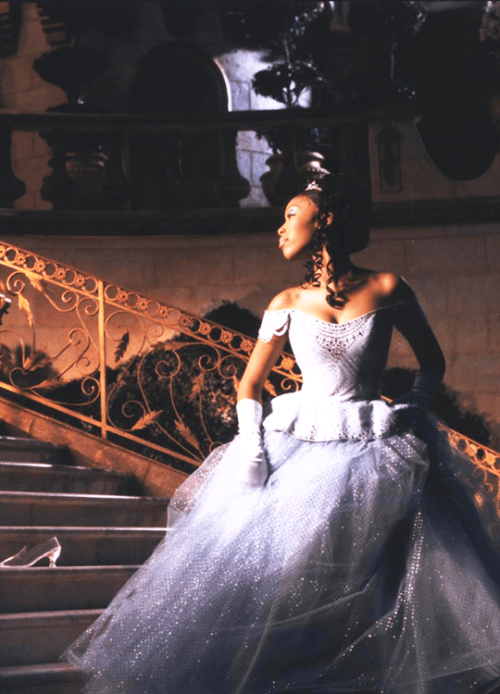
Prior to her iconic transformation, Norwood’s Cinderella spends the first half of the film dressed in dull shades of brown and beige that separate her from the rest of the colorful world. After meeting her shimmering fairy godmother and undergoing her own transformation, adorned in a unique shimmer of her own, she is drawn in her pumpkin carriage to the ball where all of its attendees are dressed in eerily similar cool colors: blue and purple in varying tones, with female attendees in tulle-bottom dresses in the exact same pattern and shape. In addition to the uniformity of dress, the ball itself is stifled by a ballroom dance loop that shuffles the Prince — notably dressed in white — through various suitors who vie for his attention. The latent desire for a semblance of homogeneity in Zadan’s statement is most salient in this scene, and Cinderella’s presence, historically marked by her individuality that clashes with the rigidity of the upper class, does very little to remedy the sameness in the room. The glitter embedded in the tulle of her iconic blue dress matches the glitter in the tulle of everyone’s blue dress. It makes the tale’s classic ‘aha’ moment, in which she appears at the top of the ballroom stairs as the Prince gazes in awe and the world seems to stop, much less impactful. Norwood’s Cinderella is granted shine, yet it is diluted so everyone else can receive the same shine.
Ever After lacks Cinderella’s special effects and materialized sparkle — in fact, the film is noticeably lacking in the tale’s usual showcase of sparkle. This is due in part to the film’s setting and time period of sixteenth century France and the real-world constraints that eliminate the possibility of the supernatural. But instead of computer-generated sparkle or even sparkle via glamor, the viewer is introduced to a young Danielle in the film’s opening sequence with her face covered in dirt after roughhousing with a peasant boy. Later in the film as a young adult, scenes will often open with her performing acts of labor with remnants of dirt and cinder on her face. Danielle’s base state is inherently marked by grime, a visual cue that is briefly made mention of in Iscove’s Cinderella, but never actually seen. These moments with visible dirt and grime are small achievements in transcending sparkle and perceived notions of beauty. At the same time, the mud that cakes young Danielle’s face in the opening scene, if we see mud as the direct opposite of sparkle, helps to frame her as a tomboy, a gendered construction that is informed by her interactions “with characters in the film and the viewing audience” (Williams 105). This construction of gender is hardly ever static through the course of the film and is perpetually subject to change depending on the context, especially as Danielle grows older and begins to replace grime with sparkle.
For example, Danielle masquerades as a courtier to save a servant working in her stepmother’s home from being sold and learns to utilize sparkle as a masking device. She relies on her late mother’s wardrobe, chock full of opulent embellished gowns, to help sell the image of a courtier by the name of Nicole de Lancret. Her transformation into Nicole is not a full ‘sparkleification,’ often forgoing makeup and limiting her sparkle to a fancy dress and the occasional headpiece or necklace. Much of the performance of Nicole, however, is dependent on the adoption of hyperfemininity, defined as “an acknowledgement that it is femininity itself which is constructed as a mask—a decorative layer which conceals a non-identity” (Doanne qtd. in Williams 105). Danielle’s performance of Nicole is meant to be temporary as a means of protecting her loved ones, but when Prince Henry falls for the simulacrum she has created, the hyperfeminine ‘mask’ begins to fill in the space of the non-identity it was meant to simply obscure, slowly becoming her real identity. Her fluid construct of gender is rendered static through her role in a heterosexual relationship, and her “masculine behavior” is considered “unthreatening” and is “naturalized as a phase to outgrow” now that she has a man to affirm her femininity (Williams 106). Sparkle, when applied as hyperfemininity, is what mediates this shift and speaks to the film’s latent postfeminist message: women are allowed to be agents of change as long as they settle down at the end of the day.
In the film’s climax, Danielle’s stepmother locks her in the basement’s wine cellar, leaving her to attend Prince Henry’s masque along with Danielle’s stepsisters, where he will announce his betrothal to one of the attendees. Instead of the fairy godmother who dresses Norwood’s Cinderella (and the Cinderella’s in most iterations), it is Leonardo Da Vinci and a couple of house servants who free Danielle and dress her for the ball. Pairing Danielle’s transformation with Norwood’s transformation in Cinderella makes way for many key similarities and differences — Danielle, for the first time in the film, is covered in shimmering silver makeup and embellished with face gems similar to the rhinestones that line the collar of Norwood’s dress. Kearney would label this as textbook sparkle, as she cites one form of sparkle to consist of “glittery makeup, sequined clothing and bejeweled accessories” (7). However, Danielle’s gown is wedding-dress white instead of blue, pointing toward the film’s intended ending point of marriage. She is also, oddly, gifted a pair of fairy wings by Da Vinci. The wings suggest a newfound freedom, but Christy Williams recognizes the undercurrent of patriarchy pulsing beneath this specific scene of transformation.
“Leonardo’s wings—not her mother’s dress—make Danielle’s appearance at the masque spectacular. The mother—the woman—in fairy godmother is erased, and her erstwhile power is firmly resituated in the hands of men.” (Williams 114)
In this passage, Williams pokes a hole into the “girl power” bubble simply by locating the absence of the central female figure that guides and reflects onto their younger counterpart. Taking Da Vinci and filling him into the mold of the fairy godmother is meant to deconstruct how sparkle is issued and granted, but the imminence of marriage and assimilation into a larger patriarchal society unfortunately works against this deconstruction. Similar to how the sparkle in Cinderella is diluted by the false promise of an unnamed postracial society, the sparkle in Ever After is diluted by the looming promise of marriage to men, of a life indirectly influenced and moved by men. The latter film’s attempt at creating a complex female lead, while a triumph in some aspects, falls within the cracks of its “girl power” postfeminist footholds. We can watch these films and act as receptacles to the lurid and dazzling images and scenes they display — they are films intrinsic to my childhood at least and are memorable in their own right — while recognizing the ways in which they fall short of the latent goals they sought to achieve.
Bibliography
Bae, Michelle S. “Interrogating Girl Power: Girlhood, Popular Media, and Postfeminism.” Visual Arts Research, vol. 37, no. 2, 2011, pp. 28–40. JSTOR, https://doi.org/10.5406/visuartsrese.37.2.0028.
Iscove, Robert. Rodgers & Hammerstein’s Cinderella. Walt Disney Home Video 1997.
Kearney, Mary Celeste. “Sparkle: luminosity and post-girl power media.” Continuum, 29:2, 263-273, 2015. DOI: 10.1080/10304312.2015.1022945
Sasaguay, Chris. “Here’s Why 1997’s ‘Cinderella’ Is a Timeless Queer Classic.” Collider, 2 Nov. 2022, https://collider.com/cinderella-brandy-queer-classic/.
Tennant, Andy. Ever After: A Cinderella Story. 20th Century Fox Home Entertainment, 1998.
Williams, Christy, and Jack Zipes. “The Shoe Still Fits: Ever After and the Pursuit of a Feminist Cinderella.” Fairy Tale Films: Visions of Ambiguity, edited by Pauline Greenhill and Sidney Eve Matrix, University Press of Colorado, 2010, pp. 99–115. JSTOR, https://doi.org/10.2307/j.ctt4cgn37.10.

