Zeytin Ercan
Throughout the early-mid 20th Century, the art world witnessed the rise of two major, groundbreaking artistic movements in Europe: Dadaism and Surrealism. The two movements differed in their larger goals, with Dada emerging as an absurdist reaction to the devastation and catastrophe caused by World War I, while Surrealism sought to focus on more interpersonal issues, often engaging in theories of psychoanalysis (Foster 2016, 147). Despite their differences, the two movements had much in common, as both shared an overarching disdain for the precedented, seeking to challenge and critique the norms of modern European society. For female Dadaists and Surrealists alike, this sort of critique was typically directed at gender essentialism and other patriarchal values, calling into question the hierarchical nature of gender at the time. Through their utilization of self-reflection and androgynous presentation, the work of Dadaist and Surrealist female artists create narratives that both acknowledge and embrace the performative nature of gender. In doing so, their work critiques heteronormative sexuality and invites female audiences to engage in androgyny themselves.
During the Weimar Republic in Germany, representations of androgyny in art and popular culture were fairly common, often evoking themes of gender identity and sexuality (Lavin 1994, 119). One German female Dadaist who frequently engaged in such conversations through employing androgyny in her art was Hannah Hoch. Hoch was known best for utilizing the medium of photomontage to create the androgynous figures in her works. Photomontage was an extremely common medium for Dada artists, as it allowed for the systemic deconstruction characterizing the movement to be more literally conveyed through the physical deconstruction of photographs, advertisements, and other visual media that upheld the societal norms they sought to challenge. In the case of Hoch, this often meant using photomontage to create androgynous figures in her works, challenging the gender hierarchy through the literal deconstruction of explicitly gendered figures. Even when her figures did not exhibit explicitly androgynous traits, the general themes of gender and sexuality related to androgyny were still very much present, as seen in her 1930 piece, Marlene (Lavin 1994, 120). The photomontage portrays two men gazing up at a pair of legs mounted upside down on a pedestal adorned with stockings and heels. In the upper right corner, obscured from the two men, is a pair of bright red lips facing towards the audience. Written in white pastel next to these lips is the name Marlene, a reference to the famous German film actress Marlene Dietrich. Dietrich was widely recognized as a lesbian cult icon at the time for her androgynous style and general challenging of gender norms in her films (Lavin 1994, 132). The image manages to simultaneously service both the heterosexual male gaze, as exhibited through the two male onlookers, and the homosexual female gaze through the reference to Dietrich paired with the erotic pair of lips facing the audience (Lavin 1994, 133). In this work, the androgyny Hoch seeks to exemplify is not meant to be explicitly present in the piece, rather it is in the female audience that is encouraged to position themselves in the role of both the heterosexual male and the homosexual female (Lavin 1994, 133). In her paper Androgyny and Spectatorship, Maud Lavid argues that this oscillation between male and female, the masculine and the feminine, is a practice most women already partake in as a result of existing in a patriarchal society, explaining “…women in male society, although socialized as feminine, have also generally had to identify with the masculine position as the primary location of action and power” (Lavin 1994, 124). She posits that it is this forced yet entirely private juggling of gender roles women must perform subconsciously that makes androgyny so appealing, allowing women to freely move between masculine and feminine and imagine a world that rejects the gender hierarchy entirely. This is what makes Marlene such a powerful feminist image, as Hoch invites her female audience to experience the catharsis of practicing androgyny.
Along with addressing issues of gender, androgyny also served as a method of critiquing heteronormative sexuality, expressing the frustrations women had with performing femininity for their male partners. This can be seen in the work of Frida Kahlo, a Mexican Surrealist artist who primarily used self-portraiture to explore her complex relationship with her own body (Chadwick 2001, 310). Kahlo utilized the symbolism associated with the Surrealist movement to explore the more interpersonal, complex aspects of her identity, creating extremely vulnerable, vibrant self-portraits to express those aspects. These portraits typically addressed issues such as Kahlo’s mixed cultural heritage and her chronic physical pain, but in exploring her body, additional themes such as Kahlo’s relationship with her femininity naturally arose as well (Chadwick 2001, 320). Arguably, there is no work of Kahlo’s that best exemplifies this than her 1940 painting, Self Portrait with Cropped Hair (Gubar 1981, 487). The piece features Kahlo seated against a dark red background whilst wearing an oversized men’s suit and sporting a short, masculine hairstyle, both of which are juxtaposed by her heeled shoes and slender, feminine hands holding a pair of scissors (Gubar 1981, 486). Surrounding Kahlo are long wisps of her freshly chopped hair, and directly above her is a banner with lyrics and music notes from a popular Spanish song, reading “Mira que si te quise, fue pro el pelo, Ahora que estas pelona ya no te quiero,” translating to “Look, if I loved you, it was for your hair. Now that you are bald, I don’t love you anymore” (Gubar 1981, 486). The piece came as a response to Kahlo learning that her husband, and fellow artist, Diego Rivera, had been having an affair with a close friend (Gubar 1981, 487). Her feelings of loneliness and betrayal are reflected in many of the visual elements of the piece, such as her oversized suit. The large men’s clothes swallowing Kahlo, paired with her isolation in the frame, create a sense of otherness and inadequacy (Gubar 1981, 486). Despite the clear melancholy of the piece, there’s a sense of power present as well. In cutting off her hair and dressing in masculine attire, Kahlo is denying Rivera her femininity, presenting it as something within her control that she has the power to withhold if she so desires. Here, Kahlo’s androgyny frames femininity as something that women must perform for their male partners. She critiques the conditionality of heterosexual male affection through denying her husband the femininity that he loved to begin with, effectively liberating herself from him through liberating herself of forced femininity.
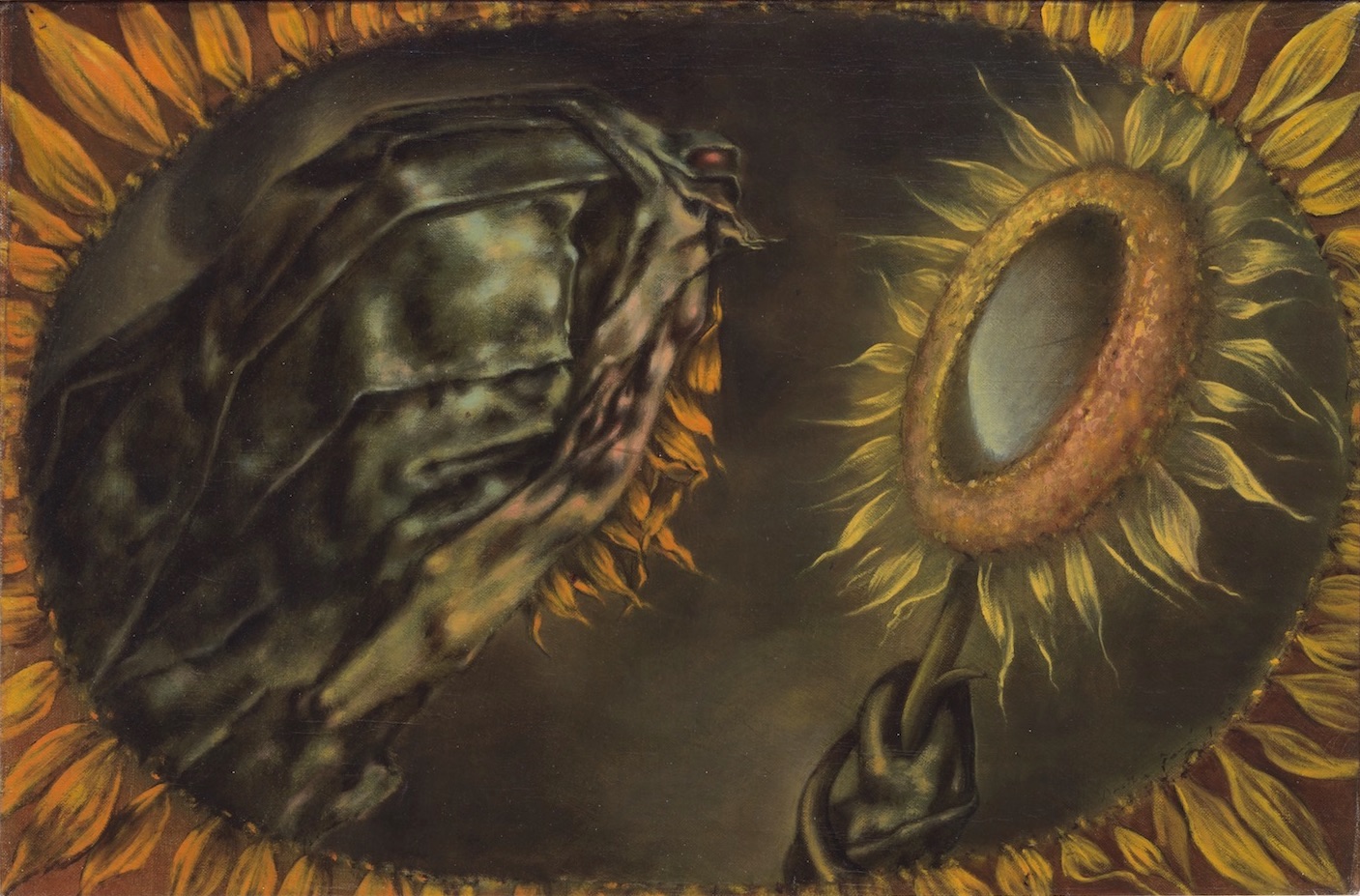
Kahlo was not alone in her use of self-portraiture, as the genre was extremely popular with other female Modernists at the time, and was frequently utilized to express issues of gender (Chadwick 2001, 305). Unlike their male counterparts, the female artist has much to consider when engaging in self-portraiture, as they must work to separate themselves from the “other” that male artists have portrayed themselves as for centuries (Chadwick 2001, 307). It is through this struggle that the longstanding association of women with narcissism and concern with self-image was born, a concept explored in Surrealist Dorothea Tanning’s The Mirror, from 1952 (Chadwick 2001, 307). The painting portrays an anthropomorphic sunflower bud gazing into a flower, which dually acts as a mirror, extended from one of its arm-like vines. The figure is surrounded with an outer layer of sunflower petals framing the scene. While not as explicit as Hoch or Kahlo, Tanning employs a similar sense of androgyny in this piece, albeit in a slightly more abstract manner, through using an inherently sexless figure to express issues of femininity and female identity. Despite the plant figure exhibiting no explicitly feminine or masculine traits, the act of self-reflection and concern with self-image is so entrenched in the concept of femininity that the figure is immediately read as female, or, at the very least, the scene is read as relating to gender (Chadwick 2001, 308). One could argue that the piece is further commenting on the association of women with nature, specifically with the delicateness and fragility of flower petals. In Surrealism, the mirror image is expected to challenge the viewer’s perceptions of reality rather than confirm them (Chadwick 2001, 308). Unlike real life, the reflected image in Surrealist art does not present any answers, rather, it simply confirms that a question about identity has been asked by the surveyor (Chadwick 2001, 308). As such, it is important to note that the form of the figure itself is not the primary concern of the piece, as the audience cannot see the face of the figure nor its reflection. Rather, as emphasized by the floral framing, the focus is on the scene itself, on the act of self-reflection alone. Through this, Tanning invites her female audience to relate to this genderless being, to practice androgyny and see themselves in the flower that is concerned with its appearance as a reaction to the gender hierarchy.
Bibliography
Chadwick, Whitney. “An Infinite Play of Empty Mirrors: Women, Surrealism, and Self-Representation.” In Viewpoints: Readings in Art History. Edited by Carole Gold Calo. Upper Saddle River, New Jersey: Prentice Hall, 2001.
Foster, Hal, Rosalind Krauss, Yve-Alain Bois, Benjamin H.D. Buchloh, David Joselit. Art Since 1900: Modernism, Antimodernism, Postmodernism 3rd Edition. London: Thames & Hudson, 2016.
Gubar, Susan. “Blessings in Disguise: Cross-Dressing as Re-Dressing for Female Modernists.” The Massachusetts Review 22, no. 3 (1981): 477–508. http://www.jstor.org/stable/25089168.
Susan Gubar, “Blessings in Disguise: Cross-Dressing as Re-Dressing for Female Modernists,” The Massachusetts Review 22, no. 3 (1981), .
Lavin, Maud. “Androgyny and Spectatorship.” In Modern Art and Society: An Anthology of Social and Multicultural Readings. Edited by Maurice Berger. New York: Icon Editions, 1994.

