Emily Jordan
Shakespearean texts and performances are well known for their investigations of the mind, body, and their relationship to philosophical ideologies. However, a darker, more morbid aspect emerges within Shakespearean tragedies and romances concerning the placement of the human body, becoming a tool to further the melancholic, deathly hauntings of the English Renaissance stage. Concerning the ‘revenge play,’ Henry Jacobs states that “Gruesome relics of human carnage show up repeatedly on the English stage
between 1585 and 1640,” falling directly in Shakespeare’s era of script (1). The role of violent dismemberment of the body highlighted in Shakespearean text, I argue, is a major precursor to Julia Kristeva’s theory of abjection. Kristeva’s theorism surrounds “the human reaction […] caused by the loss of the distinction between subject and object or between self and other,” which can be explored in Shakespearean works, most prominently in Macbeth and Hamlet (Felluga 4). Although Kristevan theories of abjection were not referential during the Renaissance period, they are apparent in these plays nonetheless, aligning with movements such as memento mori that encompass the same visceral emergences in death. Experience of abjection in Shakespeare’s text becomes identifiable by how our protagonists respond to witnessing a human form transform into an objectified ‘other,’ whether it is their skeleton, corpse, fluids, or severed limbs. However, Shakespearean abjection must ultimately be recognized as gendered as well, as it often emphasizes dead women as beautiful objects, while the male form more often becomes the ghost, with a sense of remaining agency. Within Shakespearean tragedies, exposure to abjection is what triggers reflection on humanity, morality, and society, and through this memento mori, a liminality between life and death derails and decenters the original ideologies of characters.
Abjection would not have been a theory yet defined in Shakespeare’s time; however, the ideas are part and parcel of the well-known concept of memento mori, a Latin phrase that roughly translates to “remember you must die.” This symbol was well-known and internalized by the Shakespearean audience, being a contemplative experience in which someone is reminded of their inevitable death and materiality, often triggered by the sight of rotting forms of the human body, such as severed limbs, skeletons, bones, and bodily fluids (Ostberg). Memento mori, like Kristeva’s abjection, becomes an uncomfortable experience in which one encounters an object that reminds them of their mortality, none more evident than the corpse. Felluga quotes Kristeva that “the corpse, seen without God and outside of science, is the utmost of abjection. It is death infecting life,” which can be exemplified in Act Five, Scene One of Hamlet, in which Hamlet converses with Horatio over the skull of the jester Yorick (6). Hamlet contemplates, “He hath bore me on his/ back a thousand times, and now how abhorred in/ my imagination it is! My gorge rises at it […] Where be your gibes now? Your gambols? Your songs?” In this moment, the audience, as well as Hamlet, are meant to be reminded of human mortality and materiality, as Hamlet’s “contemplation of Yorick’s skull remains consistent and conformative with the medieval traditions and the subtext of the memento mori” (V.i.192-197; Jacobs 7).
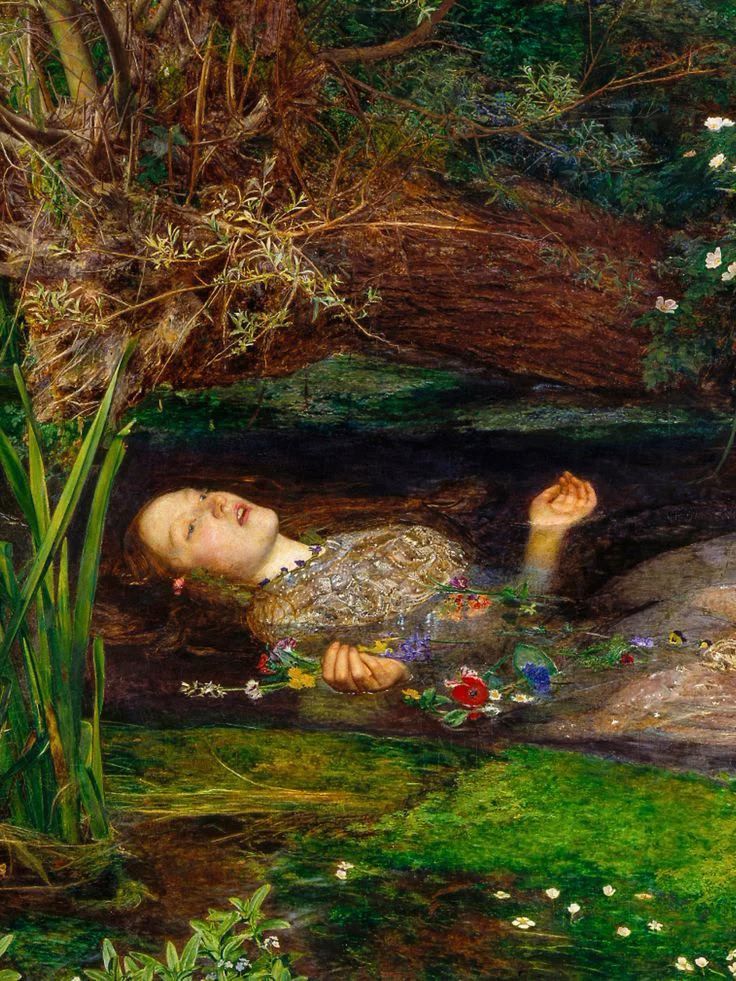
Immediately after Hamlet’s jarring recovery of Yorick’s skull and his subsequent reflections on humanity, death, and the abject dissolution of consciousness into the shell-like material skeleton, we witness the deceased corpse of Ophelia lowered into Yorick’s grave (Jacobs 8). The audience, and Hamlet, is meant to envision Ophelia’s beautiful form molding through decay and death into the next material, skeletal form, just as Yorick has, and as Hamlet jumps into Ophelia’s grave beside her, his eventual fate to die and decay into Yorick’s form is also foretold. The juxtaposition posed to the viewer between corpse and the skull references an early desire of Hamlet’s in the play, wishing “[his] too solid flesh would melt,” in a moment of yearning and romanticization for death (I.ii.132). With the death of Ophelia, however, this earlier contemplation of Hamlet’s turns disgusting in the revelation that her flesh will inevitably “melt” into a skeleton. It is through abject exposure to the corpse of Ophelia that Hamlet develops a new notion of death being more discomforting than he once thought. This epiphany plays into how Kristeva associates abjection as “the eruption of the Real into our lives,” as a distinct separation of experiences must be created between being aware of death in the world and being shown something which makes you confront your own inevitable death (Felluga 5). This divide separates the Hamlet we are introduced to and that which we end with, as he goes through phases of philosophical contemplation over the meaning of death, first as a kind of escapism and later in its Real form of Yorick’s skull and Ophelia’s corpse.
Chikako Kumamoto quotes G.S. Eliot in their essay “Gertrude, Ophelia, Ghost: Hamlet’s Revenge and the Abject,” restating the evident visibility of “‘the inexpressibly horrible’ that Shakespeare wanted to reveal but could not” (1). This “inexpressibly horrible” is that of the abject form, ranging from decay and dismemberment of bodies to theories of materialism vs spectrality after death. Similar forms of abjection as found in Hamlet can also be found in Shakespeare’s Macbeth. In this tragedy, the primary and most repeated encounter of abjection is placed in the hands of the three witches, who, in themselves, are uncanny and liminal, placed between humanity and otherness. Most famously, the witches list abject forms of animals to make a witches brew: “Eye of newt, and toe of frog,/ Wool of bat, and tongue of dog,/ Adder’s fork, and blind-worm’s sting,/ Lizard’s leg, and owlet’s wing–” and I would argue that the very reason this speech is so memorable to audiences is because of the distrubing images of dismemberment being evoked in our imagination, picturing these living creatures dismembered and reduced to ingredients (IV.i.14-17). These abject symbols have become deeply associated with the witches’ role in Macbeth, becoming an interesting passage into gendered forms and how they take on different formations within Shakespearean text, as one considers the “materiality of the feminine” and the maternal body as the “sexualized other” (Kumamoto 3).
In both Shakespeare’s Macbeth and Hamlet, a dichotomy is created between what is spiritually masculine and materially feminine. In death, both Banquo and Hamlet the First return to haunt the male protagonists in spectral forms, insinuating that upper-class males are often allowed a mode of agency for an outlet of revenge against an ‘unnatural’ or undeserved death, subverting the abject form of the corpse for the ghost. These characters are depicted as returning for the sake of bringing about the ‘natural order,’ as Old Hamlet prompts his son to remove Claudius from the throne and “Let not the royal bed of Denmark be/ A couch for luxury and damned incest” (I.v.82-83). Banquo’s character further spirals Macbeth downwards (who, like Claudius, has cheated the throne) until, through his death, the throne becomes ‘pure’ again. Thus, masculine forms of power become “the uncanny par excellence [between] being alive and being dead, the real and the unreal, the familiar and unfamiliar,” which escapes into an uncanny, philosophical, empowered form that is not granted to many women in these plays (Bennett and Royle 40).
Unlike the uncanny spectral forms of powerful kings and soldiers presented in Hamlet and Macbeth, who offer a mode of the villain’s undoing, after their death, the women of these plays become the paramount of abjection, their corpses and materiality becoming a display of decay and death rather than of revival in the afterlife. Returning to Act Five, Scene One of Hamlet, the body of Ophelia is immediately and distinctly objectified in death, strikingly different than the treatment of Hamlet’s father, as the gravedigger makes explicit that her entire identity has been lost to death and abjection. The following exchange exemplifies how Ophelia relinquishes her personhood and gender in death for materiality:
HAMLET: What man dost thou dig it for?
FIRST GRAVEDIGGER: For no man, sir.
HAMLET: What woman, then?
FIRST GRAVEDIGGER: For none, neither.
HAMLET: Who is to be buried in’t?
FIRST GRAVEDIGGER: One that was a woman, sir; but, rest her soul,
she’s dead. (V.i.121-126)
This moment makes explicit how, in death, Ophelia becomes neither man nor woman, and does not have any further entitlement, agency, or personhood as the form of Old Hamlet has as a ghost. Similarly, when Ophelia is laid in the open grave in which Yorick’s skull was interred, she becomes representative of “a potentially maggot-breeding female” and mortality itself (Kumamoto 7). Gertrude’s inability to see the ghost of Hamlet’s father in Act Three, Scene Four, can also be interpreted as her material body making her unable to enter the spectral realm, her “feminine physicality and sexuality [becoming] items of filth and decay,” placing Gertrude’s body as well as her physical, pseudo-incestuous relationship with Claudius between abjection and divinity (Kumamoto 7).
The dichotomy of feminine material mortality and masculine spectral eternity is also shown in the ghost of Banquo in Macbeth, whose form contrasts with descriptions of Macduff’s mother, who died in childbirth. The witches prophecize that “None of woman born shall harm Macbeth,” which is a statement that is only applicable if the deceased woman who has died still holds a claim on gender, which, as we have seen in Ophelia in Hamlet, is not always the case (IV.i.89-92). Macbeth falls into this trap merely because he does not see a reason that men and women can stop being gendered, even beyond their death, but the birth of Macduff relies on this loophole of female material abjection, transforming into objects in death. While going head to head, Macbeth warns Macduff, “I bear a charmed life, which must not yield/ To one of woman born,” to which Macduff answers, “Despair thy charm/ And let the angel whom thou still hadst served/ Tell thee Macduff was from his mother’s womb/ Untimely ripp’d” (V.viii.15-20). The word ‘untimely’ implies that Macduff was cut out of his mother’s womb after she died in childbirth, and thus, the loophole of the Witches’ prophecy is that, being born from his dead mother, Macduff was born from a material, abject object, not a woman.
The deathly materiality of these respective women, in both Macbeth and Hamlet, nods to specific religious and philosophical beliefs concerning the place of women and those of lower classes, such as Yorick, compared to the lives beyond death found in Banquo and Old Hamlet, as the abject and spectral forms “concern patriarchal repression and male and female stereotyping by gender and social role” (Hunt 3). In other words, those who were objectified in life are also objectified in death. Spiritual beliefs and systems of society based on religion and patriarchal archetypes place the abject woman and the spiritual man as with or beyond religion, as in abjection, “the rotting corpse becomes the central relic in an inverted religion that displaces God with man” (Jacobs 3). Religious views of the time, as well as movements like memento mori, are placed at the center of these images of the abject, the uncanny, and the ghostly presence.
Maurice Hunt’s article entitled “Shakespeare, His Contemporaries, and the Religions of His Time” offers very interesting insight concerning the world that Shakespeare was immersed in while writing his plays, especially concerning the Elizabethan era and the rise of Calvinist Protestantism over Catholicism, which can be explored especially in Hamlet. Spectrality in Hamlet plays heavily into this religious divide, as the ghost of Hamlet the First seems to exist between Catholic beliefs of purgatory and the Protestant beliefs that ghosts haunt their victims as a means of trickery, two possibilities Hamlet considers when encountering his father’s call to revenge. Between religious viewpoints, one may argue that Hamlet even plays with nihilism and fatalist views, as Hamlet contemplates in his ‘to be or not to be’ speech, “Whether ‘tis nobler in the mind to suffer/ The slings and arrows of outrageous fortune,/ Or take arms against a sea of troubles/ And, by opposing, end them,” Hamlet questions the meaning of a life in suffering and, through it, suicide, in a way that contemplates if it is more noble to end your misery than live through it just for the sake of not dying, death being a passion overtly explored and doctumented in this era of time (III.i.65-68; Jacobs 1). However, Hamlet reveals that it is the “undiscovered country from whose bourn/ No traveller returns,” the fear of an afterlife, which scares people into living, even though it could be easier for all to believe in nothing, a nihilistic ideology Hamlet comes extremely close to in his assertion “for there is nothing/ either good or bad but thinking makes it/ so” (III.i.87-88; II.ii.267-270).
The tragedy of Macbeth also contemplates nihilistic views, as the more our protagonist descends into paranoia over his unstable role as king, the more he contemplates the meaning of his position in life. One may argue that within the first interaction with the Witches, Macbeth’s assumed belief in Christianity is troubled, the figures resembling the blur between the natural and unnatural, the masculine and feminine, the spiritual and the real, where “fair is foul and foul is fair” (I.i.12). By embracing the prophetic powers of the Witches, Macbeth begins to descend into a space that is beyond reach of the faith that is ‘safe’ or ‘protective’ of him, while Banquo remains in doubt of the Witches’ prophecy, and remains spiritually and morally content. Near the end of the play, we encounter a pessimistic and paranoid, half-mad Macbeth who sees life as: “a walking shadow” and compares his role as king to that of “a poor player/ That struts and frets his hour upon the stage/ And then is heard no more: it is a tale/ Told by an idiot, full of sound and fury,/ Signifying nothing” (V.v.27-31). Macbeth’s stance on his life in this revelation becomes quite dismal and nihilistic, as he predicts that all that he has committed and sacrificed to keep the crown will have been done for nothing, as he must resign his power to someone else one way or another.
This revelation comes about after Macbeth hears of the death of Lady Macbeth, to which he replies, “She should have died hereafter, ”stating his opinion that she would have died eventually no matter what happened (V.v.20). This assertion, as well as Macbeth’s aforementioned nihilistic speech, can be seen as the product of his exposure to the abject Witches and the presumed existing nihilistic attitudes of Lady Macbeth, as all of these women are portrayals of masculinized femininity and a threat to Macbeth’s own systemic role. Macbeth’s increasingly unreligious stance through abjection can be seen in his conversation with Lady Macbeth in Act Two, Scene Two, as he becomes increasingly distressed due to his murder of King Duncan and recent inability to pray, after witnessing the abject corpse he created:
MACBETH: I could not say “Amen”
When they did say “God bless us.”
LADY MACBETH: Consider it not so deeply.
MACBETH: But wherefore could not I pronounce “Amen”?
I had most need of blessing, and “Amen”
Stuck in my throat. (II.ii.39-44)
In Macbeth, unlike Hamlet, the abject becomes a byproduct of diverting from the ‘natural’ order or religion and instead immersing in repulsion and murder. Macbeth and Lady Macbeth undergo a transition from an unstained society into corruption, spiraling further into nihilistic approaches by their pursuit of power.
The Witches already live immersed in uncanny forms, and they collide consistently with the abject in their undefinability by social standards, Banquo stating “you should be women,/ And yet your beards forbid me to interpret/ That you are so” (I.iii.48-49). In this way, abject forms, including the corpse, are defined by their immersion in the unknowable, such as death, or by living outside of social, hegemonic constructions, such as the Witches do. This descent into undefinability is tracked in Lady Macbeth, as she reinvents her femininity into grotesque, ‘unnatural’ forms. Her statement “Come, you spirits/ That tend on mortal thoughts, unsex me here […] Make thick my blood […] Come to my woman’s breasts/ And take my milk for gall” (I.v.48-55) is as if she is casting a spell on herself, willing her body to become an abject form of femininity to achieve masculinity, something we can presume that the witches have done to themselves by more extreme extents. The vague nature of Lady Macbeth’s beliefs also comes into this unknowability, as she can not be boxed explicitly into ideologies of religion, just as she cannot be boxed into a gender.
During the Elizabethan era, the genre of ‘revenge play,’ such as Hamlet, was quite popular and discussed among the society of the time, also concerning their religious placement, as before this era it was often believed, according to Hunt, that the politics of revenge were being debated as something that was in man’s right to perform personally or if it should be left to God to inflict, as popular belief dictated that “nature may be the agent of religious Providence” (6). The conceptual ‘revenge’ genre often went hand in hand with the memento mori movement in the Renaissance, as it is another means of conceptualizing and remembering human materiality and death, a notion that appeared throughout European history as a unique and diverging concept (Ostberg). Religion and death became an intertwined relationship and obsession in the Elizabethan era, and thus it is clear why Shakespeare could incorporate it within his text; however, his use of the uncanny and abject forms within death creates theories that are complex and multifaceted beyond religion.
This inevitability of death is partially what makes Shakespeare’s philosophical tragedies so moving, as the audience must witness a character who was attempting to figure out the mysteries of death and life, is fated to die before he can do so. Hamlet, in all of his contemplation of life and death, of identity and spirituality, of morality, tragically suscepts to death before he can be answered, stating over and over after he is poisoned “I am dead,” “I die,” and “The rest is silence,” existing in the unique placement of being both living and dead, much like a ghost, being able to feel death internally before he has lost consciousness (V.ii.276, 281, 295, 301). Similarly, Macbeth, in all his fear, paranoia, and determination to keep the royal crown, such as when he anxiously contemplates “For Banquo’s issue have I filed my mind;/ For them the gracious Duncan have I murdered,/ Put rancors in the vessel of my peace […] To make them kings, the seeds of Banquo kings,” and after having Banquo murdered, and attempting to undo this prophecy, Macbeth still succumbs to unknowability as he loses any hope or notion of kingly fame to his reputed tyranny, supposedly erased from history, only being a means of transferring the crown from Duncan to Banquo (III.i.70-75).
The incorporation of memento mori and the uncanny, abject condition of dismemberment, beheading, and bones enters into the unfamiliar familiarity of what disturbs us in death, as “Death as something at once familiar– ‘all that lives must die,’ as Gertrude puts it (Hamlet I.ii.72) – and absolutely unfamiliar, unthinkable, unimaginable. As the Anglican Book of Common Prayer declares: ‘In life we are in the midst of death’” (Bennet and Royle 39). Shakespeare’s Macbeth and Hamlet enter into an unresolved sphere of death and the afterlife, which makes them quite applicable and timeless to modern standards, as the current world still tends to avoid the abject images of death through bones, corpses, and other ‘taboo’ forms, either focusing on the living or life after death that religion offers. In the practices and traditions of religion and faith, a space is created in which “a specific ideological matrix within which the literal memento mori can be seen,” in which the very romanticization of life through religion and the fear of death creates a place that forces us to recognize the abject, as there are always objective reminders in life to cause us to remember we must die (Jacobs 2).
The audiences, like the protagonists of these tragedies, “cannot always solve the mysteries of the self, and confident rationalism is woefully inadequate to explain much of what goes on in his world,” and one of the greatest means of philosophical contemplation within Shakespeare’s work involves images of that which can interrupt human thought with human materiality in abject and uncanny forms (Kumamoto 14). These forms take the audience out of the realm of theory and wonderment, interrupting the narrative with the ultimate Real, the image of abjection, materiality, and death via the human object (or the corpse), triggering a respondent’s memento mori, complicating what may be in the theory of death with what will be in the decaying corpse concerning the human form. The use of gender, animality, and royalty all play into the spiritual versus the natural realm, and images of what becomes abject or a ghost play into social systems of religion, spirituality, and objectification, and the wonderment of the Renaissance period, and even to contemporary readers and audiences, of whether the celestial or the decaying position is the ‘real’ one in death.
Bibliography
Bennett, Andrew, and Nicholas Royle. “The Uncanny.” An Introduction to Literature, Criticism
and Theory, 5 ed., Routledge, 2016, pp. 35-42.
Felluga, Dino. “Modules on Kristeva: On the Abject.” Introductory Guide to Critical Theory. 31 Jan, 2011. Purdue U. 13 Jan, 2021.
<http://www.purdue.edu/guidetotheory/psychoanalysis/kristevaabject.html> .
Hunt, Maurice. “Shakespeare, His Contemporaries, and the Religions of His Time.” Religion and the Arts, vol. 12, no. 4, Jan. 2008, pp. 585–601. EBSCOhost, https://doi.org/10.1163/156852908X357425.
Jacobs, Henry E. “Shakespeare, Revenge Tragedy, and the Ideology of Memento Mori.” Shakespeare Studies, vol. 21, Jan. 1993, pp. 96–108. EBSCOhost, research.ebsco.com/linkprocessor/plink?id=04d7416c-0117-3774-bd99-4934479f90c2.
Kumamoto, Chikako D. “Gertrude, Ophelia, Ghost: Hamlet’s Revenge and the Abject.” Journal of the Wooden O Symposium, vol. 6, Jan. 2006, pp. 48–64. EBSCOhost, research.ebsco.com/linkprocessor/plink?id=9e534c59-7308-3b9b-80e3-28c65b55656b.
Ostberg, René. “Memento mori | Meaning, Symbols, & Facts.” Britannica, 18 March 2025, https://www.britannica.com/topic/memento-mori . Accessed 11 May 2025.

