Zoe Tedesco
Treaties can be seen as a reflection and manifestation of the diplomatic relationships between groups of people, both indigenous and non-indigenous. They usually consist of specific terms and conditions or a shared goal that all parties agree to uphold. Simply put, many treaties, particularly those that included land cessions and annuities, were essentially trade agreements. By looking at the language of a treaty and the parties who benefit the most from it, one will find that treaties between indigenous and Euro-Americans carried with them an imbalance of power, as the latter almost always came out on top at the expense of the former. Many who wrote and ratified the treaties did not view indigenous people as equals and these mindsets were often present in diplomatic conversations as well as the written treaties themselves. They were willing to go to great lengths to achieve their goals, uncaring about the harm they caused along the way to those communities. Written treaties, particularly those from the 18th and 19th centuries, generally favored non-indigenous people (e.g. Euro-Americans) and were often used as tools to exert control over indigenous communities, demonstrating an unequal power dynamic, and reflecting the poor relationships, diplomatic and otherwise, between them.
Treaties and agreements existed amongst indigenous communities long before they encountered Euro-Americans. One example of this is the late 1600s Great Peace (or Great Law of Peace), an agreement between five (later six) Haudenosaunee tribes that brought them together as a Confederacy. Putting a stop to ongoing conflicts, “…the Great Peace transformed the territory of the Five Nations from places of great danger to a single place of peace and safety for Haudenosaunee people.” Taking place before modern technology and with no access to paper and pen for letters, diplomatic conversations and communication between the tribes would have likely required traveling for meetings in person. Any treaties would have been “unwritten” (but no less valid or important), relying on verbal agreement.
The Peacemaker Ayenwahtha went from tribe to tribe, spreading a message of kindness, taking it a step further when he “…strung the wampum [shell beads] into a belt that recorded the agreement of a united territory and marked the relationship between the nations that would flow from that agreement.” This belt, named after Ayenwahtha, is a physical symbolization of the agreement of the Haudenosaunee Confederacy to uphold the Great Law of Peace. The belt’s pattern is a symmetrical design of square outlines and a diamond shape with a flat bottom. Each shape represented a tribe, similar to the signatures on future written treaties with the Euro-Americans. The belt’s design was not purely ornamental, however, as “The Ayenwahtha Belt is often described as the map of the Haudenosaunee homelands,” representing peaceful coexistence, unity, and a sharing of lands.
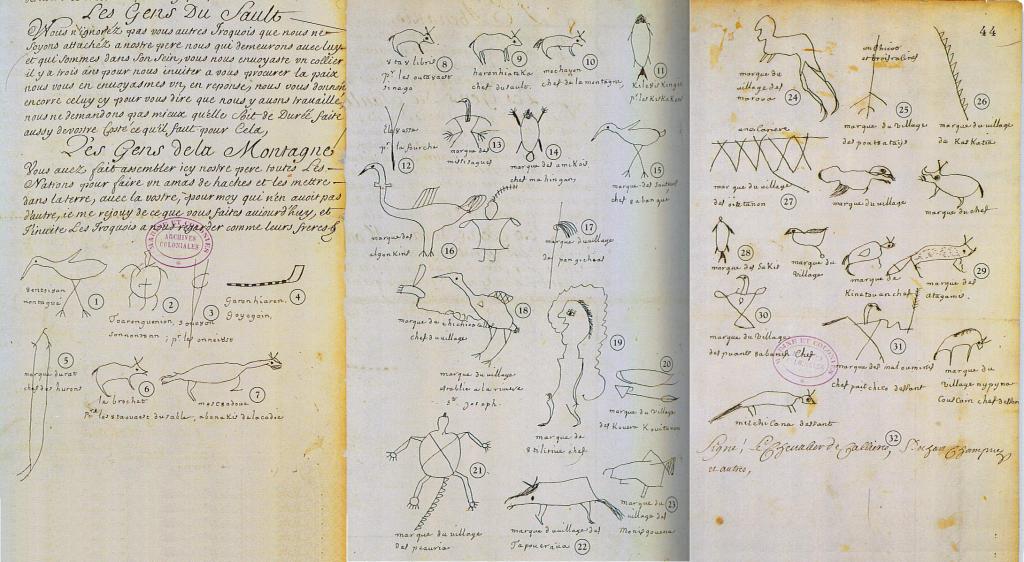
Another example of treaties/agreements between indigenous communities is the 1701 Great Peace of Montreal. Written by the French, they sought to establish a relationship with the natives while also acting as a third party for inter-tribal conflicts. At the request of Monsieur the Chevalier de Callière, the chiefs of over a dozen indigenous nations gathered to end conflicts, exchange any prisoners that they had, and strive for peace with each other.
However, there was a power imbalance between the French and the indigenous people, stemming from different interpretations of the treaty. After reminding the others that he and the French had allied themselves with the Haudenosaunee Confederacy earlier, Calliére begins his address with referring to the indigenous nations as “[his] children” and doing so multiple times throughout the treaty. He also states his role as mediator: “…as you have each placed your interests in my hands, I may cause you all to live in tranquility.” The French and the indigenous nations had different views on what a father/child relationship should be, especially in terms of control. Many indigenous cultures saw the father as someone who yielded to the demands of the child and provided for them. The French likely viewed the father as someone who had power over the child, requiring them to listen and comply. Callière conveys this view by stating that “[his children] owe him their obedience” and that if conflict breaks out between them, he should be the one to “reestablish justice.” An ideal mediator would not insist on being in control of conflicts (only stepping in when necessary or if asked) nor would they view the other parties as “children” to lord over.
Written treaties in the 1700s that followed the Great Peace of Montreal also demonstrated the power imbalance between Euro-Americans and indigenous communities. As British colonists came to the U.S. and began settling, they brought with them enslaved Africans. Some Cherokee tribes, along with others, slowly became involved in the trading and capturing of enslaved persons in return for European goods. To further cement this, “…the Cherokee role as slave traders was written into law with the passage of the Treaty of Dover [in 1730], enacted in
England between King George II and a makeshift “delegation” of seven Cherokees who had no official power within the Cherokee nation.” It’s entirely possible that the choice in Cherokee delegates was intentional to ensure compliance with the treaty, as those that did have power in the tribes (such as chiefs or elders) may have spoken out. Any disagreement to this part of the Treaty of Dover may have held more weight, as chiefs or elders would likely speak on behalf of their entire tribe. Knowing this, the British may have wanted those that could be easily swayed or overruled because even if they rejected some or all of the treaty, they had no real power to back up their rejections.
Because of this, questions can be raised about Cherokee complicity in the involvement with the slave trade. There seemed to be a mix of communities that provided shelter for runaways and communities that worked to hunt and catch them. Furthermore, after the 1730 Treaty of Dover, “…British officials included slavecatching clauses in many of the treaties they entered into with Native people of the Southeast. It was difficult, if not impossible, for Indians to avoid formally agreeing to such clauses if they wanted to gain some measure of legal protection from the spread of European settlements.” British settlers, having issues with runaways, thought that they could prohibit Cherokees from helping enslaved persons through manipulation with these clauses. Legal protection would have likely aided in the survival of indigenous communities. This was used by the British colonists against them, finding a way to pressure the Cherokees into doing what they wanted by having the written treaties largely favor their goals and interests.
Building on this imbalance of power,written treaties soon became tools to gain control over indigenous communities, especially when those treaties included land cessions and annuities. An 1803 letter from Thomas Jefferson giving unsolicited advice to
William Henry Harrison on future written treaties reveals how he wanted Harrison to achieve their goals. Jefferson explains that “…to promote this disposition to exchange lands which they have to spare & we want, for necessaries, which we have to spare & they want, we shall push our trading houses, and be glad to see the good & influential individuals among them run into debt, because we observe that when these debts get beyond what the individuals can pay, they become willing to lop th[em off] by cession of lands.” By creating a situation where, in order to get what they need to survive, an indigenous person must go into debt and cede the land they live on to get out of said debt, traders could keep raising their prices, as well as cheat people into spending more. Agreeing to cede their lands would “pay off” their debts, thus appearing to be beneficial, but because the debt was created by an unfair system, the people who controlled the system (e.g. the Americans) were the ones truly benefitting from the written treaty.
In the years following Jefferson’s letter, “Harrison proceeded to negotiate with the Delaware, Potawatomi, Miami, and Eel River Indians, making separate treaties with the Weas and Kickapoos later that year [1809]. The main text agreed to, the Treaty of Fort Wayne, ceded over two and one half million acres to the United States, for about two cents an acre—a high price for Indian treaties, but still a massively unequal exchange.” It seems likely that Harrison followed through on Jefferson’s advice to run the indigenous communities into debt which they then paid off through acres of land, but it’s also possible that he found other ways (perhaps in addition to Jefferson’s advice) to incentivize them into signing written treaties with land
cessions. While the money they earned through the cession might have been a lot for a treaty at that time, it would probably have been split among those who signed and used to pay off any debts first. The amount left afterwards was probably a small percentage of what was already not enough.
In addition to money, the Fort Wayne treaty also gave indigenous communities annuities (resources sent annually) in exchange for the land, but because annuities were sent to them by the treaty writers (Europeans, Americans, etc.), a written treaty that includes annuities was able to at least partially control the flow of resources. Resources being late or simply never sent would have an impact on the indigenous communities who would be dependent on them being available to their tribe. Others, such as the Shawnee Prophet Tenskwatawa and his brother Tecumseh, viewed them as bribes and “…both objected to annuities. The prophet refused a salt annuity in July 1810. Tecumseh, in a direct confrontation with Harrison at Vincennes later that summer, clearly equated annuities with the loss of land: “By taking presents from you, you will hereafter say that with them you purchased another piece of land from us…” While annuities were certainly added to written treaties as incentives to cede land, they were sometimes a matter of survival, especially when the resources the annuities offered were much needed. And if refusing to cede land put them at war with the Americans or started violent conflicts, indigenous communities would have to decide whether it was worth the risk, the power of the Americans factoring into their decisions.
Written treaties continued to be used as tools against the indigenous communities, as only a few years after the Treaty of Fort Wayne, the 1818 Treaty with the Miami (also called the Treaty of St. Mary’s) pushed for even more control. In exchange for ceding land, the Miami tribe were given six small reservations and land section grants were awarded to individual people, with the most land awarded to Jean Bapt. Richardville who was the chief at that time. The locations of the land allotted to the Miami people was not chosen by them. By determining where they would live, the U.S. gained immense power and control over their livelihoods and survival. If the land wasn’t fertile, any crops would have been affected. If there wasn’t a river or lake nearby, finding a source of water may have required travelling several miles. Ideally, the U.S. would have chosen locations that were unoccupied but even so, conflicts with settlers who had to work around the reservation or were upset with their presence likely arose.
The treaty also gave the Miami people $15,000 annually in silver, a gristmill, a saw-mill, a blacksmith, a gunsmith, implements of agriculture “as the proper agent may think necessary,” and a salt annuity of 160 bushels. Disagreements over the “implements of agriculture” could clearly be a source of conflict between the indigenous communities and the U.S. agents. The money may also have not been enough to sustain them, especially once split amongst six different reservations and factoring in potential population growth. A gristmill and sawmill would require some knowledge in order for them to work, or time would have to be taken to learn through trial and error. It is clear that even the supposed benefits of the written 1818 Treaty with the Miami still heavily favored the U.S.
And indeed, problems did arise after the treaty was signed. A speech given from Meehcikilita from the Miami tribe to James Barbour in 1826 conveyed a list of issues that needed addressing. The Miami held up their end of the treaty but the U.S. did not: “…we have
not been furnished with those smiths [one blacksmith and one gunsmith], and five years have passed away, since we demanded the fulfillment of this part of the Treaty, but the smiths have not yet been provided for us.” Essential for repairing tools and weapons, the absence of these smiths would have impacted the tribe’s surviviability, as without a way to repair things, they would have had to be bought new or traded for. These smiths could have also potentially passed down their knowledge to others, helping with long term survival and prosperity.
To make up for going years without the U.S. providing the smiths, Meehcikilita proposes that they send a blacksmith, who can also repair their guns, and a miller instead of a gunsmith. Because the blacksmith would also have the role of gunsmith, the addition of the miller would mean that this proposal would benefit the Miami tribe, if accepted and followed through by the U.S. Meehcikilita’s speech also brought up another issue: “There is not a year that we do not pay from five hundred to one thousand dollars, in satisfaction of such claims; and on our part, we have never yet received pay for one stolen horse.” Useful for mobility and travel, the loss of a horse would be likely to negatively impact any indigenous community who owned them. Covering the costs of stolen horse claims would cut into the $15,000 annuity in silver that the U.S. was giving to the Miami nation. They were not able to defend themselves against these claims, nor prove if they were true, which resulted in them having to pay to cover supposed losses. While claiming that the Miami stole their horses, the settlers were able to get away with theft themselves and even if caught, they did not have to pay.
After the Miami nation had been moved and reduced to six small reservations, the 1833 Treaty of Chicago focused on removing the Potawatomis and benefitted non-indigenous people
almost exclusively. Unlike the 1818 Treaty with the Miami, many people were invested in whether or not the Potawatomis would be removed. Because “…business concerns shaped the process of the Potawatomis’ removal most significantly,” there were people on both sides. Those who wanted to buy the indigenous land the Potawatomis would leave behind advocated for removal but those benefitting from having them close by for trade would be against it, making removal more challenging for the U.S.
Additionally, “ratification [of the treaty] did not settle the matter of where removed Indians should go once they left northern Illinois, and the years of uncertainty led to tremendous confusion on the part of Indians, government officials west of the Mississippi River, and non-Indian settlers.” By leaving them without a home, the U.S. would render the Potawatomis not only homeless but powerless. Once the deadline for removal had passed, others likely started to encroach on what they thought was unoccupied (or soon to be unoccupied) land, and, when locations were eventually chosen for them to live, they would arrive only with the resources they brought with them, diminishing the strength and power that they might have had while living on their homelands.
Treaties (both written and “unwritten”) symbolized several things at once: diplomatic relationships, shared goals, trade agreements, etc. Treaties written specifically by Euro-Americans slowly began to favor them, taking advantage of the unequal power dynamic that existed between them. They brought to the treaties their views on indigenous people, often portraying them negatively and far from equals. As time passed and the Euro-Americans found treaties useful as tools of power, they pushed until they had a stifling amount of control over indigenous communities. Written treaties were not made to favor indigenous communities. Rather, it is clear that they were made to help Euro-Americans achieve their goals of obtaining more land for development (amongst other goals), at the expense of them.
Bibliography
Althoff, Josh. “The Haudenosaunee Confederacy and the Great Peace of Montreal.” Lecture. Knox College, Galesburg, IL, October 6, 2025.
Bowes, John. “The 1833 Treaty of Chicago and Potawatomi Removal.” In Land too Good for Indians: Northern Indian Removal. University of Oklahoma Press, 2016.
Dowd, Gregory. “Renewing Sacred Power in the North.” In A Spirited Resistance: The North American Indian Struggle for Unity, 1745-1815. John Hopkins University Press, 1992.
Founders Online. “Thomas Jefferson to William Henry Harrison, 27 February 1803.” National Archives, https://founders.archives.gov/documents/Jefferson/01-39-02-0500. [Original source: The Papers of Thomas Jefferson, vol. 39, 13 November 1802–3 March 1803, ed. Barbara B. Oberg. Princeton: Princeton University Press, 2012, pp. 589–593.]
Hill, Susan. “Karihwa’onwe—The Original Matters.” In The Clay We Are Made Of: Haudenosaunee Land Tenure on the Grand River. University of Manitoba Press, 2017. https://brightspace.knox.edu/content/enforced/8483-2026FA_FF_HIST_181__1/The_Clay_We_Are_Made_Of_Haudenosaunee_Land_Tenure_…_—-_(Chapter_1_Karihwa%e2%80%99onwe%e2%80%94The_Original_Matters).pdf.
Miles, Tiya. “Chapter 2: Slavery.” In Ties That Bind: The Story of an Afro-Cherokee Family in Slavery and Freedom. University of California Press, 2005.
Speech from Meehcikilita (Le Gros) to James Barbour, Jan. 27, 1826.
Tribal Treaties Database. “Treaty with the Miami, 1818.” Accessed November 19, 2025. https://treaties.okstate.edu/treaties/treaty-with-the-miami-1818-0171.
Wikisource contributors. “Translation:Great Peace of Montreal.” Accessed November 18, 2025. https://en.wikisource.org/w/index.php?title=Translation:Great_Peace_of_Montreal&oldid=10392397.

