Kokono Matsukawa
Abstraction may be assumed to be the formal progression of modern art, but a revisionist art history route reveals that the formal and symbolic abstractions of Mondrian and Kandinsky, as well as their differences in approach can be explained through their different approaches to Theosophy.
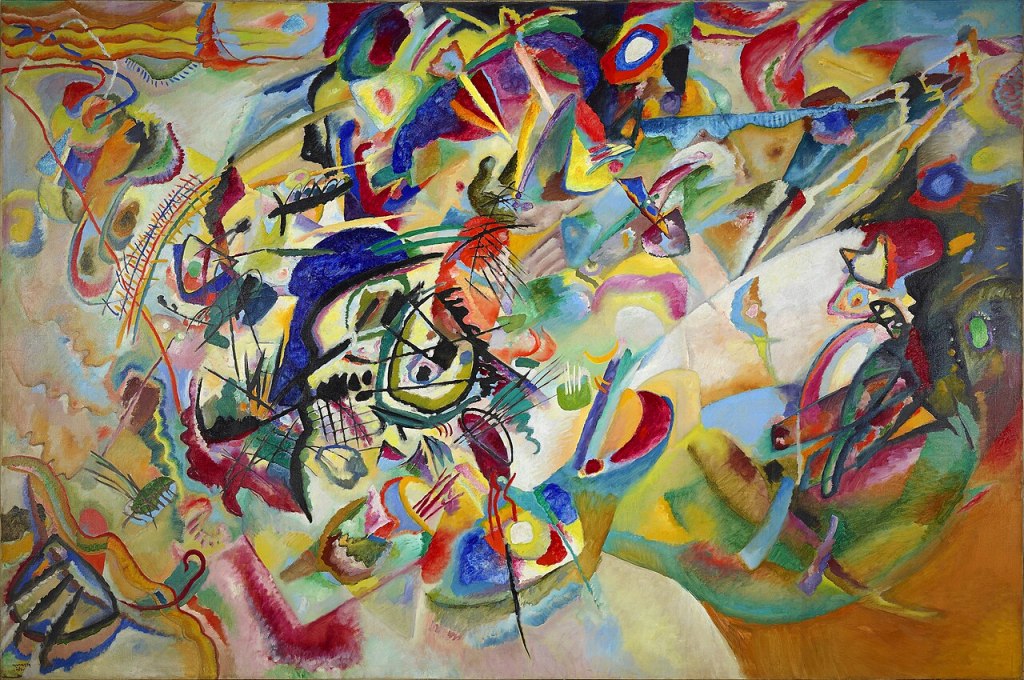
This will be discussed mainly in relation to Kandinsky’s Composition VII(1913) and Mondrian’s Composition with Red, Blue and Yellow (1930). While both artists pursued the spiritual through Theosophical thought, their art ultimately diverged in its direction — Kandinsky’s abstraction turns inward toward the subjective perception of the spiritual, while Mondrian’s turns outward toward an objective vision of universal harmony.
Abstraction in Kandinsky and Mondrian’s era evolved from Symbolist roots into their distinct forms—expressionist abstraction and neoplasticism. Both drew from Symbolism’s emphasis on emotional expression through exaggerated forms and color. They were also deeply influenced by Theosophy, a late 19th-century blend of Judeo-Christian, Eastern, and occult sciences that believed the physical world was veiling true reality and that only indirect methods such as art could lead to heightened consciousness. As Mondrian wrote, Theosophy aimed for “the unity that would resolve harmoniously all antitheses”2. Amid the turmoil of the Balkan Wars and World War I, both artists saw Theosophy as a doctrine of salvation: Kandinsky sought to guide humanity toward transcendence, while Mondrian envisioned harmony through universal order.
Kandinsky’s vibrant, rhythmic abstractions were inspired by Steiner’s visions of higher spiritual realms, which allegedly resembled Kandinsky’s mature works. Yet, as Long argue throughout her paper, these paintings do not simply depict heaven—they reveal how the spiritual plane is obscured by material reality. Composition VII, for example, portrays the apocalypse preceding transcendence. Its swirling colours, lack of spatial orientation, and flowing organic forms create a sense of frenzied motion, with no point of rest for the eye. Through this visual turmoil, Kandinsky evokes the confusion of earthly perception before spiritual revelation. Theosophists believed that the newly industrialised society with its vices of materialism and modern rationality distorts our perception of true spiritual reality. The abstractions in this piece are complex to communicate how the modern people’s visions are obscured by a false reality perpetuated by modern society. Colour also plays a vital role in Kandinsky’s Theosophical abstractions. He assigned symbolic meanings based on spatial values—blue, which recedes, represents the heavenly, while yellow, which advances, signifies the earthly. In this composition, warm yellows dominate to evoke the material world’s impending apocalypse, while cool tones flicker across the canvas, hinting at spiritual transcendence. Kandinsky’s spiritual goals are made clear here as he attempts to guide the viewer through confused reality to seek the spiritual. Furthermore, Kandinsky also embedded hidden symbols within the work, layering his vision of the coming spiritual awakening beneath the surface. He painted Theosophical symbols on the canvas, and then covered them over with thin layers of colour, in a process called veiling. He disguised trumpets that were present in preparatory sketches, meaning he purposefully covered them and also a Saint George4. Furthermore, he uses striping to create implicit illusions of spiritual symbols through scratch like marks, such as the angel with a trumpet heralding the apocalypse. Kandinsky’s disguise of his symbols adds further backing to Long’s argument, as the viewer is forced to literally train their perception as these symbols encourage the viewer to learn the visual language of Theosophy, open their minds to the spiritual even within material reality.
Kandinsky’s works like Improvisation 30 make symbols of destruction more apparent, as improvisations were done in a less abstract style due to its spontaneity. Cannons and building-like structures appear, echoing Kandinsky’s disillusion with modern society and warfare, as the blue and yellow planes are kept isolated from each other. The work seems to take on a diagonal axis, where the warm colours surround the manmade cannons and buildings while cool colours dominate the literal underbelly of human society with abstract scratch marks, showing Kandinsky’s belief in the submerged and isolated spiritual in relation to reality.
While Mondrian, like Kandinsky, was inspired by theosophy, he had an additional influence – Dutch Symbolism. Theosophy strongly influenced Mondrian’s art, as the Netherlands was immersed in new spiritual movements. Inspired by the unity of mathematical order and by French Cubism, he developed a geometric style rooted in Dutch theosophical circles of the late 19th century. Unlike Kandinsky’s exploration of subjective perception, Mondrian sought universal beauty. He distinguished between individual and universal realities and believed true art expressed spiritual essence purely through line, colour, and relation6. Before arriving to his neoplasticism, Mondrian was a Symbolist painter, then a cubist, and experimentalist. Mondrian’s early 1910 work Evening depicts a bright red tree standing lonely in a blue landscape. Through the scatterings of colour beyond their local object, the tree and landscape meld into one, as the red earthly material ventures into cosmic transcendence of blue. This represents the spiritual growth of the individual through Theosophical transcendence, with the spiritual growth being represented through the growth of the massive tree. This iconography of the tree continues throughout Mondrian’s artistic career, with one of his ventures into cubist abstractions, Flowering Apple Tree, sharing the same subject. The work is abstract beyond recognition in the cubist style but still focuses on spiritual growth under Theosophical guidance. It’s evident that Mondrian believed in Theosophy as a catalyst for human transcendence, and although the subject has mostly been abandoned in neoplasticism, his dedicated message throughout his works shows the viewer his commitment to Theosophical teachings. Mondrian’s 1930 work Composition with Red, Blue and Yellow exemplifies this vision of a cosmic guide.
Like Kandinsky, Mondrian—a devout Theosophist—assigned spiritual meanings to colors based on spatial values; blue as heavenly, yellow as earthly due to their proximity to the viewer. Red, however, symbolized the unity of both realms, embodying the harmony between universal and spiritual reality. While Kandinsky overlaid the material and spiritual to depict humanity’s chaotic perception, Mondrian sought the purified essence of transcendence.
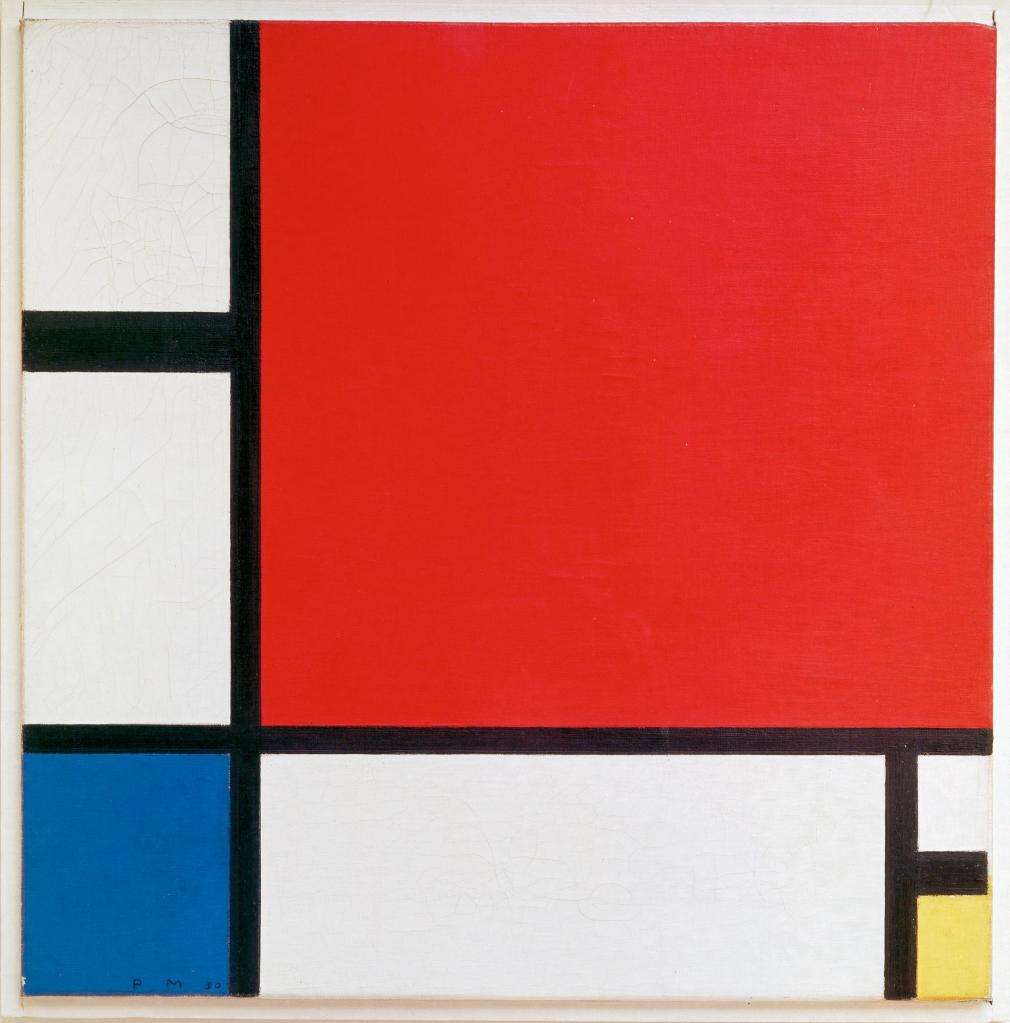
His emphasis on red and geometric balance reflects a distilled vision of universal beauty, where harmony replaces confusion. Furthermore, Mondrian was inspired by Dutch mathematician Schoenmaker’s theories on lines, and in Mondrian’s works, horizontal lines represent the earthly reality, and vertical lines spiritual forces that descend down. When these lines intersect, they represent the perfect harmony of transcendence. Mondrian focuses on the ultimate end goal of Theosophy, the unification between opposites far more than Kandinsky, who focuses on the separation and disguised spiritual.
This approach to different aspects of Theosophy lead to vastly different styles, as while Kandinsky’s lines were expressive and lyrical, Mondrian’s are far more objective and balanced. In his 1930 composition, even expanses of color are geometrically rendered into satisfying ratios where all parts fall into place, due to the complete balance between blank space and color. The size of the squares relative to the canvas are relatively large, even with the smaller squares. This creates planes the eye can move to and rest at before following the orderly line of geometric grids. This may be because while Kandinsky was a Theosophist who believed in spreading its beliefs, he focused far more on internal perception. Composition VII is still rooted in the human perception of the two realities, while Mondrian’s works are as objective as possible to differentiate from misguided human vision. Mondrian sought to guide humanity toward a new spiritual epoch through the strict order of neoplasticism, which he believed represented true universal reality. His compositions are governed by authoritative lines that leave no room for error. In Plastic Art and Pure Plastic Art, Mondrian asserts that all of art history has been moving toward the perfection of plastic art—an ideal form that must be imposed, not negotiated, as a path to spiritual transcendence. He declared that “clarity of thought should be accompanied by clarity of technique”, and this principle shaped his ascetic, disciplined style, mirroring the purity of the spiritual world he aimed to reach. He also declared that the laws of plastic art were fixed, calling it “a truth for all time”. Created in an era of turmoil marked by the Balkan Wars and the approach of World War I, Mondrian’s art can be read as a response to chaos—a vision of order and salvation through geometry. Believing himself a kind of spiritual guide, he viewed neoplasticism as the means to restore harmony to a fractured world. Unlike Kandinsky, whose abstraction reflected the individual’s confused perception of reality, Mondrian’s objective geometry presents a determined vision of universal beauty—absolute, mathematical, and meant to lead the unenlightened toward transcendence.
While Kandinsky and Mondrian were both inspired by similar Theosophical scriptures, they took branching paths in its interpretation, leading to a very different stylistic approach to the abstract. Theosophy was special to them both as salvation, especially considering the almost world ending tragedies that were about to take place. Kandinsky’s lyrical Expressionism was a result of his attempt to depict the confused vision of humanity, while Mondrian’s geometric neoplasticism was a cosmic guide for humanity to achieve transcendence and therefore had to be as objective and didactic.
Bibliography
Blotkamp, Carel. “Annunciation of the New Mysticism: Dutch Symbolism and Early Abstraction.” In The Spiritual in Art: Abstract Painting 1890-1986. Los Angeles County Museum of Art, 1986.
Long, Rose- Carol Washton. “Expressionism, Abstraction, and the Search for Utopia in Germany.” In The Spiritual in Art: Abstract Painting 1890-1985. Los Angeles County Museum of Art, 1986.
Mondrian, Piet. “Plastic Art and Pure Plastic Art.” In Art & It’s Significance: An Anthology of Aesthetic Theory. Albany: State University of New York Press, 1984.

