Zoe Tedesco
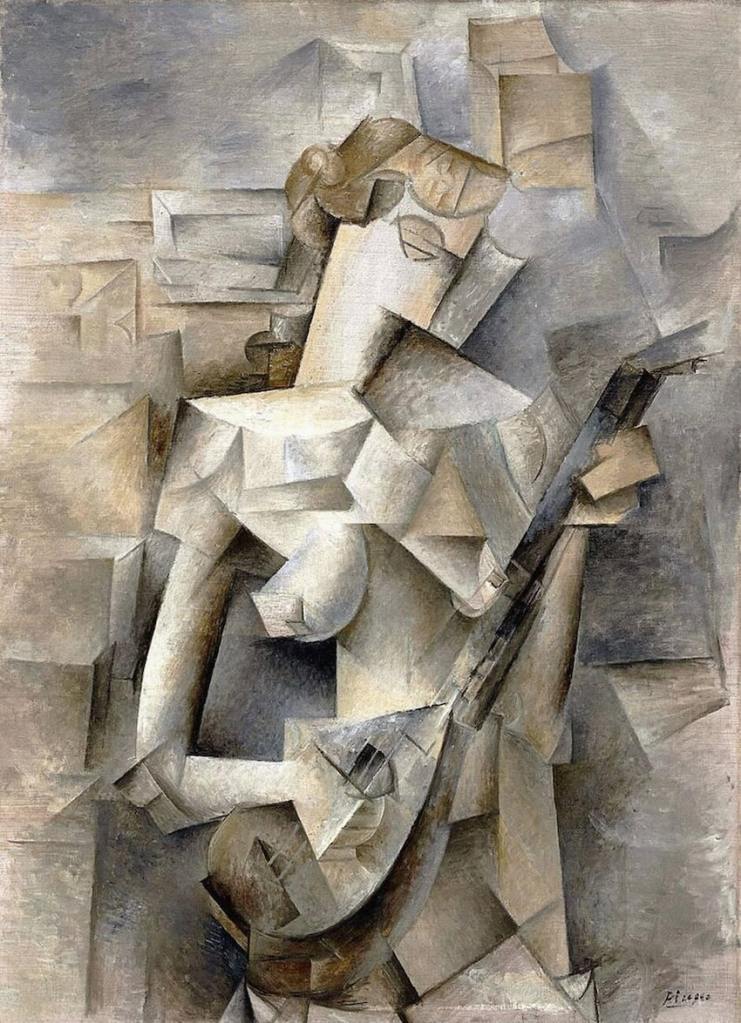
The Modernist movement, described by Maurice Beebe in the Journal of Modern Literature as an “international revolution in literature and the arts” (Bebee 1066), demonstrated the importance of poetic imagery and established free verse, with its appealing unrestrictiveness, as a dominating form of poetry. Importantly, Modernist art and poetry became nearly inseparable during this time: “Not only did that movement cross national boundaries, but it also saw a breakdown of genres as writers, painters, and composers sought to borrow techniques and achieve effects like those in the other arts” (Bebee 1072).
Poets inspired and influenced artists and they in turn were inspired by the poetry written during the movement. Modernist poets Gertrude Stein and William Carlos Williams turned to visual art as examples to work off of when building images in their poetry, and they were inspired by painters like Juan Gris, Paul Cézanne, Picasso, and Charles Demuth when crafting imagery.
There are conflicting ideas about when the Modernist movement began and when it truly ended but most agree that it was an early 20th century movement that lasted into the 1950s. It also overlaps with an “interwar” period, between World War I and World War II, which influenced art and literature produced during that time. As such, critics have noted “that many modern writers and artists [were] concerned with death and violence” (Beebe 1068). Poets, and writers in general, of this period focused heavily on literary newness: stepping away from cliches and common ways of saying things, exploring new language and new vocabulary, and thus creating poems that readers had not come across before.
This included the form of their poetry and poets attempted “to break through the limitations of form imposed by specific kinds of art” (Beebe 1072). To do so, many turned to free verse, a style of poetry absent of any particular structure, rhyme, meter, or form. The intense focus on poetic form in general was “a major distinguishing feature of Modernism” (Beebe 1072). During the Modernist movement, the technique of imagism was created through the Imagist movement which overlapped with Modernism. Poets Ezra Pound and Amy Lowell are associated with imagism and the latter laid out “six guiding principles of the movement, with the aim of clarifying the movement’s focus on precision and cadence…” (Lowell). These principles were: exact word, rhythm/mood, freedom of subject, present an image, hardness/clarity, and concentration. Cubism, a new form of art, also popped up during the Modernist period. Painters who practiced the Cubist style “attempted to show many sides of an object at once and thus to break through the barriers of the painter’s two-dimensional canvas” (Beebe 1072). It became a source of inspiration for many poets.
One poet heavily inspired by the Cubist style was Gertrude Stein (1874-1946), author of a book of poetry titled Tender Buttons and more. After moving to France in 1903, her “Paris salon at 27 rue de Fleurus that she shared with Alice B. Toklas, her lifelong companion and secretary, became a gathering place for the “new moderns,” as the talented young artists supporting this movement came to be called” (Poetry).
It was here that she met with and supported several post-impressionist painters—Henri Matisse, Juan Gris, and Pablo Picasso. Both Gris and Picasso are credited with inventing Cubism and “what these creators achieved in the visual arts, Stein attempted in her writing” (Poetry), using descriptive language and repetition to present an image from “many sides at once.”
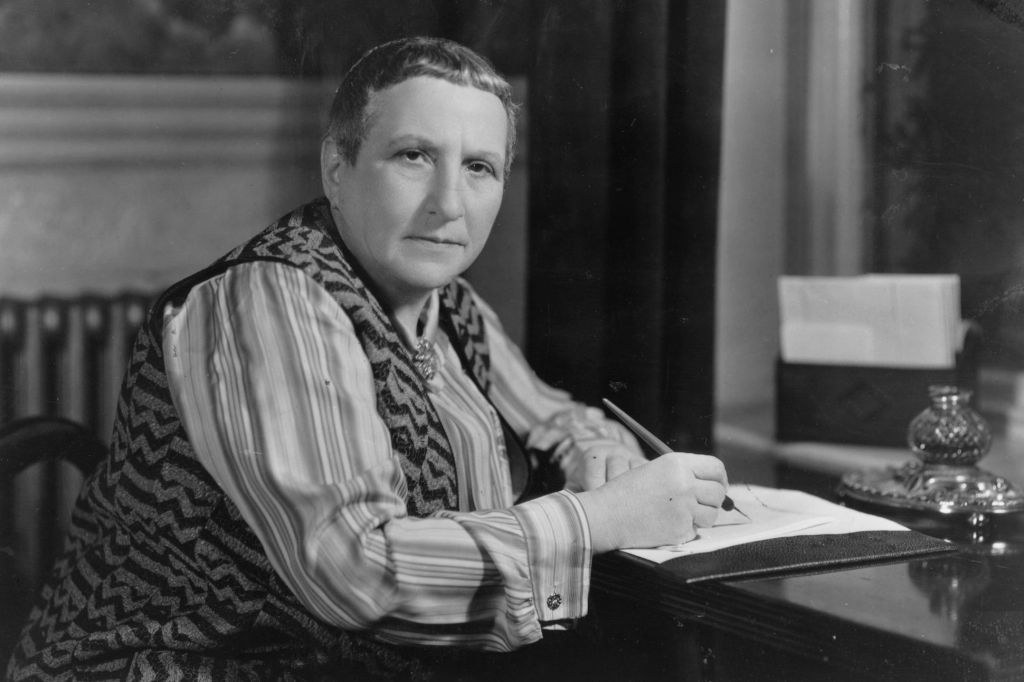
A clear example of this is in Tender Buttons, which is divided into three sections: Objects, Food, and Rooms. The section Objects in particular is “not only fragmented and decomposed as they are in Cubist still-life; they also serve as false leads, forcing the reader to consider the very nature of naming” (Perloff 8). Her work was very experimental, “driven in part by her engagement with Cubist paintings” (Poetry) and played with form, language, and definition. Reading a poem from Tender Buttons can be challenging for a reader. A lot of information is thrown at them, completely out of order, and they have to sort through and organize it to see the desired imagery. In an attempt to replicate the effects of Cubist paintings, Stein’s poetry has been described as “devoid of logic, narration, and conventional grammar, it resembles a verbal collage” (Poetry). This links back to the Cubist idea of “showing many sides at once.”
One example of this “verbal collage” is seen in the prose poem “A Plate.” Paragraph by paragraph, Stein slowly reveals the whole picture with her simple but not easily understood imagery. The poem begins outside of the collage. The first paragraph speaks of a plate regarding its value: “An occasion for a plate, an occasional resource is in buying and how soon does washing enable a selection of the same thing neater. If the party is small a clever song is in order” (Stein 17, paragraph 1). If a plate is placed before a guest, a meal of some sort is likely to occur. A plate is also “an occasional resource” as typically, one buys some plates and then doesn’t have a need to buy more unless one breaks. Stein also alludes to a birthday party with the line “if the party is small a clever song is in order,” adding to the value of a plate. The second paragraph begins to show the edges of the collage: “Plates and a dinner set of colored china. Pack together a string and enough with it to project the centre, cause a considerable haste and gather more as it is cooling, collect more trembling and not any even trembling, cause a whole thing to be a church” (Stein 17, paragraph 2). The plate’s fragility is acknowledged by the line “pack together a string and enough with it to protect the centre.”
The plate itself is described in the third paragraph, and in Cubist fashion, Stein makes sure to describe all of the details equally, without emphasizing anything in particular: “A sad size a size that is not sad is blue as every bit of blue is precocious. A kind of green a game in green and nothing flat nothing quite flat and more round, nothing a particular color strangely, nothing breaking the losing of no little piece” (Stein 17, paragraph 3). She speaks again to the plate’s susceptibility to fall and break with the line “…nothing breaking the losing of no little piece.” In the next paragraph, Stein moves away from the plate to a different piece of the collage: “A splendid address a really splendid address is not shown by giving a flower freely, it is not shown by a mark or by wetting” (Stein 17, paragraph 4). “A splendid address” could be interpreted as a fancy letter. It is in one of the last paragraphs that Stein reveals the rest of the collage with imagery of a lamp and a cake: “A lamp is not the only sign of glass. The lamp and the cake are not the only sign of stone. The lamp and the cake and the cover are not the only necessity altogether” (Stein 17, paragraph 6). However, these lines can be confusing to the reader as they seem to not make logical sense. But, looking at the collage as a whole, it paints a picture of a plate, a letter, a lamp, and a cake together in a space.

Another Modernist poet who was around during Stein’s time was William Carlos Williams (1883-1963). He wrote many things during his lifetime from his first book Poems to Kora in Hell: Improvisations which faced a lot of criticism, the novel trilogy of White Mule, In the Money, and The Build-Up, to a mix of prose and poetry which is Spring and All.
Williams was strongly connected to imagism and he “was a leading poet of the Imagist movement and often wrote of American subjects and themes” (Poetry). Through college, Williams met Ezra Pound who introduced him to other poets and the painter Charles Demuth. Williams, Pound, and others became the “core of what became known as the Imagist movement” which was a “reaction against the rigid and ordered poetry of the time” (Poetry). Pound and Williams were originally friends but as their poetry and ideals continued to evolve, they drifted apart. In contrast, Williams and Demuth became close friends, and “it seems clear that… this intimacy inspired the dedication of Spring and All” (Breslin 251). This friendship with Demuth and observations of his works would inspire much of his poetry. Williams decided to stand on his own with “neither the high culture nor the old-world manners of [T.S.] Eliot or Pound” (Poetry). He was also a doctor, which gave him a unique perspective on life and death. He explains that he was able “to follow the poor defeated body into those gulfs and grottos… to be present at deaths and births, at the tormented battles between daughter and diabolic mother” (Poetry). It was Eliot’s success with his book The Waste Land that prompted Williams’ move towards modern poetry. He says, “It was a shock to me that he was so tremendously successful. My contemporaries flocked to him—away from what I wanted. It forced me to be successful” (Poetry). And thus, Spring and All was born.
Williams’ usage of imagery is very different from Stein’s. While Stein describes every detail equally to paint a bigger picture, relying on repetition and unusual grammar, Williams seems to provide only the minimal amount of detail to get an image or idea across to the reader. According to Frederick Morgan in The Sewanee Review, “In his successful images, the reader feels that Williams has selected the proper details, omitting irrelevancies; he also recognizes that these images are egocentric and fragmentary, referring only to themselves as they are observed at a particular moment in time” (Morgan 2). This would align with the imagist principle of exactness that Amy Lowell talks about in an anthology titled Some Imagist Poets. She says that “to use the language of common speech, but to employ the exact word, not the nearly-exact word, nor the merely decorative word” is one of the “essentials of all great poetry” (Poetry).
This can be seen in Williams’ poetry from Spring and All, like in the poem “VIII.” This exactness is seen in the lines “pulling at the / anemonies in / Persephone’s cow pasture —” (Williams 33). Williams conveys spring and rebirth but also a feeling of dread to the reader. In Greek mythology, it was when Persephone, usually referred to as the Goddess of Spring, was picking flowers in a field that she was kidnapped by Hades, the Greek God of the Underworld. In only three short lines, the entirety of the abduction is conveyed to the reader, and adding more would be unnecessary. “VIII” is also an excellent example of Williams’ harsh enjambments, seen from the very beginning: “The sunlight in a / yellow plaque upon the / varnished floor” (Williams 32). This sentence fragment could have been all one line but he decided to break it into three lines. His choice to do so helps emphasize each image to the reader because the enjambed line “supplies by visual means an extra punctuation of the rhythm that prevents it from falling into shapelessness; it is useful also in isolating individual images or in contrasting one image to another” (Morgan 6). Williams’ skillful use of enjambment here also helps to explain the distinct lack of periods because the sudden cut-off creates a natural pause, a signature of his poetry.
Gertrude Stein and William Carlos Williams were inspired by visual art and painters, but each went about using the inspiration for their poetry in different ways. Knowing Picasso personally, Stein was able to observe his growth as an artist. According to L.T. Fitz in American Literature, Stein shared three things in common with him: “(1) a cubist approach; (2) a style which concentrates on what is seen rather than what is remembered; and (3) a calligraphic or nonsymbolic concept of language” (Fitz 230). These things can be seen in Tender Buttons, where Stein focuses on “showing many sides at once” but also presents the object as is, without relying on the reader to fill in missing information from memory. For example, the beginning of her poem “A Box” begins with a simple description: “A large box is handily made of what is necessary to replace any substance” (Stein 16, paragraph 1). When it comes to language, Stein plays with grammar and the meaning of words to challenge the reader on how they view language both as words and as a system. Michael Edward Kaufmann expands on Stein’s use of language in the Journal of Modern Literature, saying that she made “the habits of language and reading conscious by foregrounding her materials (her true similarity to the Cubists)—language and print” (Kaufmann 449). If Picasso’s medium is painting, Stein’s is Tender Buttons, and her other books were created using not the common paintbrush
but the pen. In a way, each printed page of poetry is a painting itself but made of words instead of paint.
Like Stein, Williams also looked at Cubism and “admired Cubism’s effort to separate ‘imaginative reality’ from false ‘copying,’ to demonstrate the value of the imagination in ‘complet[ing]’ and unifying experience” (Neumann 6). Combined with creativity, Williams’ focus on imagination allowed him to create new images, requiring the reader to think through them to understand their meaning. For example, in the poem “VIII,” Williams uses imagery such as “whirling flywheels” and “the triangle of the air” (Williams 33). Notably, these phrases are placed in different stanzas, allowing for the “isolation of individual images” quoted from Frederick Morgan earlier. This isolation is also seen in the watercolors of painter and close friend Charles Demuth. James E. Breslin argues in the Journal of Modern Literature that “one striking feature of Demuth’s watercolors is the dramatic use he makes of the white paper: abstracting his flowers and vegetables from any background, he floats and isolates them in empty space” (Breslin 251). Williams used these watercolors as inspiration for the form of his poetry. In Spring and All, his poetry is structured to include white space between each stanza, which is further emphasized by his use of enjambment. “In Williams’ work, too—nowhere more than in Spring and All—we find a similar preoccupation with negative space, emptiness…” (Breslin 252). Referring again to “VIII,” each stanza is three lines, followed by a break, and then the next stanza. It seems that instead of creating a collage of words like Stein, Williams has chosen to focus on the form of the poem itself, deliberately choosing when to add words and when to leave space empty.
Both Williams Carlos Williams and Gertrude Stein are excellent examples of how modernist poets used visual art as a template for their imagery. Stein sought to capture the aesthetic of Cubist paintings by focusing on several different details equally to portray a larger image. She was inspired by artists like Juan Gris and Picasso, all of whom have connections to Cubism. Williams was a part of the Imagist movement for some time, which included several painters who helped to establish the ideas of imagism through their art. He was also inspired by Juan Gris but also drew inspiration from his friend Charles Demuth. While both poets looked at visual art, they took away different things: Stein was inspired to create imagery that looked at objects from every angle and Williams was inspired to show the importance of imagination in his poetry and thus focused on form, structure, and the mind of the reader when crafting his imagery.
Bibliography
Beebe, Maurice. “Introduction: What Modernism Was.” Journal of Modern Literature, vol. 3, no. 5, 1974, pp. 1065–84. JSTOR, http://www.jstor.org/stable/3830997. Accessed 1 Nov. 2024.
Breslin, James E. “William Carlos Williams and Charles Demuth: Cross-Fertilization in the Arts.” Journal of Modern Literature, vol. 6, no. 2, 1977, pp. 248–63. JSTOR, http://www.jstor.org/stable/3831169. Accessed 6 Nov. 2024.
https://doi.org/10.2307/1208223. Accessed 26 Oct. 2024.
Fitz, L. T. “Gertrude Stein and Picasso: The Language of Surfaces.” American Literature, vol. 45, no. 2, 1973, pp. 228–37. JSTOR, https://doi.org/10.2307/2924449. Accessed 26 Oct. 2024.
“Gertrude Stein.” Poetry Foundation, Poetry Foundation,
http://www.poetryfoundation.org/poets/gertrude-stein. Accessed 1 Nov. 2024.
Kaufmann, Michael Edward. “Gertrude Stein’s Re-Vision of Language and Print in ‘Tender Buttons.’” Journal of Modern Literature, vol. 15, no. 4, 1989, pp. 447–60. JSTOR, http://www.jstor.org/stable/3831601. Accessed 26 Oct. 2024.
Lowell, Amy. “Preface to Some Imagist Poets.” Poetry Foundation, Poetry Foundation, 13 Oct. 2009, http://www.poetryfoundation.org/articles/69404/preface-to-some-imagist-poets.
Morgan, Frederick. “William Carlos Williams: Imagery, Rhythm, Form.” The Sewanee Review, vol. 55, no. 4, 1947, pp. 675–90. JSTOR, http://www.jstor.org/stable/27537788. Accessed 26 Oct. 2024.
Neumann, Anne Waldron. “Diagramming the Forces in a ‘Machine Made of Words’: Williams’ ‘Red Wheelbarrow’ as Picture Poem.” William Carlos Williams Review, vol. 12, no. 1, 1986, pp. 13–20. JSTOR, http://www.jstor.org/stable/24564866. Accessed 26 Oct. 2024.
PERLOFF, MARJORIE. “Poetry As Word-System: The Art Of Gertrude Stein.” The American Poetry Review, vol. 8, no. 5, 1979, pp. 33–43. JSTOR,
Picasso, Pablo. Girl with Mandolin (1910). Oil on canvas. Pablopicasso.org. Accessed February 26th, 2026. https://www.pablopicasso.org/cubism.jsp
http://www.jstor.org/stable/27776276. Accessed 26 Oct. 2024. “William Carlos Williams.” Poetry Foundation, Poetry Foundation, http://www.poetryfoundation.org/poets/william-carlos-williams. Accessed 2 Nov. 2024.

