Zeytin Ercan
Throughout the course of art history, the female nude has frequently appeared as an important subject for artists from a variety of backgrounds and artistic disciplines. Certain details of these portrayals of the nude female body, such as the identity of the subject, the composition of the piece, and the positioning of the body in relation to the viewer, can communicate opinions regarding female sexuality and the role of women in society in greater depth.
Modernist art was no exception, with many artists such as Ernst Ludwig Kirchner, Henri Matisse, and Pablo Picasso all turning to the nude female as the lead subject for some of their most celebrated and prominent works. Despite each artist coming from different Modernist disciplines (Kirchner having originated the Die Brucke group, Matisse being a Fauvist, and Picasso primarily being known as a Cubist) each artist’s various portrayals of the female nude present a similar narrative exemplifying the emerging Modernist conflation of women and the primitive natural world. In this paper, I argue that Modernist art utilized the female nude to communicate a disdain for urban modernity and commodification, whilst inadvertently revealing the artists’ own desires to sexually objectify, primitivize, and vilify women and their role in modern society.
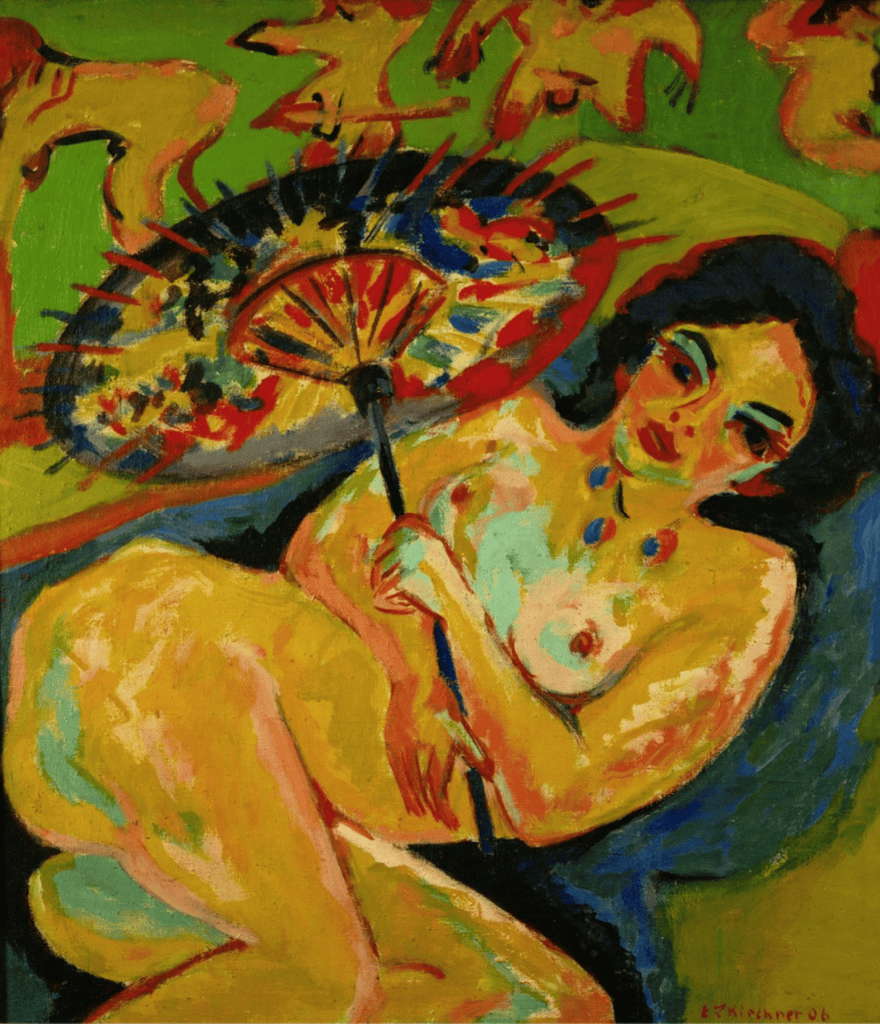
Many Modernist artists sought to portray the female nude as a pure sexual conquest, employing the male gaze to strip the subject of any autonomy outside of their connection to the presumed heterosexual male viewer. One such work that exemplifies this trope is Ernst Ludwig Kirchner’s Girl Under a Japanese Umbrella from 1909. The piece portrays a young naked woman laying back with an umbrella held at her side. The position of the woman is highly unnatural, contorted in such a way that both her breasts and buttocks are simultaneously exposed in a seductive, highly erotic manner. The colors and brushwork are noticeably frantic and spontaneous, capturing the figure with an almost violent sense of urgency. Behind the woman is an erotic primitive scene featuring several crudely painted nude figures dancing against a jungle-green backdrop. As a whole, the piece has strong themes of power and control, with the central woman portrayed as being at the whims of the viewer, just as she was originally at the whims of Kirchner upon her creation. The violent contortion of the woman’s body to show only her most desirable sexual features, paired with the elevated perspective of the viewer implies a desire for complete physical and sexual control over women, relegating them to sexual objects meant to exclusively cater towards the male gaze. Kirchner’s brushwork conveys a similar desire, as his rushed, borderline crude paintstrokes seem to imply a sense of personal sexual frustration—as if he seeks to take out his own raw hatred and sexual dissatisfaction towards women onto this malleable, entirely vulnerable woman of his own creation. The colors utilized also work to objectify, as the woman’s cheeks are flushed a bright, harsh pink, implying the scene is meant to be post-coital. However, her seductive posture would suggest that she is also open to and inviting of another sexual endeavor, communicating both Kirchner’s own sexual desires with the subject and the assumed titillation of the viewer. Through this, Kirchner frames the woman as a perpetual sex object, an idea furthered by the erotic painting behind her, which implies a reluctance to permit women to exist comfortably beyond the context of male sexual pleasure. Overall, Kirchner’s Girl Under a Japanese Umbrella degrades the female nude through means of forced vulnerability, reducing her to a representation of male sexual desire completely devoid of bodily autonomy.
Along with sexual objectification, another key aspect of the typical Modernist female nude was the association of women with primitivism and the natural world. This conflation can be observed in Henri Matisse’s Dance II (1910), which portrays five nude women dancing together in a circle against a simplistic mountainscape.
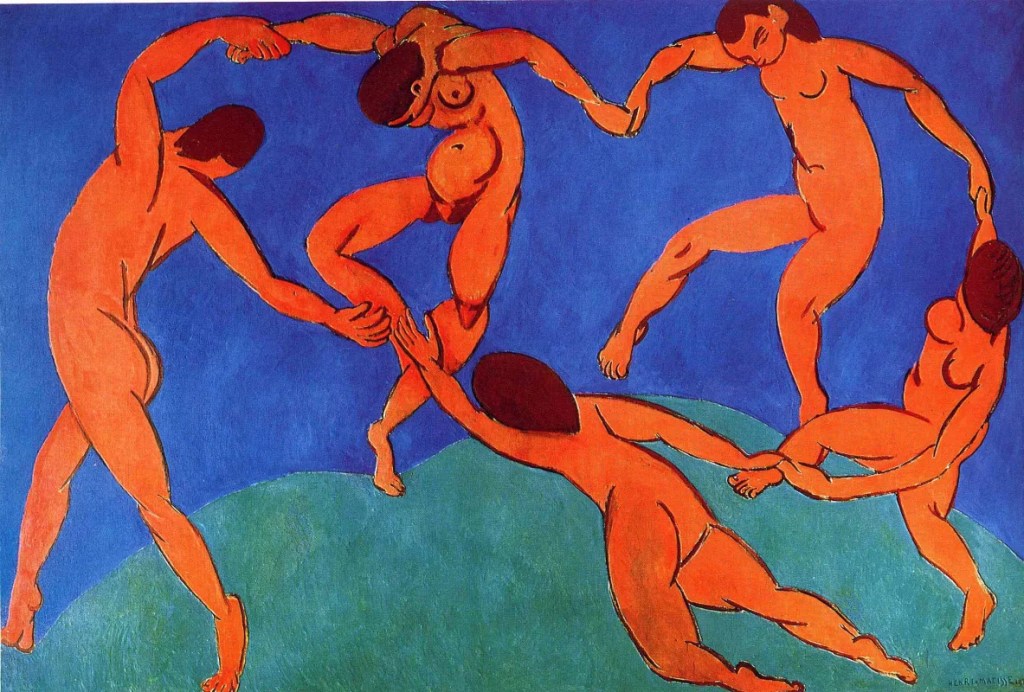
The faces of the women are obscured, with the focus instead being on their bodies, each of which are contorted in unnatural, wild movements. The composition of the piece is relatively simple, with the most striking stylistic element, aside from the contorted positioning of each woman, being the color palette. The women themselves are captured in a vibrant vermillion hue, a stark contrast from the background mountainscape composed of deep blue and green tones. Matisse utilizes these stylistic elements to primitivize the nude female form, presenting it as something wild and untethered. Despite the figures in Dance II sharing a similar bodily contortion to that of Kirchner’s Girl Under a Japanese Umbrella, it should be noted that, unlike Kirchner’s piece, the contorted movements here seem to be attributed to the women themselves as opposed to a controlled choice made by the artist. We, as the audience, are meant to believe that these women are purposefully contorting themselves in these strange, unnatural positions, presenting these movements as being representative of some natural, primitive bodily autonomy rather than a controlled, sexual objectivism. The color palette contributes to this reading, as the bright-red dancing figures bring to mind images of fiery embers. In drawing a direct comparison between women and fire, Matisse both reinforces the chaotic and reckless nature of women, whilst simultaneously aligning them with the natural Earthly element most closely associated with danger and disruption. There is a surface-level sense of power and autonomy that Matisse allows his nudes here that Kirchner notably does not. Crucially, however, this power is not portrayed as being admirable or deserved, and is instead attributed to the supposed intrinsic connection with nature most Modernists believed women to have. It is a power allotted in a manner that is fearful rather than congratulatory, implying that, like nature, women possess an otherworldly power that is both unpredictable and dangerous.
In Les Demoiselles d’Avignon (1906-1907), Picasso effectively utilizes both sexual objectivity and primitivism to portray the female nude as being representative of urban commodification, vilifying sex workers in particular. The piece portrays five nude female sex workers, with the assumed viewer perspective being that of a male customer who has just entered their brothel.
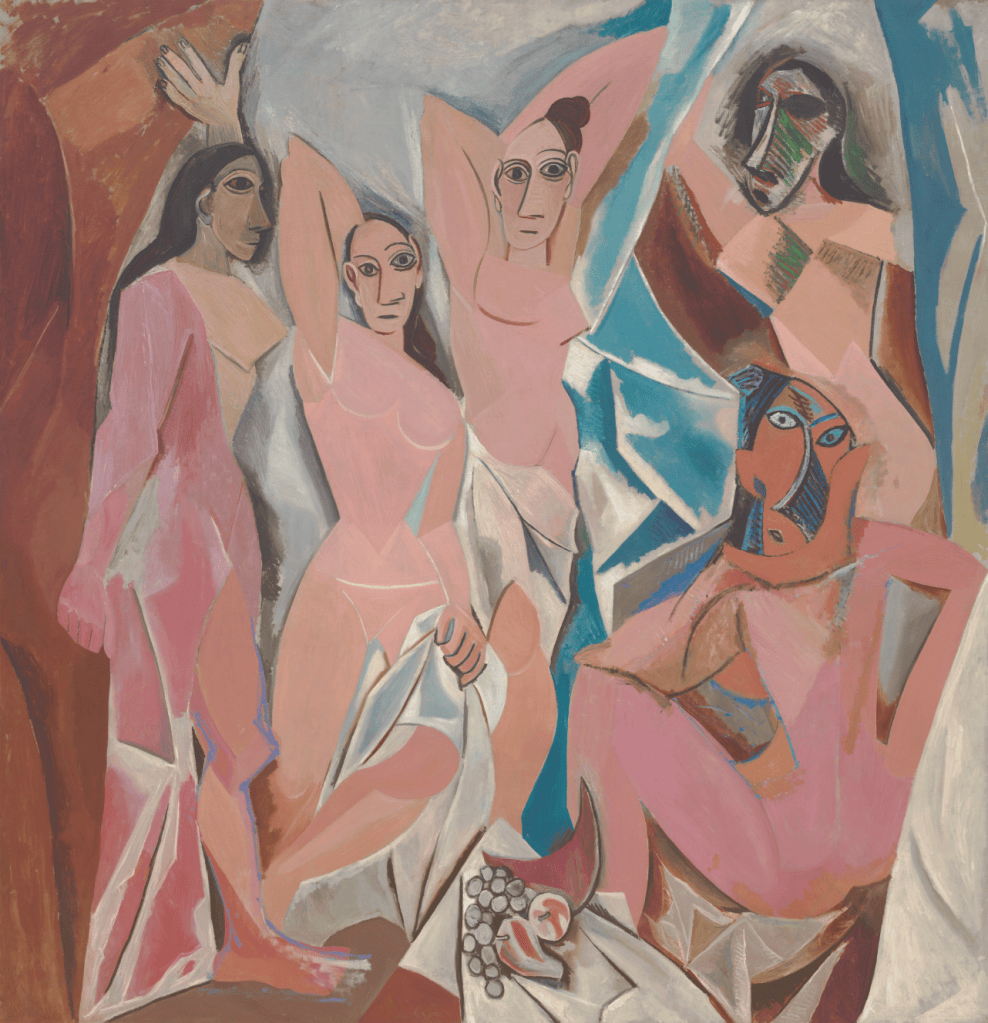
The painting is an example of Cubism in its early stages, as the women are represented through flattened, geometric shapes showcasing multiple perspectives rather than a single fixed perspective. Three of the women are presumably Iberian, while the other two on the right have faces inspired by African tribal masks and are meant to be perceived as African themselves.
The facial expressions of the women range from indifferent to confrontational, as they all collectively stare down the viewer. Here, Picasso presents women as being representative of sexual conquest and primitive recklessness simultaneously. As sex workers, the women themselves are inherently there to service the viewer, implying a sense of sexual vulnerability and temptation we also see present in Kirchner’s piece. However, unlike Girl Under a Japanese Umbrella, these women are far from a passive presence in the image. Their cold gaze is intimidating, and their non-chalant poses, confidently showing off their nude bodies, imply a sense of complete security in their own sexuality that is threatening to the presumed heterosexual male viewer. Like Matisse, there is a sense of uncertainty Picasso seems to have in regards to women as a foreign species, a fear that their primitive savagery will infect and cause irreparable damage within society. This point is furthered through his implementation of African symbolism, representing a fear of racial “contamination” through prostitution, and continuing the Modernist tradition of sexualizing and dehumanizing non-white women. Picasso takes these conflicting feelings of sexual lust and fear to create a narrative that frames women, particularly sex workers, as inherently villainous.
When observed in synthesis, these three Modernist art pieces represent a desire to assert sexual control and dominance over women as a way to prevent them from acting on their supposed inherent primitive and reckless proclivities. They exemplify the Modernist frustration with prostitution as a commodifier of the nude form, and the misdirection of that frustration onto sex workers, and by extension, women as a whole, as opposed to the men commodifying them.
Bibliography
Chave, Anna C. “New Encounters with Les Demoiselles d’Avignon: Gender, Race, and the Origins of Cubism.” In Art Bulletin, vol. 76, no. 4. 1994.
Duncan, Carol. “Virility and Domination in Early Twentieth-Century Vanguard Painting.” In Feminism and Art History: Questioning the Litany. Edited by Norma Broude and Mary D. Garrard. New York: Harper & Row, 1982.
Foster, Hal, Rosalind Krauss, Yve-Alain Bois, Benjamin H.D. Buchloh, David Joselit. Art Since 1900: Modernism, Antimodernism, Postmodernism 3rd Edition. London: Thames & Hudson, 2016.
Kirchner, Ernst Ludwig. Girl under a Japanese Umbrella (1909). Oil on canvas. Artsy.net. Accessed January 8th, 2026. https://www.artsy.net/artwork/ernst-ludwig-kirchner-madchen-unter-japanschirm-girl-under-a-japanese-umbrella
Matisse, Henri. Dance II (1910). Oil on canvas. Blog.artsper.com. Accessed January 8th, 2026. https://blog.artsper.com/en/a-closer-look/art-analysis-dance-by-henri-matisse/
Picasso, Pablo. Les Demoiselles d’Avignon (1906-1907). Oil on canvas. Moma.org. Accessed January 8th, 2026. https://www.moma.org/collection/works/79766

