Jubilee Close
In 1934, the Hollywood film industry was slapped in the face when Joseph Breen was appointed to enforce the Hays Code. The original intent of the Code was to keep the hands of government censorship off of cinema, but after being campaigned by the Catholic Legion of Decency, it became a way for a stubborn conservative ideology to be imposed over the products of the entire mainstream industry. In his book Film Noir, Andrew Spicer details this history and breaks down the Code, which begins with three General Principles to promote “correct standards of life” and “home and family values” (37). Following these General Principles are the numerous Particular Applications, which get into the specific dos and don’ts. This Code had a tight grip on the Hollywood industry until World War II, during which the “restrictions began to loosen,” and by the 1950s, the Code started losing power (Spicer 37-39). Spicer details how classic film noir spearheaded pushing against the boundaries of the Code. Double Indemnity (dir. Billy Wilder, 1944) is a prime example, if not the milestone, representing the loosening Code, because it depicted sexuality and violence at a level never seen in Code Hollywood before. In the discussions of film noir pushing boundaries, one film is often overlooked: In a Lonely Place (dir. Nicholas Ray, 1950). This film slipped under the radar during this period of loosening. While In a Lonely Place does not push the boundaries of depicting violence and sex in the glorified way the Code was scared of, it pushes against the conventional depiction of heterosexual marriage as an all-powerful institution, putting across a harsh argument against it.
Much of In a Lonely Place’s subversion of convention comes from the source material, a 1947 novel of the same name by Dorothy B. Hughes. Dijana Jelača, in her essay about this film, explains how the novel “was seen as harshly critiquing the postwar return to masculinist dominance and the relegation of women (back) to the private sphere” (311). Although the plot of the film is very different from the novel, the feminist critique from the novel widely translates to the film. The novel laid the progressive groundwork for this film, which goes directly against the conventional cinematic patterns of the time.
Describing the effect of the Code on Hollywood films, John Paul Athanasourelis writes “The most obvious manifestation of rigid control of the narrative is the insistence on a ‘happy ending’ by means of establishing a monogamous, heterosexual, seemingly lasting relationship between protagonists by the fade-out” (325). This pattern in Hollywood quickly becomes apparent. No matter what happens in the film, the man and the woman should end up a happy couple, and the film presents this ending as “a sure indication that problems have been overcome and all is well” (325). One of the clearest examples of this is in Gilda (dir. Charles Vidor, 1946). The film depicts a long ordeal between the male protagonist, Johnny (Glenn Ford), and the eponymous female protagonist (Rita Hayworth), in which they reunite and marry after separating in the past, but Johnny begins to emotionally torture her because he thinks she is unfaithful, and she repeatedly fails to escape from him. In the final scene, he learns she never cheated, they reconcile, and they go home together. This ending does not feel real to the audience. The film took the easy way out. The trajectory of the film up until the last scene has only highlighted the growing terror that Johnny is reigning onto Gilda. Their highly abusive relationship is consistently portrayed as negative and irredeemable, and so the ending undercuts the whole narrative. With film noir’s dark tone, it is an easy landscape in which to portray domestic violence, but because of the Code, the films end up dismissing the abuse and supposedly defeating the conflict through an endgame heterosexual relationship. Patrick Cattrysse breaks down the Code’s impact on film noir, pointing out that the Code states that “under no circumstances, the institution of marriage may be displayed in a [sic] unfavourable light” (183). Cattrysse goes on to claim that no film noir adaptation “makes an exception to this rule” (183). This claim, however, completely overlooks In a Lonely Place, despite the article referring to it elsewhere. The Code caused patterns in cinema to emerge, which created Hollywood conventions, which continue to inform audience expectations going into the film. Because of clear audience expectation, In a Lonely Place can subvert it through using a surface narrative and a true narrative. Additionally, by giving the woman control of the narrative instead of the man, it argues that heterosexual marriage is an act of gendered violence and exposes how film noir excuses domestic violence through female performance.
The relationship between the In a Lonely Place protagonists at first tends in the same direction as Gilda, as Dixon “Dix” Steele (Humphrey Bogart) and Laurel Gray (Gloria Grahame) meet, fall in love, and get together, but then he begins to terrorize and abuse her. Where this film diverts from the expected Hollywood formula is that in the final scene, the domestic abuse ends up tearing their relationship apart for good, and they separate. Throughout the film, there are moments that highlight the Hollywood tendency to overlook abuse, establishing the progressive step this film took. When Laurel is crying to Mel (Art Smith) about how she wants to leave Dix, he tries to convince her that she is overreacting, that Dix’s violence is simply in his nature, and that she has to take “the bad with the good” (In a Lonely Place, 1:16:57). He tries to justify Dix’s abuse. This would have been an easy way out for the film to take, but Laurel refuses to accept this. The film refuses to let itself succumb to the pressure of convention.
The audience expectation of the film is based on Hollywood and generic convention. It is combated most obviously through the film’s ending, where the male protagonist and his female love interest do not stay together. The way their split happens is especially surprising to generic expectations of film noir, which, when not ending in romance, usually end in death or lawful justice. For example, in Double Indemnity, their relationship—based on manipulation—does not work out because the man kills the woman and then is arrested. Even in this case, the ending is romanticized with Phyllis’s (Barbara Stanwyck) love confession. Instead of the relationship not working out for a criminal or fatal reason, Dix and Laurel part ways simply because of Dix’s domestic abuse. On categorizing film noir, Robert G. Porfirio writes, “It is the underlying mood of pessimism which undercuts any attempted happy endings and prevents the films from being the typical Hollywood escapist fare” (80). Even though many film noirs have a supposed happy ending, said underlying mood of pessimism ultimately does not allow those endings to have power over the lasting narrative. In a Lonely Place acknowledges this, recognizing that any attempt at a happy ending in film noir is futile, which makes this film, in a sense, more noir-ish than many of the more widely identified picks. Jelača writes, “the world [Dix and Laurel] live in does not allow for things to fall back into more stable and ‘traditional’ structures” (322). The noir world is, by definition, undermined by a happy ending, so In a Lonely Place, by not conforming to the Hollywood ending, successfully remains within the noir world in the way that many film noirs seemingly would if it weren’t for the Code and convention. In the same way that Athanasourelis jabs at the endgame heterosexual relationships as “seemingly” lasting (325), this film points out that an abusive relationship can never truly seem lasting. In one of the many instances of meta commentary in the film, Dix complains about the current state of Hollywood products, saying he is sick of directors “[making and remaking] the same picture” (In a Lonely Place, 4:27). As the film unfolds, it makes clear to the audience that on the contrary, In a Lonely Place is not the same picture they are used to seeing.
Humphrey Bogart himself is the cherry on top of the audience’s generic expectations. Jelača calls him the “quintessential noir face” (316), as he is one of the most recognizable noir protagonists. Megan E. Abbott discusses the idea of the Bogartian protagonist and how his numerous high-profile roles have influenced the way we think of noir protagonists in general, as he is “the unmitigated embodiment of tough and true American masculinity” (321). Unlike In a Lonely Place, other famous noirs starring Bogart feature Hollywood endings. For example, The Big Sleep (dir. Howard Hawks, 1946), ends with the morally transgressive—aka sexual—Vivian (Lauren Bacall) tamed by Bogart’s Phillip Marlowe. In the infamous final line of the film, Vivian says that her flaws—her femme fatale characteristics—are “Nothing [he] can’t fix” (The Big Sleep, 1:53:30). Bogart’s significant roles are characterized as the strong heterosexual man who saves and/or fixes the deviant woman. In turn, Bogart’s roles characterize him as an actor and the way in which the audience views him. The name “Humphrey Bogart” is the first shot in In a Lonely Place. It spreads over the whole screen, overlaid on a shot of a car’s rear view mirror, in which Bogart’s recognizable eyes glance repeatedly. His name is the first image the audience sees, and thus his name functions as a signifier for the Bogartian noir protagonist. His eyes in the mirror further nod to the audience’s automatic idea of what his character will be. In contrast to the idea of the Bogartian protagonist, “a man who remains consistently in control of himself and the situations in which he finds himself” (Abbott 306), this film deromanticizes him by unfolding the narrative and disassembling audience expectation, presenting a Bogart who is not in control of the narrative.
In a Lonely Place opens on a recognizably noir narrative: Dix is accused of a murder he did not commit, but the girl next door, who falls in love with him, starts to suspect he might be guilty. This is only the surface narrative, and by the end, the narrative unfolds to reveal a true narrative. One element of noir Porfirio identifies is paranoia of impending violence, explaining that noir’s “undercurrent of violence which could literally strike a man at any moment” leads to a high level of paranoia in the characters and the audience (90). This film certainly maintains the paranoid air of impending violence, but it subverts the audience’s idea of what the violence will be. As the surface narrative unfolds, the revealed narrative presents the true violence at the heart of the film. The narrative is presented at first to be about the murder of Mildred (Martha Stewart), and whether Dix is innocent. The impending violence in this surface narrative is the potential that Dix may be a murderer. As the film goes on, the question of the murder becomes less and less important, as the predominant conflict that arises is that Laurel begins to fear domestic abuse from Dix. As the true narrative is revealed, the impending violence becomes violence between Dix and Laurel, which I will refer to as being within the domestic sphere. As James W. Palmer points out, Mildred’s murder is the film’s MacGuffin (203), a term which Jelača defines as “a plotline positioned as important, but ultimately irrelevant to the film’s deeper meaning” (317). Mildred’s murder and the following investigation are at first presented to be the plot the audience is supposed to be invested in, but as the narrative unfolds, this MacGuffin gives way to the actual important plot—Dix’s domestic violence towards Laurel. Often in classic noir, the couple stays together because it turns out that no one did anything wrong, and it was some form of misunderstanding. In Gilda, for example, Johnny learns that Gilda never actually cheated, and suddenly all is well between them. Supposedly, neither of them are guilty, even though Johnny abused Gilda for a lengthy period of time. In In a Lonely Place, this same type of reveal occurs, as we learn that Dix for sure did not murder Mildred, but instead of this being a relief, all it does is shift our full focus onto the true narrative. By the time of this reveal, the true narrative we are invested in is domestic abuse, which Dix is revealed to be guilty of. The moment the audience learns that he is innocent is a moment of dramatic irony, as the audience knows before the characters do. The reveal to the audience is underplayed, as the murderer’s confession happens off-screen and barely any details are given. Although this offhand nature of the reveal might seem strange on paper, it fits perfectly within the film because the audience simply does not care that much about it. At this point, it does not interest the audience anymore whether or not Dix killed Mildred, because we are focused on whether or not Laurel can escape the domestic abuse. The way that In a Lonely Place achieves this shift is through paralleling it to a shift in audience alignment from Dix as the protagonist to Laurel as the protagonist.
As in a typical classic noir, the film begins with the audience aligned with Dix, the male protagonist, then shifts over time, and by the end, the audience is aligned with Laurel as the protagonist. In one of her first scenes, there is a moment where we see an extended period of her looking at Dix. It is not a close-up, as Captain Lochner (Carl Benton Reid), who is speaking, moves in and out of the shot, but her face takes up one corner of the screen, clearly to be seen by the audience. During this shot, the nuances of her facial expression continuously shift. She is clearly contemplating something, but the audience does not know what she is thinking. At this point in the film, the audience can only tell what Dix is thinking and feeling. Because he is the audience’s footing in the story, they believe he did not murder Mildred. As time goes on, and Laurel begins to question Dix’s innocence, the audience starts to suspect that they might not have known what he was thinking after all. As the cinematic narrator begins to align with Laurel, her growing paranoia and fear become what the audience feels, and so the audience suspects that Dix is unreliable. Aligned with Laurel now, her fears about his violent nature are directly felt by the audience. He fulfills this fear in the final scene, physically attacking her for the first time, trying to strangle her to death. A phone call interrupts the violent act, in which they learn what the audience already knows—that Dix is innocent. He tells her, “A man wants to apologize to you” (In a Lonely Place, 1:31:40), ironically emphasizing the lack of remorse on Dix’s part for something much worse. In this moment, Dix refuses the redemption that most noirs force upon their male protagonists. Even though his name is cleared, it does not matter, which Laurel herself says and the audience agrees with. The film underlines this by not relieving the grave music at all in this scene. The tone stays exactly the same before and after they learn of his criminal innocence. Even though Dix is innocent—in the sense that he does not require lawful punishment—the film understands that he is guilty of something that transcends law. By the final few shots of the film, it is firmly established that the audience is aligned with Laurel. After Dix leaves her apartment, the camera does not follow him. It watches from the doorway through which Laurel stands as he walks out of the apartment, out of the courtyard, and out of sight. The film ends on an intimate close-up of Laurel watching him leave. She whispers out loud, “Goodbye, Dix” (In a Lonely Place, 1:32:56), and her facial expression conveys a bittersweet sorrow. The audience can tell what she is thinking because they are aligned with her, the female noir protagonist.
The narrative and the role of the characters in In a Lonely Place go against the grain of classic noir and classic Hollywood as a whole. Already playing with narrative structure through the usage of a surface narrative and a true narrative, it goes a step further against Hollywood convention—and narrative convention as a whole—by giving the female character more narrative agency than the male character. Laurel controls the narrative throughout the whole film, clearly evidenced as soon as her first three scenes. In her first appearance, she boldly enters the frame while Dix is centered, cutting right past him, forcing him to step aside. Here, she penetrates the male-dominated space. Plot-wise, she had just moved into the apartment complex, thus entering his sphere. Further, her apartment is positioned above his, in a way that she can see into his apartment, but he cannot see into hers. She is in a spatial position of power over him. While Dix notices this, Laurel stands above on her balcony while Mildred is down the step into the living room, reflecting their respective positions in the narrative. Over the course of the film, both of these women are attacked by gendered violence. Mildred, who is below and stripped of positional power, is unable to control the narrative and is killed. Laurel, positionally empowered by the structure of the apartment complex—within which the majority of the film takes place—controls the narrative and survives. After these two brief views of Laurel, her third scene is when she comes into the police station for questioning. She enters the room with an air of confidence, head held high. The camera follows her through the whole scene. Even though Dix sits behind her and can thus see her more than she sees him, she narratively structures the scene. She controls the narrative by the nature of Dix’s fate hinging on her alibi. In this scene, we discover part of Laurel’s narrative power: she is not affected by the Bogartian protagonist in the way that female characters usually are. (For example, in The Big Sleep, every female character throws herself at Bogart’s Marlowe.) Her sarcastic remark about Dix’s celebrity status shows that she is not starstruck by him, and he has none of the usual Bogartian power over her. She then refuses his pass at her when he offers to drive her home, showing that she does not easily succumb to him. She makes him pursue her, and the development of their romance continues to be on her terms and her timing, and thus she controls the narrative.
Highly contrary to Bogart’s other roles, Dix does not control the narrative. He tries to gain control, but he fails. It is this lack of control that ultimately sends him spiraling into violence. When he learns that Laurel hid from him the fact that she met with the police, he realizes that she is controlling the narrative, and he bursts into his first fit of violent anger towards her. He starts driving recklessly, and the camera uses a shaky POV from the car, representing his violent headspace. Laurel is clearly terrified. This scene climaxes when he gets into a minor collision and beats up the other driver, whom he would have killed if Laurel did not intervene—again controlling the narrative. Jelača discusses how this relates to the postwar male reaction to women entering the workspace, and thus entering the male sphere, writing that “Dixon attempts to regain control over the social sphere by becoming increasingly controlling of Laurel” (321). He tries to control the narrative, and the only method of control he turns to is violence. When he directs Brub (Frank Lovejoy) and Sylvia (Jeff Donnell) to act out Mildred’s murder, he is controlling a narrative that he was not even a part of. The lighting focuses on the violent, gleeful glint in his eyes. During the final scene of the film, that same lighting focuses on that same look in his eyes, right before he starts strangling Laurel, also an attempt to control the narrative through physical violence.
Dix’s response to Laurel controlling the narrative reveals the film’s deeper project: exposing heterosexuality as gendered performance and heterosexual marriage as gendered violence. Jelača sums up how Dix and Laurel “fail to conform to the stereotypical tropes of romantic protagonists, which are typically organized around the heteronormative axis of passive, feminine women and active, masculine men” (310). From the get-go, the film draws suspicion on the institution of heterosexual marriage. The first interaction in the film is Dix making a cynical, somewhat offensive quip about a stranger’s marriage. A little further into the film, when Brub announces he got married, Dix immediately responds, “Why?” (In a Lonely Place, 16:14). These early examples show how Dix begins the film cynical towards heterosexual marriage. He views it as being tied down and trapped, but then he turns around and imposes this entrapment on Laurel. Dix is a screenwriter and Laurel is an actress. These careers parallel their roles in the dominant gender narratives. In writing screenplays, Dix controls narratives. This, to society, is what he is supposed to do as a man. Laurel, as an actress, must perform male-constructed narratives, paralleling the idea that within the heterosexual sphere, women must consciously perform as the passive female. Sylvia, the only other prominent woman throughout the film, is an example of this. As Brub walks Dix to his car after dinner, the camera zooms into a close-up on Sylvia, bringing the audience into her perspective when she is alone and not having to perform, and shows how concerned she is by Dix’s behavior. When she talks to Brub about it, he cuts her off and does not let her speak, instead insulting her college education out of a place of insecurity that she, a woman, is more educated than he is. She tries to stand up for herself, but then retreats back into a conscious performance of the heterosexual marriage. Her independence is stifled. She is not allowed narrative control because she must perform.
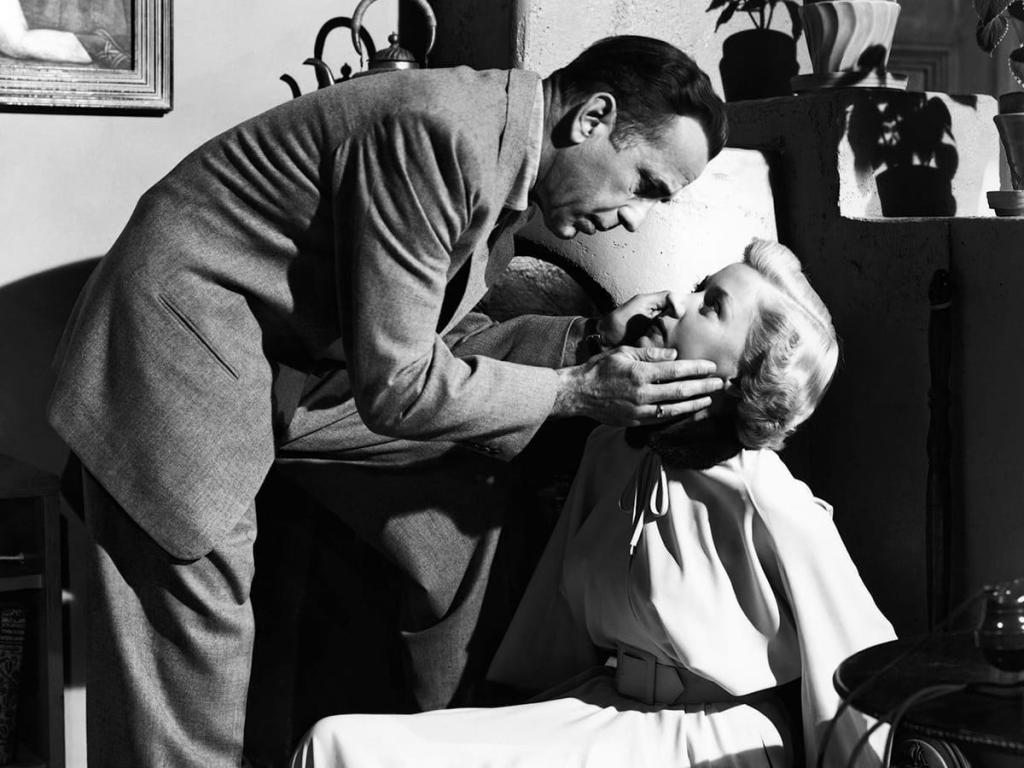
“Dixon enacts gendered violence not only in the physical act of strangling, but also by refusing to allow Laurel to act independently, or to reassert control over her own life” (321), writes Jelača, summarizing her brilliant analysis of In a Lonely Place’s representation of gendered violence. She argues that gendered violence in the film is not only the physical acts of aggression, but also the symbolic acts, writing that it “starts with his proposition of marriage that would see Laurel controlled and relegated to the private sphere” (321). Physical acts of gendered violence are present even before the abuse begins. For their first kiss, he stands above her as she sits, his face shadowed ominously while her face is brightly lit. His hand is on her throat in what could be seen as a romantic touch, but what concerningly looks like strangulation. This foreshadowing of the ending establishes his violent approach to their relationship from the start. The symbolic gendered violence is never clearer than when they discuss marriage. She is shown to be terrified of marrying him. The first time he brings up marriage, the music grows ominous to a close-up of Laurel trying to hide the fear on her face. When he asks her to marry him, she tries to avoid answering, so with both hands, he grabs her firmly and forces her to answer yes or answer no. In doing so, he narrows the structure of the possible narrative, trying to control it through violence towards Laurel. She recognizes the violence that the institution of heterosexual marriage threatens. Not only does she recognize this, the audience also recognizes it, and the film tells the audience to support this stance, a far cry from what most classic noirs tell the audience to do. When Dix makes Laurel breakfast, and they are in the kitchen together, a key moment demonstrates how the film calls the audience to support this progressive angle. Dix says to her, “Anyone looking at us could tell we were in love” (In a Lonely Place, 1:12:03). There is a beat of silence after he says this line, a beat in which the audience notices that no, they do not at all look like they are in love, and if they are, then this is not a love they should want. Production designer Robert Peterson conveys this through a stark mise en scene. The shot is almost wall-to-wall, showing the full kitchen and giving a tight sense of entrapment, evoking how Laurel feels trapped within the relationship and the possibility of heterosexual marriage. Even with the whole width of the kitchen, the two of them are on opposing sides. The space between them is as expansive as they can manage in that room. She is pressed against the wall, as far away from him as she can be. The door, wide open, takes up half of the space in between them. She stays closer to her means of escape than to him. The audience, seeing this shot, cannot support their relationship nor the idea of love that Dix is imposing on them. Seeing that this is what it means for them to stay within their domestic sphere, the audience understands the symbolic gendered violence of heterosexual marriage and is as terrified as Laurel is.
Although Jelača’s theories about gendered violence ring true with my analysis of the film, I end up disagreeing with the conclusion she comes to. She argues that the film says “attempts at anything different [than the dominant narratives of gender] end in bitter failure” (331), claiming that the film’s ending suggests the only alternative to a happy heterosexual marriage is “misery and doom” (331). However, this is not what the ending of the film is suggesting. I would argue the film says that following the dominant narratives of gender—i.e., excusing abuse—results in gendered violence, and this film is one of the only classic noirs that opt to speak out against it. In a Lonely Place argues that, despite what other noirs may try to say, love itself is not sufficient for a healthy relationship.
The shocking final scene ties the ideas of gendered performance and gendered violence together. Since the audience becomes aligned with Laurel, they know that she is performing her gendered heterosexual role for Dix, so when she speaks up and says, “Don’t order me around. I don’t like it” (In a Lonely Place, 1:28:45), the audience knows her performance of passivity is cracking. Her speaking up is what leads to Dix’s physical act of gendered violence—strangulation. As he strangles her, she desperately tries to speak, which shows that since strangulation is an attack on the throat, it is physically and symbolically an attack on the female voice. The moment he begins to strangle her, she immediately says, “I’ll stay with you, Dix, I promise I’ll stay with you! I love you, Dix!” (In a Lonely Place, 1:30:29), and she continues into a desperate string of similar sentiments. This is Laurel instinctively resorting to gendered performance as a defense mechanism. Within the domestic sphere, female performance is a defense mechanism against gendered violence. In film noirs that overlook abuse to create a Hollywood ending, this is what feels like happens, even though most films do not acknowledge it. Gendered violence prompts the woman to resort to performance in self-defense, and because the audience is regularly aligned with the male protagonist, the film presents the performance as the truth, thus overlooking domestic violence. In a Lonely Place stands out, as it does acknowledge Laurel’s performance, giving the female character narrative agency and audience alignment in order to show it, and following through with its portrayal of the consequences of gendered violence in the domestic sphere.
In a Lonely Place subverts the audience’s expectations of the film’s project based on Hollywood conventions, generic patterns, and Bogart’s image. It refuses to promote the typical happy heterosexual ending, instead opting to portray the genuine effect of abuse. To accomplish this, the film opens with a surface narrative, structured to look like a recognizable film noir, but as the film goes on, it reveals the true narrative. The murder around which the film seemingly revolves turns out to be a red herring to the true concern: domestic abuse. Going against the grain of Hollywood at the time, Laurel is given control of the narrative, and Dix is shown to be incapable of gaining control, despite his violent efforts. What the film does here is expose classic noir’s heterosexual ex machina as an act of gendered violence, and sets out to prove that female performance is the only way it can appear to work in a film noir. In a Lonely Place acknowledges that a Hollywood happy ending is not logical within the world of noir. Violence is impending, and so the truest happy ending possible is one in which the woman escapes it, not in which she makes it work through performance.
Bibliography
Abbott, Megan E. “‘Nothing You Can’t Fix’: Screening Marlowe’s Masculinity.” Studies in the Novel, vol. 35, no. 3, 2003.
Athanasourelis, John Paul. “Film Adaptation and the Censors: 1940s Hollywood and Raymond Chandler.” Studies in the Novel, vol. 35, no. 3, 2003.
Cattrysse, Patrick. “Descriptive and Normative Norms in Film Adaptation: The Hays Office and the American Film Noir.” Cinémas, vol. 6, no. 2–3, 1996.
Double Indemnity. Directed by Billy Wilder, Paramount Pictures, 1944.
Gilda. Directed by Charles Vidor, Columbia Pictures, 1946.
Hughes, Dorothy B. In a Lonely Place. Penguin UK, 2010.
In a Lonely Place. Directed by Nicholas Ray, Columbia Pictures, 1950.
Jelača, Dijana. “Feminist, Postmodern, Violent: Postwar Film Noir Romance, and the Undoing of Truth and Subjectivity.” Art of Words / Umjetnost Riječi, vol. 59, no. 3/4, 2015. Palmer, James W. “In a Lonely Place: Paranoia in the Dream Factory.” Literature/Film Quarterly, vol. 13, no. 3, 1985.
Porfirio, Robert G. “No Way Out: Existential Motifs in the Film Noir.” Film Noir Reader, edited by Alain Silver and James Ursini, Limelight Editions, 1996.
Spicer, Andrew. Film Noir. Routledge, 2002. The Big Sleep. Directed by Howard Hawks, Warner Bros. Pictures, 1946.

