Emily Jordan
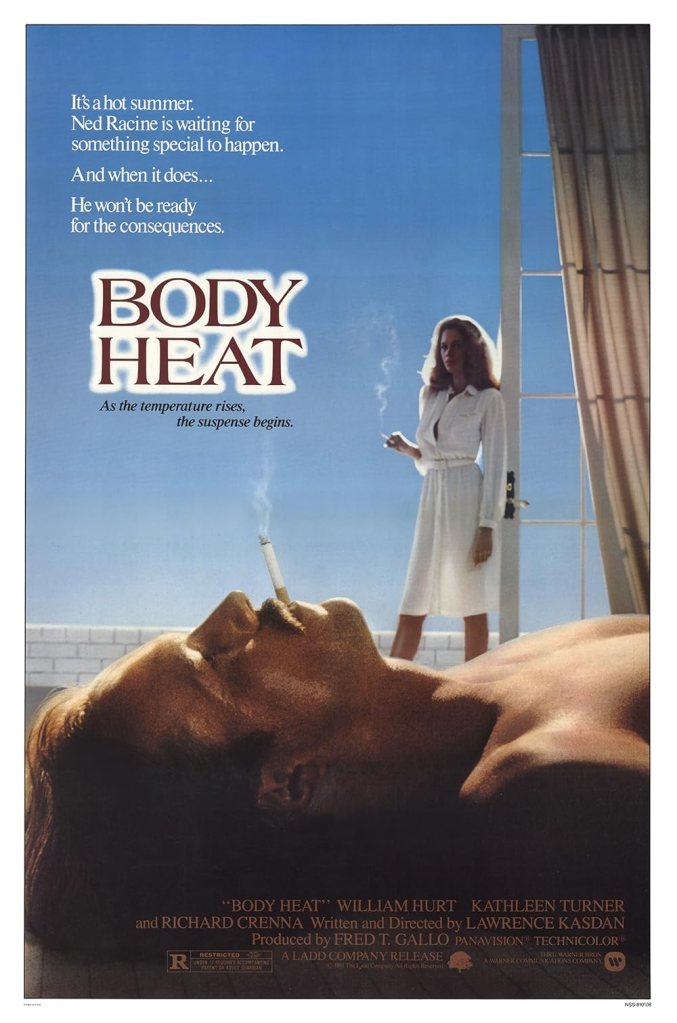
When it comes to the enigma of the film noir genre, it often seems that patriarchal ideologies are at the center. Lawrence Kasdan’s 1981 film Body Heat entered the Hollywood scene as a “tantalizing mirage” of noir masculinity, a clear send-up of past films such as Billy Wilder’s 1944 Double Indemnity and Tay Garnett’s 1946 The Postman Always Rings Twice (Ebert). Each film follows a young, male protagonist who is faced with the consequences of turning their backs against the patriarchal code and murdering their fellow man for the seductive femme fatale, who wishes to fly from the oppressive domestic sphere.
Within these films, the viewer may find an intriguing evolution of gender roles unfolding, as characters such as Walter Neff (Fred MacMurray) in Double Indemnity and Frank Chambers (John Garfield) in The Postman Always Rings Twice become less and less successful at portraying the idealistic, egotistical Bogartian figure as they become increasingly inadequate at containing and punishing their empowered lovers. Humphrey Bogart stands as the epitome of Hollywood masculinity, and from his depictions, namely as Philip Marlowe in the 1946 film The Big Sleep by Howard Hawks, the male figure only spirals downward. Body Heat inverts classic noir film tropes to undo and de-romanticize themes of masculinity and power, paving the way for other neo-noir films to question gender dynamics and critique Hollywood depictions of ideal men. Through this evolution, masculinity grows weaker, but the femme fatale is still punished, that is, until Body Heat’s Ned Racine (William Hurt) is defeated by his own faults, his self-importance used against him, as our “spider-woman” Matty Walker (Kathleen Turner) can manipulate his blinding ego and get away with it (Place 53).
Ned Racine’s ideal masculine identity in Body Heat comes from his personal ideology of the Bogartian detective, who is seen as the epitome of what society wants manliness to look like, and is what Ned thinks he is, or is trying to compensate for failing to be in the past. The stereotypical Bogartian detective, in classic noir, moves through his world as if he were the master of both men and women surrounding him. Janey Place writes that “film noir is a male fantasy,” and within this fantasy, male protagonists have the omniscient power to uncover the issues that challenge them, particularly against feminized threats to the patriarchy (47). Thus, the liberated woman becomes an attack on the male existence, and men can only “control women’s sexuality in order not to be destroyed by it” (Place 49). Kasdan’s Body Heat refashions this male ego, as the more Ned turns Matty into his sex fantasy, the more he hurts himself by underestimating her.
The femme fatale archetype in noir films like Body Heat is often used as a tool to reflect the manliness of their male counterparts, as the main way male protagonists in the noir genre can feel secure and complete is to defeat the femme fatale who challenges their patriarchal identity. Matty Walker is a challenge to the audience and Ned’s expectations of the femme fatale in the noir world, as it is more often true that women in film noir are more capable of their own self-destruction than of ruining the male protagonist. Often representing patriarchal anxiety of the new woman, femme fatales represent “unknowable […] epistemological trouble that threatens, in their strength, a weaker man” (Doane 10). However, it is Matty who spots male weakness in Ned and can harness it to her will, in part by weakening him through her sexual power. As compared to the female roles employed in Double Indemnity and The Postman Always Rings Twice, in which women consistently appear as an “agent of cruel fate or as the man’s own lust, greed and criminal violence displaced and projected upon the aspiring modern woman,” Matty Walker is a display of how male figures underestimate feminist power, and how hyper-masculinity is an assault against both genders (Walker-Morrison 25). In every case, the only means of male redemption is a return to misogynistic roots, as the femme fatale’s only hope of survival is to allow the male protagonist to “fix” her, as Lauren Bacall’s Vivian Rutledge is defeated by Bogart’s Philip Marlowe in The Big Sleep.
The use of queer coding and male relationships in Body Heat, as well as Double Indemnity, displays diversions of male character from the Bogartian ideal, the role of the friend, sidekick, or partner being used to reflect complementary or demeaning qualities of the protagonist. The different uses of queer coding between classic and neo-noir film undergo an evolution just as expectations of the femme fatale trope change between the categories. In Wilder’s Double Indemnity, queerness is read by Brian Gallanger as a means of connecting men through the patriarchy, as both queer men and straight men have reason to hate women. Gallanger states that in Walter Neff’s concluding argument with his business partner Barton Keyes (Edward Robinson), queer coding of Keyes feeds into anti-heterosexual and anti-women tropes, as “Walter’s confession ultimately affirms the correctness of Keyes’s whole attitude […] toward women and toward heterosexual relations in general [ending with a] temporary misogynist bonding” (Gallagher 2). This analysis of Keyes feeds heavily into the relationship in Body Heat that Ned Racine has with Peter Lowenstein (Ted Danson), as, despite effeminate characteristics, Lowenstein becomes the safer form of masculinity than Ned, as Lowenstein can see through Matty’s exploitations of Ned’s ego, and reveal how Ned’s real skill becomes using his “incompetence as a weapon” (Body Heat 5:12)
Queer coding in noir films emphasizes a form of masculine identity that troubles the ideal male ego, often associated with Humphrey Bogart, whose example represents what Ned aspires to but never can be. Bogartian detectives, decidedly unlike Ned Racine, recall a time when “men were still men,” as their hyper-masculine, playboy characters set themselves apart from male characters coded as homosexual, such as Peter Lowenstein (Abbott 306). Bogart can emphatically “fix” or condemn his women; even Walter Neff can murder Phyllis Dietrichson (Barbara Stanwyck), but Ned Racine cannot even keep up with Matty Walker. Ned expresses his self-emasculation in dress and appearance, often wearing tiny shorts, heaving after a jog, and sweating profusely until he seems like the feeblest of men, even compared to the effeminate Lowenstein. Peter is portrayed as a dancing intellectual who laughs boisterously at dirty jokes, in contrast to Ned’s tough, macho-guise; however, Lowenstein’s effeminate nature draws attention to Ned’s imploding hypermasculinity. Because Lowenstein understands the danger of women, he can see the danger of Matty that Ned belittles, and is thus in a safer position of masculinity than Ned is, even if he is not necessarily manly.
Body Heat also plays into gender roles as masculinity is depicted as oppressive heat compared to cool, fluid femininity, the hot, foggy Florida setting becoming a metaphor for when testosterone grows so dense you can choke on it. Employing noir’s “stylized realism,” the use of cigarette smoke, frier-steam, and dense fog creates a suffocating, oppressive heat that drenches characters in sweat and angst until the viewer feels a bit itchy themselves (Hirsch 51). The haze becomes inescapable as it follows characters inside and outside, from smoke-filled bathrooms and restaurants to steamy bedrooms, foggy streets to law offices. The use of reds only amplifies this heat: the diner pie options are “cherry, cherry, and…cherry,” and we see cherry snow cones, red clothing, red lipstick, Ned’s blazing Corvette, and, ultimately, hot blood (Body Heat 26:32). The mise-en-scene makes the heat palpable in the film, the only break offered being Matty’s singing windchimes that play even when there is no wind. Matty’s cool, clear mind emphasizes how foggy masculinity steams up the setting, and detective Oscar Grace states that “when it gets this hot, people try to kill each other” (Body Heat 27:19).
Oscar Grace, like Peter Lowenstein, exists on the outside of the masculine form that Ned is idealizing, not because he is effeminate, but because he is a black man. While Ned overestimates his own capability to manipulate the law and moral code for the sake of sexual conquest, Oscar is the closest the audience gets to a Bogartian detective who lives by his own code, in this case, aligning with the law, even if it means incriminating his friend. Oscar is even dressed in the classic noir detective uniform, “typically in trench coat and fedora” (Hirsch 24). Oscar Grace and Peter Lowenstein, because they live outside patriarchal idealism, become more pure forms of masculinity than Ned, achieving clarity that their friend cannot, as they make him the butt of their jokes as well as Matty’s fool. The plot takes a serious turn, though, as Peter reveals Oscar’s strict moral code to Ned when he meets him alone on the dock to talk about the murder of Edmund Walker: “As far as I’m concerned, I don’t care who killed him […] But Oscar’s not like that. His whole life is based on doing the right thing. He’s the only person I know like that” (Body Heat 1:27:35). For Lowenstein, there is a moral grey area, but Oscar has to be on the right side of the case, even if it means incarcerating his friend. Ned, seeing himself as privileged and capable of outsmarting this moral code, and assuming he can get away with it because he is the ideal form, ignores Oscar and Lowenstein’s more realistic outside perspectives, such as when the three meet in Ned’s apartment and Lowenstein warns him that “someday [his] dick is going to lead [him] into a very big hassle,” to which Ned promptly and ignorantly responds that he does not care if Matty is dangerous, and “besides, maybe she’ll try to fuck [him] to death” (Body Heat 1:14:26).
Body Heat refashions African American presence in noir films with a dominant white cast, giving Oscar power and agency that is closer to the Bogartian ideal detective than Ned is. In classic noir films, African Americans are most often seen in minor roles that are meant to serve male leads, such as the car mechanic in Double Indemnity, Charlie, who gives Walter Neff an alibi. In Body Heat, Oscar, not Lowenstein or the police force, finds the evidence to incriminate Ned for the murder of Mr. Walker and personally arrests him, refashioning the placement of black masculinity in the noir world and highlighting the racism of the film’s precursor. Hyper-masculine performance and expectations of success blind Ned to the point that he is even more disadvantaged than his peers, who are perceived as outsiders of hegemonic privilege, as they consequently understand the real world better than he does, trapped in his Bogartian fantasy.
In a fascinating scene in which Ned puts on the classic, hard-boiled detective hat Matty has gifted him, we are reminded once again how weak Ned seems compared to the Bogartian protagonist in noir, or even to Oscar, who wears a style similar to Bogart’s role in Howard Hawks’s The Big Sleep. It makes us wonder why Matty has worked deliberately to inflate his ego, the answer being, of course, because she needs him to kill her husband, and to think it is his idea, not hers. This use of the typical detective look calls again to the ideal form of man, which we understand in this sequence is how Ned wrongfully views himself: “we see not only what he sees but as he sees” (Novak 261). It is not until Ned begins to suspect how Matty has undermined him that we see his true form, how Matty has seen him for the entirety of the film, as Ned watches a garish clown drive slowly past him in a car suspiciously similar to his own red Corvette. In this transition, we see as Ned sees through the lens of crumbling classical agendas that end with men on top, and Matty’s escape and success become all the more surprising and interesting to the audience, as it forces the question of why it is so normalized in Hollywood film for the man, to some extent, to defeat the woman.
Many films in the new wave of the noir genre have refashioned what it means to be masculine based on the Hollywood Bogartian form, and Ned Racine’s character follows these deviations, just as much a send-up character of Jack Nicholson’s Jack Gittes from Roman Polanski’s 1974 Chinatown as he is of Walter Neff from Double Indemnity. Like Racine, Gittes becomes the victim of his ego, forming what could be considered a more realistic version of Bogart’s detective story, with a nihilistic and disturbing ending coming as a result of his own negligence and narcissistic belief that he can solve the crime without help. Ned Racine becomes the “victim-loser” archetype due to his inability to estimate Matty’s capability, as a “modernized, unpunished femme fatale”, and like Gittes, he fails based on his astounding ability to misread his own importance and capability (Spicer 151). However, Gittes is given the grace of being a somewhat attractive, solidified presence of the hegemonic hard-boiled detective, while Ned only embraces masculinity through sweat and ennui as his sexual partners return to their blue-collar careers.
Matty Walker can be seen as even more masculine than Ned is, as, like her ruthless businessman husband, she is willing to “do what is necessary” to meet her desired freedom, while Ned only does what is necessary to his own desire and sexual pleasure (Body Heat 1:47:40). Neither Ned nor the audience anticipates Matty’s power, but Matty knows how the men around her see her, even joking with her husband and Ned, “I’m too dumb. A woman, you know,” the punchline being that she is the real “man” at the table, feeding the men around her a fake, damsel-like persona of femininity when she is emasculating them, all while they sit in front of her blinded by their inflated egos (Body Heat 41:42). Roger Ebert writes in a review of Body Heat that “you watch the movie the first time from [Ned’s] point of view, and the second time from [Matty’s],” as she not only fools Ned but also fools the audience.
In contrast to Ned’s fragile ideal of masculine identity, Matty Walker’s dual identity only strengthens her stature in the film, as she not only is the femme fatale but can also scapegoat another woman to be punished in her place. What Ned and the viewer first assume as an ending in which Matty dies and is therefore punished is suddenly shifted into one where she escapes. By this means, Matty’s power “is derived from her ability to manipulate her own image” as she can fool both Ned and the audience into her performative femininity, creating a web that is impenetrable and unconstrainable, her own identity being a ruse (Doane 14). Ned does not have a dual form; his only goal is to prove his manliness to others, and this becomes an issue for him as his goal to achieve the Bogartian form is impossible. Other characters, such as Matty, Lowenstein, and Oscar, all have identities that are fluid and complex, outside of the hegemonic goal. These characters know they can never be Bogart, and their awareness of this makes them stronger, while Ned’s denial weakens him. Matty reconstructs this duality for her own gain, only strengthening her character and exposing Ned’s rash, over-confident foolishness. Matty and the others are “more experienced in the ways of a world in which anything is possible,” while Ned is caught in the tight loop of the patriarchy that he cannot escape (Woolfolk 109). Matty can escape the typical ending of the femme fatale in noir films by murdering her double, the real Matty Walker, and faking her death in an unbelievably clean way, since the dental records of the dead woman only prove her name is Matty Walker. Matty’s identity becomes an enigma to the male figures of the film, as not even her deceased husband knew her real name, and before Ned can prove that her true identity is Mary Ann Simpson, she is off sunbathing on a tropical island. This genre of “defeated dandyism” that Ned embodies is one that has been brewing within the noir genre since neo-noir’s alleged birth with Chinatown, as the idealized Bogartian masculinity begins to be questioned more frequently (Woolfolk 108). Body Heat reflects and rebuilds these narratives in a style that is presented as if it is “a part of a mythic past,” as Ned and Matty are not only unraveling the knot of mythological Hollywood gender types, but also being rewritten in a contemporary sense, which deromanticizes the stereotypes of undefeatable hegemony (Zizek 112). Body Heat folds the classic depictions of the ideal masculinity inwards, as “the protagonist’s project is not only doomed but laughably naive,” Ned Racine being both unattractive and stupefied by the power he insists he is entitled to in the Bogartian role (Novak 256).
Doane’s connection of classic film noir to performative narratives is fascinating, especially as masculine-oriented knowledge consistently clashes with the femme fatale’s enigmatic figure. In this sense, narratives encircling power always lead to sexual relationships, as the femme fatale’s ultimate betrayal is based on her desire for sexual liberty, driving male anxieties over his ability to know a woman only by knowing her body. Deborah Walker-Morrison writes that “the fatale as spider-woman combines physical seductiveness with lethal ambition: a drive for personal independence within which the man is no longer a romantic object of desire,” and Matty Walker uses Ned’s sex drive as an apparent transportation towards his destruction, as, like typical patriarchal men, Ned assumes that having frequent sexual affairs with Matty is enough to understand her as a person, projecting his control in the bedroom onto real life (25). This becomes Ned’s biggest problem, as his failure to understand Matty’s mind instead of her body makes him the perfect target, and “hot sex [becomes] a trap,” Ned concerning himself more with getting trapped in Matty’s sheets than in her windchimes (Hirsch 38). In classic noir films, sexual liberty in women, such as Phyllis in Double Indemnity, who appears first in a towel and a shimmering anklet, or the camera tilt up Cora Smith’s (Lana Turner) legs in The Postman Always Rings Twice, become signifiers of their doom, their display of sexual appeal telling the audience they must be punished. However, Matty does not face this ending, as Ned, rather, finds himself incarcerated for trusting the notion that patriarchal sexual liberties are his power when they really become his weakness. Thus, “heterosexual relations resemble a state of constant sexual warfare” in which sex affairs can only end fatally, the strengths of queer-coded characters such as Keyes and Lowenstein stand as having learned this lesson without living through it (Gallagher 4).
Body Heat is a fascinating example of an “attractive crime” in which gender in both private and public spheres becomes performative, the duplicity of women outlasting the hyper-focused masculine act that is expected and embodied in noir men (Athanasourelis 326). When first meeting Ned Racine, Matty says to him, “You’re not too smart, are you? I like that in a man,” challenging Ned in a way that ensures that he will waste time futilely proving he is conventionally manly, not realizing Matty is cunningly faking feminine weakness (Body Heat 8:31). In this light, neo-noir films are more apt to explore the dichotomy of strong women and frail men, as contemporary femme fatales blatantly “understand femininity as occurring within a public domain long traversed and dominated by men […] less of a matter of being than of acting,” where the male figures have not yet realized that they are also performing their gender (Shillock 9). Neo-noir deconstructs classic noir’s advertisement of the ideal man that bent to the post-WWII audiences who wanted to be reminded of a kind of masculinity that was dominant over women, foreigners, and the corrupt world itself, and Hollywood willingly spoon-fed these ideals through Bogartian detectives. Through neo-noir films such as Body Heat, this hero is deromanticized and displayed in their nonfictional forms, displaying the truthful narrative of an egotistical figure who is attempting to dominate the world but can only fail.
Body Heat deviates in multiple forms from the typical role of masculinity and femininity that have been presented from Hollywood noir archetypes, twisting the expectations and focus from male perseverance to the danger of hyper-masculine spiraling. In an effort to keep himself from appearing weak, Ned does just that, while Matty becomes one of the few femme fatales to survive her crimes unscathed by the patriarchal system or susceptible to a narrative of being “fixed” like Vivian Rutledge of The Big Sleep. and it is entirely due to the blindness and easily fallible male egotism. Matty Walker becomes a send-up, just as Ned Racine is, to past noir characters, such as Barbara Stanwyck’s Phyllis Dietrichson of Double Indemnity and Lauren Bacall’s Vivian Rutledge. Matty Walker “is self-directed rather than other-directed, mobile not inert. Those with whom she interacts serve her rather than the reverse” (Shillock 3), asserting her position as the femme fatale as the centrifugal force of the story, not Ned Racine’s machismo. Matty makes the viewer, as well as Ned, believe that Ned is the one who is in control, that he can “handle her,” and that Ned is the key that either makes or breaks her plan to murder her husband (Ebert). However, it is up to us all to discover that our place has always been on the outside of Matty’s narrative, and that Ned is one small piece of her grand scheme, the audience and Ned never even knowing her true identity until the very end of the film.
Bibliography
Abbott, Megan E. “‘Nothing You Can’t Fix’: Screening Marlowe’s Masculinity.” Studies in the Novel, vol. 35, no.3, 2003, pp. 305-24.
Athanasourelis, John Paul. “Film Adaptation and the Censors: 1940s Hollywood and Raymond Chandler.” Studies in the Novel, vol. 35, no. 3, 2003.
Doane, Mary Ann, “Gilda: Epistemology as Striptease.” Camera Obscura: A Journal of Feminism, Culture, and Media Studies 11. 1983: 6-27.
Ebert, Roger. “Body Heat movie review & film summary (1981).” Roger Ebert, 20 July 1997, https://www.rogerebert.com/reviews/great-movie-body-heat-1981. Accessed 25 April 2025.
Gallagher, Brian. “‘I Love You Too’: Sexual Warfare & Homoeroticism in Billy Wilder’s Double Indemnity.” Literature/Film Quarterly, vol. 15, no. 4, Jan. 1987, pp. 237–46. EBSCOhost, research.ebsco.com/linkprocessor/plink?id=ec1fa5b9-629f-3acc-90f1-02a9479384a8.
Hirsch, Edward. “The Dark Side of the Screen: Film Noir.” The Literary Background, 1981.
Novak, Phillip. “The Chinatown Syndrome.” Criticism, vol 39, no 3. Wayne State University Press, 1 July 2007.
Porfirio, Robert G. “Film Noir Reader.” No Way Out: Existential Motifs in the Film Noir, 1976.
Place, Janey. Women in Film Noir. Second ed., London, Palgrave Macmillan, 1998.
Shillock, Larry T. “Black Widow, Gender Criticism, and the Narrative Agency of the Femme Fatale.” Interdisciplinary Humanities, vol. 33, no. 1, Mar. 2016, pp. 136–49. EBSCOhost, research.ebsco.com/linkprocessor/plink?id=fc794414-7878-3264-b86a-a46a29e2f61e.
Spicer, Andrew. Film Noir. Longman, 2002.
Walker-Morrison, Deborah. “Sex Ratio, Socio-Sexuality, and the Emergence of the Femme Fatale in Classic French and American Film Noir.” Film & History: An Interdisciplinary Journal, vol. 45, no. 1, June 2015, pp. 25–37. EBSCOhost, research.ebsco.com/linkprocessor/plink?id=ab93ca42-722f-30dd-b8ec-0fc51fbd0f04.
Woodfolk, Alan. “The Horizon of Disenchantment.” The Philosophy of Film Noir, 2006.
Zizek, Slavoj. Looking Awry: An Introduction to Jacques Lacan through Popular Culture. MIT Press, 1995. pg. 112)

