Guy McEntarffer
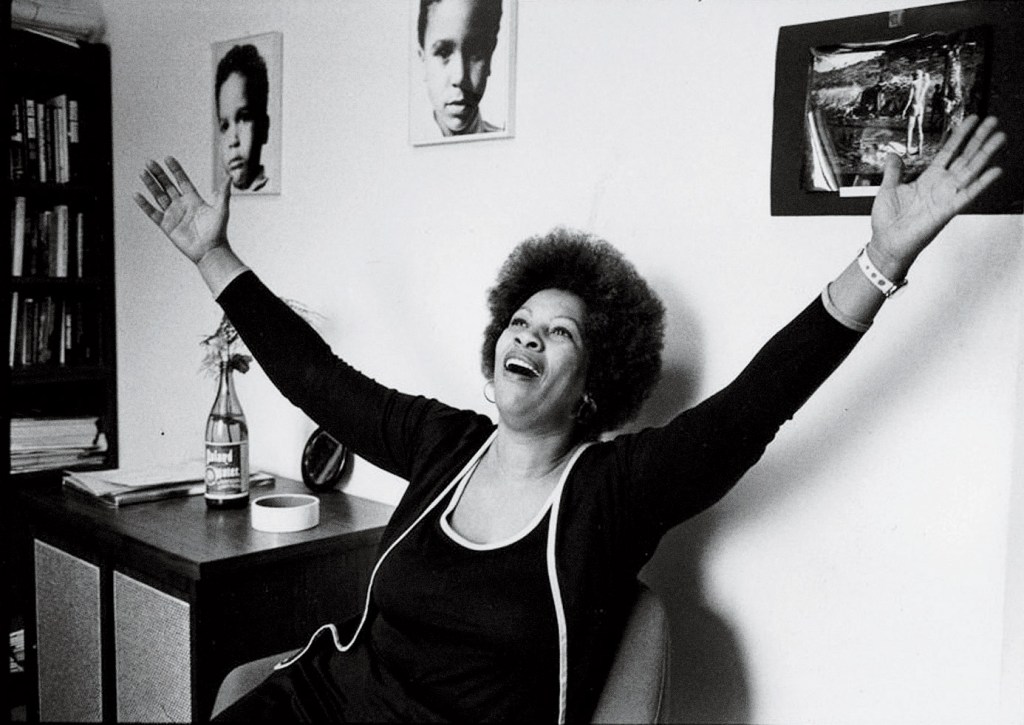
It was this hysterical, out-of-the-ordinary, bizarre form of evil… So what you did instead was laugh at him, at the absurdity, at the monumental crudeness of it.
– Toni Morrison
Toni Morrison‘s literary impact cannot be overstated, and this is reflected in the plethora of secondary literature regarding her writing. Nearly every aspect of Morrison’s work has been written about extensively: Her unique relationship with modernism’s experiments with narration, her extensive and consistent cross-textual usage of symbols, her relationship with the salutary value of community—these and more have been approached via feminist, womanist, ecocritical, psychoanalytic, and Marxist methodologies. However, if it’s possible that there is a single aspect of her work that is, to date, underexplored, it is her usage of humor within her books. Due to both the quantity of other subjects for analysis and the intensely academicized way her work is often discussed, this under-exploration of humor is ripe for critical attention.
When humor comes up in Morrison’s novels, it is usually either a satire of white culture or humor grounded in the black vernacular tradition. In Morrison’s fourth novel, Tar Baby, the Streets, a seemingly ideal white family, are used to satirize white culture when they’re all revealed to be the opposite of the image they intend to project. Black vernacular humor can be found in Song of Solomon, Morrison’s fifth novel, when Porter expresses his internal strife through humor (pleading for sex up on a roof). However, in her second novel, Sula, Morrison turns to a mode of humor that cannot be easily explained by these frameworks. There are humorous elements throughout Sula that feel at a distance from either satire or black vernacular oral traditions. Chiefest among these are the name of the fictional town in which the novel takes place (“The Bottoms”), “National Suicide Day” (a day when the town crazy encourages everyone to kill themselves), and “the deweys”—three four-foot-tall boys no one can tell apart. Neither satire, nor in-group joke—both of which point to a world of sense— these events in Sula strike a distinctly absurd chord for the fact of their sheer senselessness. By leaning on the absurd in Sula, Morrison creates a reflection of the largest and most widespread absurdity within American society: the absurdity of anti-black racism.
Humor in Tar Baby and Song of Solomon can be viewed as two sides of the same coin—they take opposite routes, but accomplish the same goal of weakening American white supremacy. Tar Baby satirizes a seemingly overwhelmingly privileged white family by showing how every single member of the family contradicts their deepest values. Valerian Street, the sophisticated, stylish, shrewd businessman, and Margaret, the beautiful, doting mother, are both in reality contradictions—Valerian growing plants from a home he refuses to return to, and Margaret being in love with “the bloodying of her own baby.” (Tar Baby, 231). Finally, Michael, the son around whom the family’s dynamics and thoughts constantly revolve, is conspicuously absent for the entire book. Through the juxtaposition of the ever-present cultural concept of the ideal white family (loving, intelligent, complete) and the actuality of the Streets (sadistic, superstitious, fractured), Morrison satires the concept of a white family and idealized white culture as a whole. This sort of satire and interpersonal family conflict is reminiscent of mid-century American absurdist theater (such as Albee’s Who’s Afraid of Virginia Woolf?), as pointed out by Rambling Raconteur in his discussion of Tar Baby.
In Song of Solomon, humor is used far differently: instead of satire poking holes in the white cultural hegemony, it’s a way to cope, to heal, to shake off and lessen the negative impacts of anti-black racism. It is a facet of the black vernacular that served, and serves, to create “the freedom to laugh at that which was unjust and cruel in order to create distance from what would otherwise obliterate a sense of self and community” (Carpio 15). This usage of humor can be seen prominently throughout Song of Solomon, but it’s especially evident when we’re viewing interactions within a communal space. One of the earliest examples of this is Porter’s stand on the roof: “I want to fuck! Send me up somebody to fuck! Hear me? Send me up somebody, I tell ya, or I’ma blow my brains out!” (Song of Solomon, 25). While this interaction is seemingly serious, it clearly exists as an aspect of vernacular within the community, as evidenced by the women laughing at and mocking him later on in the passage. This passage can therefore be seen as an example of venting trauma and stress through humor, albeit a bleak kind. Another example of this kind of vernacular humor happens when Milkman and Guitar enter the barbershop, an important communal space:
“Reluctantly they stood up and sidled closer to the laughing man. ‘You think that’s something? Not having a beer? Well, let me ask you something. You ever stood stock still in the galley of the Baltimore and Ohio dining cart… and three of your buddies is waiting for you with a deck of cards?’ Guitar shook his head. ‘No, I never…’ ‘That’s right, you never. And you never going to. That’s one more thrill you not going to have, let alone a bottle of beer.’ Guitar smiled. ‘Mr. Tommy,’ he began, but Tommy cut him off” (59).
This interaction, if read completely straight, is Railroad Tommy simply warning the boys of things they won’t have in their lives, both due to their position and their blackness. However, Morrison is clearly intimating that Railroad Tommy is simultaneously giving a sincere lecture and participating in a collaborative joke with the boys, as evidenced by Guitar’s final response: “‘Mr. Tommy, suh,’ Guitar sang in mock humility, ‘we just wanted a bottle of beer is all.’ ‘Yeah,’ said Tommy. ‘Yeah, well, welcome aboard’” (61). Guitar’s final response clearly references and mocks the language of white supremacist dynamics and stereotypes, while disempowering them through humor. This process is best defined by Silvia Chirila: “This form of meta-language implies not only the acceptance of pain, but also a liberating and redeeming role of comic distortion, a process that allows African Americans to integrate experience and, at the same time, an unchaining from its more pervasive traumatic elements” (5). Through this process, Railroad Tommy can clearly be seen as unloading his experience onto Milkman and Guitar while at the same time disempowering it by using it to produce laughter.
Sula, however, neither depicts scenes of black vernacular humor nor social satire. Morrison’s second book, Sula, was published in November 1973, four years before Song of Solomon and eight before Tar Baby. The arc of humor throughout Morrison’s early works is complex and up to interpretation. In The Bluest Eye, intentional humor is fairly absent, while in Tar Baby and Song of Solomon, there is the aforementioned satire and vernacular tradition. Further down the line, Jazz sports elements of both satire and the vernacular, while Beloved is more of a return to The Bluest Eye stylistically. However, Sula includes a far different trend in humor–an emulation of the comedic absurdity of absurdist theater. In Sula, satire is scant. Vernacular-based humor is only marginally present, although at least one critic has interpreted the novel itself as an expression of black vernacular humor. Discussing the purported origins of the name of “The Bottom” (it began, as the novel’s narrator informs us, as “a N-word joke”), Chikwenye Okonjo Ogunyemi argues that “Sula embodies a joke that permeates the lives of individuals, neighborhoods, and towns, and the humor is quite infectious. The novel is not just about Sula but about us all, white and black, because (N-word) jokes are not only told by blacks for blacks but can also be told by anybody to anybody for comfort when the world has gone awry” (133). While this reading of Sula does capture the vernacular dualistic nature previously referred to, here called “an (N-word) joke,” it cannot explain the more absurd elements of the text.
If this is the case, what concrete, in-text, intentionally humorous aspects are included within Sula? If everything within the novel is perceived at face value, then there isn’t an enormous amount. However, if one digs a little deeper, there are an enormous number of things that are deeply absurd. National Suicide Day, the concept of “The Bottom” as a whole (and its residents’ eventual fate), and, most importantly, the presence of the Deweys at crucial points throughout the novel closely mirror the aesthetic conventions of the “Theater of the Absurd,” and show Morrison’s usage of absurdity within Sula.
The use of the term “absurd” in this essay is derived from the aforementioned discussion of mid-century avant-garde theater. The concep t of absurdist theater, and the grouping of playwrights deemed “absurd,” was first formalized by Martin Esslin in his 1960 essay “The Theatre of the Absurd.” In this essay, Esslin groups three playwrights’ (Beckett, Adamov, and Ionesco) work together through their shared “deep sense of human isolation and of the irremediable character of the human condition” (Esslin, 4). The means through which they express this sense is through absurdity within their works, defined as “that which has no purpose, goal, or objective” ( 4). This all serves one goal: “[T]he absurd and fantastic goings-on in the Theatre of the Absurd will, in the end, be found to reveal the irrationality of the human condition and the illusion of what we thought was its apparent logical structure” (5). In Sula, Morrison uses this exact technique, but to much more specific ends. Instead of implying a fatalistic view of the world and the human condition in general, Morrison turns to the absurd to reflect the inherent irrationality and absurdity of anti-black racism. She accomplishes this task and separates it from the goals of the original theater of the absurd through two strategies. First, she includes the absurd in relation to specific events, all of which point towards racism in some way. One example of this is the humorously absurd concept of “The Bottom” being situated at the top of a hill, as this situation is only in place as a direct result of anti-black racism.
Secondly, Morrison intentionally subverts one aspect of the theater of the absurd: “Verfremdungseffekt,” or “the inhibition of any identification between spectator and actor,” a concept Esslin derives from Brecht (5). In the Theater of the Absurd, this inhibition serves to create distance between the goings-on of the play and the audience. The audience is able to recognize the absurdity within the play, without rationalizing it due to its presence in life. Because of this lack of rationalization, the audience is ultimately able to connect the play to the absurdity of real life in a way that would not be possible had they been rationalizing the goings-on the whole time. However, Morrison has a complex approach to this process. In her essay “Rootedness: The Ancestor as Foundation,” Morrison discusses how important the relationship between reader and writer is in her work: “Having at my disposal only the letters of the alphabet and some punctuation, I have to provide the places and spaces so that the reader can participate. Because it is the affective and participatory relationship between the artist or the speaker and the audience that is of primary importance, as it is in these other art forms that I have described” (341). This idea of a participatory audience is clearly antithetical to “Brecht’s Verfremdungseffekt” as described by Esslin (5). This concept of a participatory audience is something that is crucial to Morrison throughout her works, and that she clearly strives for in her narrative and literary strategies. In a direct contrast to the ideals of the theater of the absurd, Morrison strives for audience participation and considers it tantamount “so that it is, in my view, Black, because it uses the characteristics of Black art” (“Rootedness: The Ancestor as Foundation,” 342). However, this does not necessarily exclude her from using the Verfremdungseffekt in certain situations. While much of Morrison’s writing requires an active reader, she makes a conscious choice with Sula to create characters such as the deweys who are utterly unrelatable and thereby are able to use the Verfremdungseffekt for its intended purpose: To build a connection for the audience between the absurdity within the work and the absurdity within real life.
Morrison even references the humorous absurdity of anti-black racism in interviews: in her 1993 interview with David Streitfeld, she refers to her parents’ house being burnt down by their landlord over 4 dollars as “this hysterical, out-of-the-ordinary, bizarre form of evil.” Through pointing out the absurdity of this clearly extreme and violent act, and stating that laughter was one of the only palatable responses, Morrison displays her cognizance of the humorous absurdity present within anti-black racism.
One of the more prominent examples of this kind of absurdity in Sula is Shadrack’s “National Suicide Day.” Due to Shadrack’s traumatizing experience in the First World War, he has a paralyzing fear of unexpectedness and lack of control over fundamental elements of life. In response to this fear, he institutes National Suicide Day. Every year on January third, Shadrack parades around town encouraging anyone who’s going to die to get it over with so “everybody could get it out of the way and the rest of the year would be safe and free” (Sula, 14). This concept is clearly absurd. Not only is it ironic in concept, but also in name—it is repeatedly shown to be a unique holiday to the Bottom, and therefore not national in the slightest. Its absurdity being established, its placement within the book (bookending the narrative) reinforces its thematic importance—we are introduced to the Bottom through Shadrack, and he leads the charge into the tunnels where the Bottom dies. This absurdity, unlike others within the book, parallels the aesthetic and philosophical roots of the theater of the absurd, as Shadrack “symbolizes the nihilistic and suicidal tendencies of twentieth-century man with his World Wars” (Ogunyemi, 132).
As I have discussed, the origins of the Bottom as a “(N-word) joke” is another example of such racialized absurdity. Morrison directly refers to the illogical contradiction of the Bottom being located at the top of a hill with humor here. The absurdity inherent in this concept reflects anti-black racism more explicitly than any other within the novel. It’s a direct result of white prejudice and unfair treatment (not wanting to give good land to a former slave), in addition to being influenced by systematic aspects such as a lack of knowledge about farming practices and land. Due to this, it’s a “(N-word) joke” that hangs over the entire book, poisoning every action taken within the Bottom with its inherent absurdity.
However, the most absurd element within Sula is, I argue, the Deweys. These characters make their first appearance in the description of the full Peace household, which is governed by Eva Peace, the one-legged matriarch. The core residents of this house are the women- Eva, Hannah, her daughter, and Sula, her granddaughter. Around these figures are male characters, all of whom get a limited amount of focus: Plum, Tar Baby, and the deweys. During the deweys’ introduction, the reader is informed of their method of adoption and naming:
They came with woolen caps and names given to them by their mothers, or grandmothers, or somebody’s best friend. Eva snatched the caps off their heads and ignored their names. She looked at the first child closely, his wrists, the shape of his head and the temperament that showed in his eyes and said, “Well. Look at Dewey. My my mymymy.” When later that year she sent for a child who kept falling down off the porch across the street, she said the same thing (Sula, 37).
This introduction already portrays the naming of the deweys as a rejection of the norms of society and an imposition by Eva. Things only get more absurd from here. Despite the implication that the three boys look racially different (one is described as “Deeply black,” one “Light-skinned,” and the third “half Mexican”) and derive from different families, the boys become indistinguishable over time, “to become a trinity with a plural name… inseparable, loving nothing and no one but themselves” (38). From these already absurd origins, the deweys go on to occupy an incongruous place in the narrative, becoming permanently forty-eight-inch-tall boys who are “mischievous, cunning, private, and completely unhousebroken,” and who never stop growing “except for their magnificent teeth” (84). Even their eventual fate is ambiguous. When the entire town follows the Suicide Day parade into a tunnel that collapses, many of the Bottom’s residents meet their final end: “Tar Baby, Dessie, Ivy, Valentine, the Herrod boys, some of Ajax’s younger brothers and the deweys (at least it was supposed; their bodies were never found) – all died there” (162). In this way, even the deweys’ fate is ultimately unreal and absurd, disappearing seemingly into thin air. Due to the absurdity inherent in Morrison’s portrayal of the deweys and their bizarre morphology and inexplicable actions, the deweys perform a blatantly absurd function in Sula.
Despite their scene-stealing role in Sula, critical analyses of the deweys are difficult to find. Kathleen Anderson and Gayle Fallon offer what is considered “the first developed examination of Morrison’s use of three diminutive boys” (Anderson and Fallon 1). In their essay “‘We Sick’: The Deweys as Women’s Willful Self-Destruction in Toni Morrison’s Sula,” Anderson and Fallon claim that the deweys act as prognosticators of the Peace women’s fate. “The deweys’ Cassandric prophesies,” they argue, “mirror the propulsive fatalism of their guardians” (3). They also acknowledge “the deweys’ significance as emblems of border crossing” (2). This points to the dewey’s role as harbingers of the absurd: by pointing out how the deweys cross societal borders, Anderson and Fallon unintentionally highlight their role in the creation of absurdity throughout the novel. In another analysis, Malea Hayles views the deweys as existing within an “identity-less state” that emulates “how white society aims to confine Black society to a singular identity” (1). Hayles’ claim is reminiscent of Hortense Spillers’ concept of the loss of identity due to slavery, which appears in her canonical essay “Mama’s Baby, Papa’s Maybe: An American Grammar Book”: “Every feature of social and human differentiation disappears in public discourses regarding the African-American person, as we encounter, in the juridical codes of slavery, personality reified” (Spillers 78). However, while Anderson and Fallon capture the crucial junctures within the novel that the deweys are placed, and Hayles begins to point to the link between the deweys and the history of anti-black racism in America, neither of these analyses address how incredibly funny the deweys are; or, more soberly phrased, the humor and absurdity that is inherent to Morrison’s portrait of them.
The deweys’ humor, however, does not exist to serve itself. Instead, the deweys’ placement serves to tie them to the concept of anti-black racism, and thereby build a connection between it and absurdity. The deweys’ placement throughout the novel, as postulated by Anderson and Fallon, is often before or after a crucial turning point, be it Hannah’s immolation, Sula’s emotional walls coming down for Ajax, or the final collapse of the tunnel and death of The Bottom. However, this is not primarily to act as a prognosticator, or as an omen—it is to add context to said acts through the reminder of the looming pressure of anti-black racism over all things in the Bottom, represented by the absurdity of the deweys. Before Hannah asks Eva if she ever loved her children, the deweys are “playing chain gang” (Sula 67) near the window and told to leave. After this conversation concludes, they are again seen “still playing chain gang; their ankles bound one to the other, they tumbled, struggled back to their feet and tried to walk single file” (72). This act of playing “chain gang” is clearly reminiscent of the forced labor that was often imposed upon black prisoners in the South (and a reminder of anti-black racism’s historical roots in slavery) while their presence in relation to the rest is one of slapstick absurdity – stumbling and tumbling, full of life in a day too hot for anyone else, playing a game that ostensibly frames them as the bottom tier of society. The deweys’ performance, constantly playing games, is reminiscent of comedic acts, especially that of the Marx brothers, a comedy group that was popular in both vaudeville and film at the time in which the first act of Sula is set. This serves to further reinforce the connection between Sula and contemporaneous forms of absurd comedy.
In my reading, though, the deweys’ most interesting appearance in Sula takes place as an interlude in the middle of the arc of Sula and Ajax’s relationship. Directly before the sex that leads Sula to succumb to more typical relationship dynamics (131), the deweys become the main focus of the sequence. Prior to their entrance, Sula is considering how both Ajax and Jude want to “do the white man’s work” (128). Immediately after, they enter the scene virtually out of nowhere and ask for money to buy medicine. Sula refuses, and they start throwing stones, beginning a scene that’s almost slapstick in the middle of one of the most important romances in the novel:
“Cocksucker!” they screamed, and she leaped out of the bed naked as a yard dog. She caught the redheaded dewey by his shirt and held him by the heels over the banister until he wet his pants. The other dewey was joined by the third, and they delved into their pockets for stones, which they threw at her. Sula, ducking and tottering with laughter, carried the wet dewey to the bedroom and when the other two followed her, deprived of all weapons except their teeth, Sula had dropped the first dewey on the bed and was fishing in her purse. She gave each of them a dollar bill which they snatched and then scooted off down the stairs to Dick’s to buy the catarrh remedy they loved to drink (129).
This cartoonish sequence is the most emphasis the deweys ever get throughout the novel, and its juxtaposition against Sula and Ajax’s romantic melodrama only serves to enhance the humor. Almost as a non sequitur, Morrison segways directly into Ajax and Sula’s climactic sex scene, with no acknowledgement of the pure comedy that just happened. This scene is never referenced again, is acknowledged by no character outside of it, and truly exists independently of any actual plot happening within the story.
Morrison’s sense of humor, despite being the least celebrated of her skills, is both subtle and incredibly illuminating. Many of her books respond well to a reading in which one focuses on the intentional humor sprinkled throughout, but Morrison explores comic absurdity in Sula far more than she does elsewhere in her first six novels. Because of the absurd nature of Sula’s characters, setting, and events, Morrison uses the aesthetics of the theater of the absurd in order to reflect the irrationality of anti-black racism. The comic absurdity that is shown throughout Sula ultimately serves to clue us in on the real joke that saturates every American’s life: the idea of structuring a society based upon the color of one’s skin.
Bibliography
Anderson, Kathleen, and Gayle Fallon. 2018. “‘We Sick’: The Deweys as Women’s Willful Self-Destruction in Toni Morrison’s Sula.” Journal of Feminist Scholarship 15 (Fall): 1-17. 10.23860/jfs.2018.15.02.
Carpio, Glenda. Laughing Fit to Kill: Black Humor in the Fictions of Slavery, Oxford University Press, Incorporated, 2008. ProQuest Ebook Central, https://ebookcentral.proquest.com/lib/knox/detail.action?docID=415485.
Chirilă, Silvia. “Humor and Ambivalence in the Novels of Toni Morrison.” COPAS: Current Objectives of Postgraduate American Studies. Vol 13.
Esslin, Martin. “The Theatre of the Absurd.” The Tulane Drama Review, vol. 4, no. 4, 1960, pp. 3–15. JSTOR, https://doi.org/10.2307/1124873. Accessed 24 May 2025.
“From Cough Medicine to Deadly Addiction, a Century of Heroin and Drug-Abuse Policy.” Yale School of Medicine, 15 Jan. 1999, medicine.yale.edu/news/yale-medicine-magazine/article/from-cough-medicine-to-deadly-addiction-a-century/.
Hayles, Malea. “The Impact of an Oppressive Force Displayed by the Deweys in Sula.” Scaffold: A Showcase of Vanderbilt First-Year Writing, Vol. 3, Spring 2021.
Morrison, Toni. Tar Baby, Plume, 1982.
Morrison, Toni. Sula, Plume, 1982.
Morrison, Toni. Song of Solomon, Plume, 1987.
Morrison, Toni. “Rootedness: The Ancestor as Foundation (1984).” I Am Because We Are: Readings in Africana Philosophy, edited by Fred Lee Hord et al., REV-Revised, 2, University of Massachusetts Press, 2016, pp. 397–403. JSTOR, http://www.jstor.org/stable/j.ctt1hd18x6.44. Accessed 19 May 2025.
Ogunyemi, Chikwenye Okonjo. “Sula: ‘A (N-word) Joke.’” Black American Literature Forum, vol. 13, no. 4, 1979, pp. 130–33. JSTOR, https://doi.org/10.2307/3041477. Accessed 24 May 2025.
Rambling Raconteur. “Tar Baby by Toni Morrison (Inverting Romance and Realism).” (https://www.youtube.com/watch?v=SdU3_eUwD2Q).
Spillers, Hortense J. “Mama’s Baby, Papa’s Maybe: An American Grammar Book.” Diacritics, vol. 17, no. 2, 1987, pp. 65–81. JSTOR (https://doi.org/10.2307/464747). Accessed 24 May 2025.
Streitfeld, David. “The Laureate’s Life Song” The Washington Post, 7 Oct. 1993

