Max Russell
O, then I see Queen Mab hath been with you.
She is the fairies’ midwife, and she comes
In shape no bigger than an agate stone
On the forefinger of an alderman,
Drawn with a team of little atomi
Over men’s noses as they lie asleep.
(Romeo and Juliet, 1.4.58-63)
Mercutio’s “Queen Mab” speech in Romeo and Juliet describes a fairy queen who is wild, morally ambiguous, and fantastical. The character that Mercutio creates may have taken inspiration from the mythological Irish Queen Medb (commonly anglicized in the modern day as Maeve). Medb is a warrior queen who rides the boundary of femininity and masculine waging of war; she is the instigator of the plot of the Irish epic the Táin Bó Cúailnge. Though the depiction of Celtic folklore in Romeo and Juliet is extraordinarily positive and whimsical, excessive romanticization of the Celtic nations has contributed to the viewing of these real countries as fantastical lands. William Shakespeare’s Macbeth, known as “the Scottish play,” contributes more to negative stereotypes, depicting Scotland as a warlike country that must be saved through English colonization, while still granting his Scottish characters humanity and sympathy. This paper seeks to examine how the Celtic nations, particularly Ireland and Scotland, are both demonized and fantasized in Macbeth, as seen through the magical and violent female characters of the witches and Lady Macbeth. In both Macbeth and Táin Bó Cúailnge, ideas surrounding colonization of the Celtic nations are discussed through women whose bodies and minds deviate from patriarchal expectations.
Táin Bó Cúailnge, or The Cattle Raid of Cooley is widely regarded as “the Iliad of Ireland” (Dunn, Preface, “The Ancient Irish Epic Tale Táin Bó Cúailnge”) and tells the story of Queen Medb and her husband Ailill going to war with what is now the province of Ulster over a prize bull. The myth is based in some historical truth; a noble couple did initiate war over a herd of cattle in Ulster. In the Táin, Medb discovers that her fortunes are not equal to her husband’s, as he owns a bull with no equal; “And it was the same to Medb as if she owned not a pennyworth, forasmuch as she had not a bull of his size amongst her cattle” (Táin Bó Cúailnge, trans. Dunn). She decides to acquire a bull called the Donn Cuailnge from a landowner in Ulster, and when rejected, wages war against the kingdom. Medb exemplifies a duality of feminine sexuality – she is noted to have had relations with Ailill while married to her previous husband and with Fergus, the exiled former king of Ulster while married to Ailill – and violence, as shown through her actions in the Táin. Edyta Lehmann states that “the narrative allows for Medb’s character’s exhibition of independence and force, while at the same time, it condemns it according to the traditional medieval misogynist thought, seeing in her an overly possessive and terrifying female, thus dooming her mission to failure” (Lehmann, 144). In modern adaptations and interpretations of the Táin, Medb would be able to be given more personhood, however, as a medieval woman, she can either be fully evil or fully good. This forced binary is also seen in how she struggles to function as both a woman and a warrior, culminating in her failure in battle because she is incapacitated by her menstrual period: “then it was that the issue of blood came upon Medb” (Táin Bó Cúailnge, trans. Dunn). Medb is bested in combat because of her womanhood, showing how the narrative forces her into traditional gender roles and binaries.
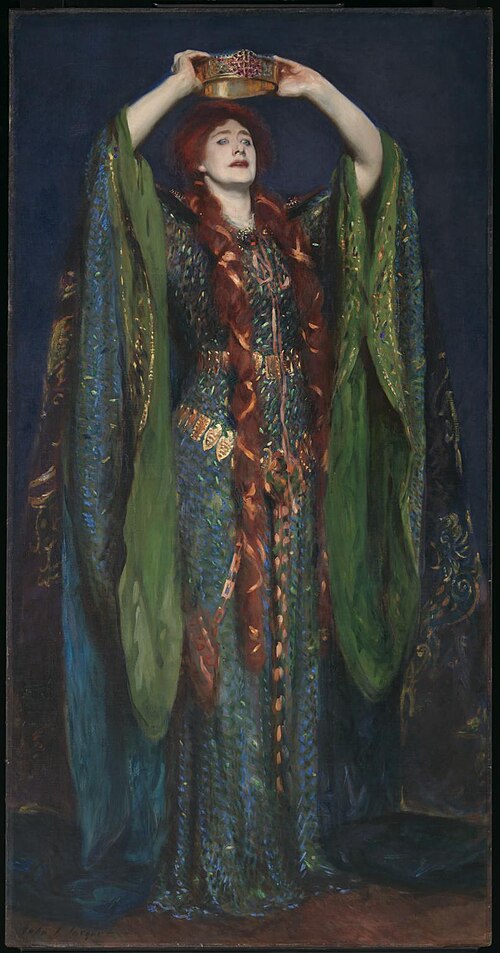
Queen Medb, a powerful, warlike woman who manipulates her husband and other men into violence, seems strikingly similar to Lady Macbeth. Lady Macbeth is painted as an unnatural villain because of how she exchanges gender roles with her husband; she is the politically interested, ambitious, and violent character, while Macbeth follows her commands. Lady Macbeth is the one to urge Macbeth towards his initial act of violence, sparking the plot of the rest of the play. She is a well-developed and complex character with much agency to develop her own character and the general plot, however, like Medb, she is a female character written in a time period that is not too forgiving of women.
Modern audiences may find sympathy with Lady Macbeth, but as she stands in her original play, she is a manipulative, monstrous personification of what women, by archaic standards, should not be. Her one moment of redeemable humanity comes in the form of her suicide, which is another instance of warning against too much female agency and implied to be a result of her becoming a hysterical woman. Again, like Medb, Lady Macbeth fails because she is a woman, specifically a woman who attempts to defy gender roles, and the narrative of her respective story prevents women who do not conform from achieving fulfillment. Lady Macbeth takes on the man’s role as an orchestrator of violence while retaining her femininity as a cunning manipulator of men. She performs a warped and demonized perception of womanhood that prevents her from either succeeding in her plot or fully redeeming herself.
“Medb is both a creator and a destroyer” (Lehmann, 148), but Lady Macbeth struggles to create. The fact that she and Macbeth have no children is essential to the plot; Macbeth has no heirs to succeed him as king. Furthermore, this fact influences the reading of Lady Macbeth as a woman outside of gender norms. If Lady Macbeth is implied to be an infertile woman, her character reads as something less than, as in, a woman who cannot perform what a patriarchal society expects of her. If she is implied to have had a miscarriage or otherwise had a child who died, she is then seen as a woman who failed at forming or raising a child. She says “I have given suck, and know / how tender ‘tis to love the babe that milks me” (1.7.61-62), which indicates that she has either had a child or nursed a child; in either case, it could point to her nature poisoning the child she nursed through her milk. Her aberrant female body is evident through her inherent nature causing her failure to perform a motherly role. Since she cannot create by giving birth, she then attempts to create through destruction by the killing of Duncan and the institution of Macbeth as king, but ultimately fails due to her nature as a woman and a “failed” woman. She is not meant to command her husband, or to commit murder, or to make outrageous choices at all, so her downfall must be the most violent and egregious choice she could make.
Macbeth’s witches are the other primary female characters in the play, and are similarly outside of traditional femininity. They are the weïrd or wayward sisters, and described as hags, otherworldly creatures, and possibly demons. Walter Clyde Curry claims that the three witches are physical manifestations of demonic entities, serving to tempt Macbeth into wickedness (Curry 397). He states that these demons take the form of women to be a more effectively frightening picture to Shakespeare’s audiences, as depictions of devils may have seemed comedic, while human women who have sold their souls to the devil were the subject of a genuine fear throughout Early Modern England. Banquo, upon first meeting the witches, says “are you fantastical, or that indeed / Which outwardly you show?” (Macbeth, 1.3.56-57) and “you should be women, / And yet your beards forbid me to interpret / That you are so” (1.3.47-49). The witches appear as uncanny women; they are not quite right, or not quite fitting into a preconceived perception of what a woman is. This aligns with the demonization of Lady Macbeth as a woman with whom there is something wrong. Just as Lady Macbeth influences her husband’s choices, the witches initiate the guiding force of the plot: Macbeth’s desire to become king and fear of his lineage ending. The female characters have too much agency and control over men, so they must be evil.
Curry suggests in his article that “certain aspects of Lady Macbeth’s experience indicate that she is possessed of demons” (Curry, 420), citing her monologue in act one, scene 5:
Come, you spirits
That tend on mortal thoughts, unsex me here,
And fill me from the crown to the toe top-full
Of direst cruelty. Make thick my blood.
Stop up th’ access and passage to remorse,
That no compunctious visitings of nature
Shake my fell purpose, nor keep peace between
Th’ effect and it. Come to my woman’s breasts
And take my milk for gall, you murd’ring ministers,
Wherever in your sightless substances
You wait on nature’s mischief.
(Macbeth, 1.5.47-57)
Curry’s assumption that Lady Macbeth must be possessed by evil spirits to be even capable of her actions throughout the play is indicative of the lack of agency associated with a character who has perhaps too much agency, as well as the tendency of male critics to demonize women who act in the male role. Many modern feminist retellings of Macbeth attempt to rework Lady Macbeth to give her more of a voice; this ignores the reality of Shakespeare’s play in which Lady Macbeth is a fully-realized female villain. She is a human, albeit exaggerated character who makes the active and continuous choice to commit and encourage violent acts, up to her violent demise. In a similar vein, picturing the witches as manifestations of demons creates another misogynistic perception of female Shakespearean characters. If the witches are read as solely physical representations of the devil and demons, then their uncanny, almost-right appearances lose the horror and their existence as women or women-like creatures who exert power over men is undercut.
The witches could, however, be read as something akin to fairies. The source text for Macbeth, Raphael Holinshed’s Chronicles of England, Scotland and Ireland refers to the characters that become the witches as “three women in strange and wild apparell, resembling creatures of elder world. . . either the weird sisters, that is (as ye would say) the goddesses of destinie, or else some nymphs or feiries, indued with knowledge of prophesie by their necromanticall science” (Holinshed, Macbeth, 211). While perceiving the witches as demons puts them in a fully evil role, reading them as goddesses of destiny, nymphs, or fairies reveals some moral ambiguity. The “goddesses of destinie” could refer to the Greek Fates, a trio of goddesses who control the fate or death of every mortal. These goddesses are not good or evil, they are simply a force of the gods and nature. “Nymphs or feiries” also implies a connection with the natural world, or “elder world.” Holinshed’s text does not imply that the witches are demons or devils sent to trick Macbeth into committing regicide, they are instead personifications of natural elements informing Macbeth and Banquo of the future. In Shakespeare’s play, the witches are presented as more aligned with wickedness and trickery. Their trochaic tetrameter verse is unnerving and unnatural, they seem to almost threaten Macbeth with their prophecies, and their repeated appearances throughout the play imply an interest in Macbeth and his downfall. In Ireland, near the end of and immediately after the Early Modern era, fairy belief was waning and an era of skepticism was rising, with many stories surfacing of what initially seemed to be the work of fairies instead being the work of a charlatan. This points towards an evolving perception of fairies, or the idea of fairies, as more malevolent beings or tricksters. Timothy Corrigan Correll, when discussing Irish Catholic fairy belief, says that “clergymen were also frequently depicted as proponents of belief” (6), pointing to associating fairy belief with religion, specifically Catholicism, and establishing priests and other religious leaders as moral people who consider fairies as they do demons: creatures that are to be believed in, but renounced as sinful.
Piotr Spyra claims that King James saw fairies as “one of the many manifestations of the devil in the world” (198), and that Early Modern English Protestants often conflated Catholicism with fairies and the supernatural. He cites Thomas Hobbes’ Leviathan, saying “This cleverly constructed political satire dismisses fairy belief, presenting it as a mere sham, a cultural and political subterfuge that serves to maintain the hold of Catholic heresies over the minds of the ignorant” (Spyra, 201). Thus, both fairy belief and Catholic tradition were demonized and discredited. A major point of reasoning for the dismissal of fairy and Catholic belief was their association with women. Fairy tales were referred to as “old wives tales” and discarded as foolish superstitions of women, while the Catholic-specific focus on honoring the Virgin Mary, female saints, and religious sisterhoods were viewed as too feminine for the Protestant faith, as Spyra discusses in connection to ideas expressed by Regina Buccola; he quotes her article, where she states that “in relegating all of these female figures or elements such as costuming and “decoration,” which were negatively linked to women in the culture at large, to Catholicism, Reform Christians in effect feminized the entire religion” (Buccola qtd. in Spyra, 169). With these ideas in mind, Lady Macbeth and the witches of Macbeth can be read as demonized women representative of the Catholic faith and fairy belief, two concepts conflated with each other and associated with women.
Lady Macbeth is by no means a whore figure in the virgin-whore dichotomy present in many depictions of women in literature, but she could certainly be interpreted as completely antithetical to the pure, chaste heroine trope of other Shakespearean women. Those characters, such as Cordelia in King Lear, Miranda in The Tempest, or Ophelia in Hamlet are more akin to the Virgin Mary. They are, of course, virgins, but also virtuous and typically innocent or naive. The plot and their respective character arcs revolve around their virtue, virginity, or general innocence; Cordelia is the most truthful and virtuous of her sisters, Ophelia dies unmarried and pure, and Miranda falls deeply into girlish love with the first eligible man she meets. Lady Macbeth is conversely characterized by her wickedness and incapability of performing a motherly role. She embodies the inverse of each typical heroine character trait, and the plot revolves around her evil acts. Connecting this to the idea of Protestant feminization of Catholicism in an attempt to discredit the faith, Lady Macbeth, as a wicked female character who controls and manipulates a man, could be read as a twisted depiction of the Virgin Mary and Macbeth as the members of the Catholic Church. Further, the witches could fit into this interpretation as representing female saints or nuns. Macbeth follows his wife’s every command in an almost worshipping manner, and listens to the advice of the witches with little questioning. Urged by these aberrant women, he usurps the throne, but is ousted by Malcolm, who is not only tied to the idea of the divine right of kings through royal blood, but also the superiority of Protestant England over Catholic Scotland and Ireland, as Malcolm flees to England and returns with an army to conquer Macbeth’s rule over Scotland.
Bryan Adams Hampton discusses at length the pervasive idea of purging in Macbeth, particularly through the many binaries presented in the play such as male and female, good and evil, civilized and uncivilized, supernatural and real, and “that which is sacred and that which is accursed” (Hampton, 328), as well as through the re-establishment of conventional values in the play’s conclusion. This idea can be applied in particular to how both Lady Macbeth and, to a lesser extent, Macbeth, are defeated. Lady Macbeth, as previously discussed, fails because she fails as a woman; she is too assertive, too powerful, too full of agency. When she dies, it is both a result of her choices and a demonstration of her return to conventional femininity. She is purged of her flawed and wicked nature through her guilt and hysteria, resulting in her suicide. Macbeth, who defers to his wife in matters of war, is re-established as a conventional man after his wife’s death, both in the events leading to his death and his actual death. He is king and in control, and his death comes through a violent battle with another man, notably, a man who “was from his mother’s womb / untimely ripped” (Macbeth, 5.8.19-20). Macbeth’s doom is Macduff, a man disconnected fully from womanhood. His death and failure to achieve his goals is masculine and a return to the conventional values of Protestant England because he dies in combat, to a man not “of woman born” (Macbeth, 4.1.91), and is replaced as king of Scotland by the rightful heir by blood supported by the English army.
Not only are these moments a return to conventional and patriarchal gender roles, but they are also a representation of English colonization of Scotland, forcing the Scottish people into English societal standards. Hampton states that the opening scene of Macbeth describes the Irish army of Macdonwald as “likened to vermin that have infested the household of Scotland” (Hampton, 333). Ireland and its predominant religion of Catholicism are associated with fairies, vermin, women, witches, and devils, while England and Protestantism are associated with kings, honor, men, warriors, and morality. In a similar vein, Donalbain flees to Ireland and is absent for the rest of the play, while Malcolm flees to England and returns in glory to succeed in battle and be crowned as king. Scotland is then caught between these two nations; it can either be viewed as wild, unnatural, and uncivilized like Ireland, or purged of its malignant qualities by the colonizing force of England. The nature of Lady Macbeth can be interpreted through this lens as well, particularly through her eventual doom. She can either be an unnatural and deviant woman, or a repenting, conventionally feminine woman. Macbeth depicts the Celtic nations and English colonization of those nations through the lens of demonization, feminization, and fictionalization. The Scotland of Macbeth is a wild place full of witches, fairies, and gender-nonconforming women who manipulate the natural world of men until the force of royal blood and the English army overpowers them, instating conventional order. The Ireland of the Táin is a separate world that Scotland must choose to reject in order to be purged of what Protestant England views as sinful and unnatural. Queen Medb may be confined to similar gender roles and eventual doom as Lady Macbeth, but she is afforded more victory in the end. She loses the battle, but gains the Donn Cuailnge and therefore, equal status with her husband. Just as the bull Ailill holds over Medb’s head is in actuality the calf of one of the cows in her herd, each interesting and violent act committed by Macbeth is conceived of by Lady Macbeth, an act of power and rebellion against colonization and the patriarchy.
Bibliography
The Ancient Irish Epic Tale Táin Bó Cúalnge. Translated by Joseph Dunn. London, 1914. Project Gutenberg. https://www.gutenberg.org/files/16464/16464-h/16464-h.htm Buccola, Regina. Fairies, Fractious Women and the Old Faith: Fairy Lore in Early Modern British Drama and Culture. Selinsgrove: Susquehanna UP, 2006.
Correll, Timothy Corrigan. “Believers, Sceptics, and Charlatans: Evidential Rhetoric, the Fairies, and Fairy Healers in Irish Oral Narrative and Belief.” Folklore 116, no. 1 (2005): 1–18. http://www.jstor.org/stable/30035235.
Curry, Walter Clyde. “The Demonic Metaphysics of ‘Macbeth.’” Studies in Philology 30, no. 3 (1933): 395–426. http://www.jstor.org/stable/4172210.
Friedman, Michael D. “Shakespeare and the Catholic Revenger: ‘V for Vendetta.’” Literature/Film Quarterly 38, no. 2 (2010): 117–33. http://www.jstor.org/stable/43797667.
Gluck, Victor. “Macbeth (an undoing).” Theater Scene, April 22, 2024. https://www.theaterscene.net/plays/macbeth-an-undoing/victor-gluck/.
Hampton, Bryan Adams. “Purgation, Exorcism, and the Civilizing Process in Macbeth.” Studies in English Literature, 1500-1900 51, no. 2 (2011): 327–47. http://www.jstor.org/stable/23028078.
Holinshed, Raphael. “Macbeth.” In Holinshed’s Chronicle as Used in Shakespeare’s Plays, edited by Allardyce and Josephine Nicoll. J. M. Dent and Sons LTD, 1927. Internet Archive. https://archive.org/details/holinshedschroni0000unse/page/n7/mode/2up.
Lehmann, Edyta. “‘And Thus I Will It’: Queen Medb and the Will to Power.” Proceedings of the Harvard Celtic Colloquium 28 (2008): 142–51. http://www.jstor.org/stable/41219620.
Reid, Ava. “Exclusive Cover Reveal + Q&A: Ava Reid Introduces Us to Her Thrilling New Take on Lady Macbeth.” Interview by Lacy Baugher Milas. Paste Magazine, December 20, 2023. https://www.pastemagazine.com/books/ava-reid/lady-macbeth-cover-reveal-interview-fic tion-feminist-retelling.
Shakespeare, William. Macbeth. Edited by Stephen Orgel and A. R. Braunmuller. The Complete Pelican Shakespeare, Second Edition. Penguin Random House, 2002.
Spyra, Piotr. “Shakespeare and the Demonization of Fairies”. Text Matters: A Journal of Literature, Theory and Culture, no. 7 (2017):194-213. https://research.ebsco.com/c/oyqk56/viewer/pdf/dcvm7zcvs5.

