Hazel Carroll
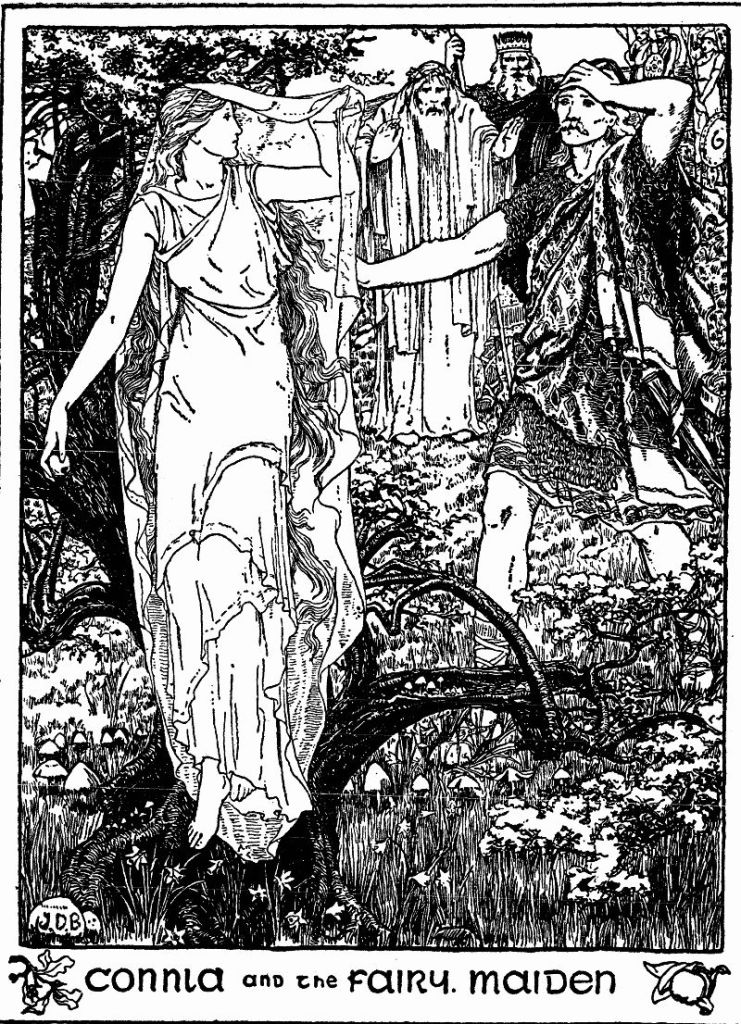
The Otherworld features at the center of both Immram Brain and Echtrae Chonnla, as is customary of both Immram and Echtrae tales. Both have also been the center of much scholarly debate over their Christian elements, in particular how they seem to deviate from other Immram and Echtrae tales around this topic. Immram Brain is seen as less ecclesiastical than other Immram tales and Echtrae Chonnla is seen as having heavier Christian elements than other Echtrae tales. One of the best ways to view these influences is
through comparison. This essay will seek to compare these two tales with others from both Irish and Welsh sources in order to better understand the way the Otherworld is defined and analyze potential Christian elements. The disclaimer must be made that it’s difficult to ascertain with certainty whether any particular aspect of a tale is Christian or pagan as there exist no pre-Christian sources for either Irish or Welsh tales. For ease of comparison, this essay will attempt to break down the depictions of the Otherworld in Immram Brain and Echtrae Chonnla into three main categories: space, time, and morality. This structure is borrowed from John Carey’s ‘Time, Space, and the Otherworld’, which aims to define the main features of the Irish and Welsh Otherworld, thus, as the definition is divided in such a way, the comparison will be as well (1987). As these three categories don’t cleanly encompass all aspects of the depicted Otherworld that are worth comparing, any outlying details will be included in the section that best fits.
As previously stated, one of the motivating factors for scholarly comparisons of depictions of the Otherworld in early Irish and Welsh tales, beyond establishing a definition, is to attempt to determine the impact of Christianity on the earlier pagan stories, as well as potentially date the story itself. Immram and Echtrae tales both have to do with someone going on a voyage and are similar enough when simply described that they are often compared, but they can be very different in their approaches (Dumville, 1976, 73-4). Echtrae tales, which translates to ‘an outing’ tales, depict a hero journeying into the Otherworld. The Otherworld itself as a space may not necessarily be depicted, in Echtrae Chonnla it is only ever described, but the presence of a supernatural realm as destination is important (Dumville, 1976, 73). It is partially because of this that Echtrae tales are seen as having distinctly pagan origins. In contrast to the Echtrae tales’ lack of emphasis on the journey itself, Immram, or ‘rowing-about’, tales feature an episodic series of events, usually including island hopping, preceded by a motivating introduction and proceeded by a conclusion (Dumville, 1976, 75). The journey is a penitential one taken in response to some sinful act, as in Immram curaig Máele Dúin where the titular Máele Dúin pays for the murder of Fiachu mac Domnaill at the hands of the Men of Ross, as well as for the rape of a nun which resulted in his birth (Hillers, 1993, 69). Immram tales are often seen as the more ecclesiastical of the two, potentially taking influence from the many sea pilgrimages of the period (Hillers, 1993, 68). Barbara Hillers argues that, despite this, Immram tales may still be based in pre-Christian storytelling motifs and that it’s notable that they aren’t frequently used in anti-nativist arguments (1993, 69). This runs counter to David Dumville’s, himself not necessarily an anti-nativist, assertion that the Immram tales are likely entirely ecclesiastical in origin, though they may draw from secular Irish sources (1976, 76-7). Immram Brain in particular is given as an example of an Immram tale that stands out, as it doesn’t fit neatly into the ecclesiastical framework of other Immram tales. There is an earlier copy of the tale which was deemed by scholars to be an Echtrae rather than an Immram which may help explain this discrepancy (Dumville, 1976, 87-8). Whether the Immram tales are solely ecclesiastical in origin or not, both forms provide good examples of ways in which the Otherworld was represented in a Christian context.
The space in which the Otherworld appears in Welsh and Irish tales is often characterized by sacred or otherwise significant spaces (Carey, 1987, 5). In Echtrae Chonnla, the fairy woman appears to Connla and his father while they are sitting on the Hill of Usnech, which is, as the fairy woman explains, a fairy mound, though it is clear the Lands of the Living, or Mag Mell, where she hails from is not the same mound as the Hill of Usnech (Cross and Slover, 1936, 488). This event has several things in common with other depictions of the Otherworld across Irish and Welsh tales. The most obvious is the way it parallels Pwyll’s first meeting with the lady Rhiannon in the first branch of The Mabinogion. Like Connla, Pwyll sits on top of a significant hill, Gorsedd Arberth, which was said to deliver either a wound or something wonderful upon the nobleman that sat on it, and Rhiannon, a supernatural woman, rides out of it (Davies, 2008, 8). The fairy woman in Immram Brain appears within the significant space of the royal household, emphasizing the importance of nobility when interacting with the Otherworld (Cross and Slover, 1936, 588). Bran, Pwyll, and Connla are all of the nobility, likewise those they meet in the Otherworld are also nobility. The woman Bran speaks to is insinuated to be the chief of the Land of Women, Rhiannon is daughter of Hyfaidd Hen, who is lord of his court, and the woman who Connla meets describes herself as ‘a young and beautiful woman of noble descent’ (Cross and Slover, 1936, 488, 595)(Davies, 2008, 11).
The space of the Otherworld is also characterized by geographic anomaly (Carey, 1987, 7). Though Carey was referring to the stretching and flattening of distance and time when he wrote about this aspect, a person walking out of a hill would also be considered a geographic anomaly. Connla does experience this flattening of distance and time, the woman says that Mag Mell ‘is far we [but] may reach it before night’ (Cross and Slover, 1936, 490). In Tochmarc Becfhola, Becfhola seemingly walks from Dubthor Lagen to an island approximately a hundred miles away (Carey, 1987, 3). While in Welsh tales, the Otherworld tends to be happened upon incidentally, such as when Pwyll first enters Pen Annwn in the first branch of The Mabinogion or when the surviving warriors of the second branch of The Mabinogion enter the Otherworld on their journey after the death of Bendigeidfran, the Irish Otherworld is often depicted as distant islands, though Carey notes this as controversial (Davies, 2008, 3, 32)(Carey, 1987, 1). Indeed, both Echtrae Chonnla and Immram Brain feature islands as lands of the Otherworld, though the island in Echtrae Chonnla is only implied. In fact, the description given of Connla’s isle, that ‘No other sex lives there/Save women and maidens’ may imply that it is a similar island or even the same island as the Land of Women in Immram Brain (Cross and Slover, 1936, 490). Immram Brain, after all, is not the only Irish tale to feature the Land of Women, Immram curaig Máele Dúin features the same isle, as well as the ‘Island of Joy’, creating a sense of consistency of place (Hillers, 1993, 74). Similarly, the ‘Mag Mell’ mentioned in Echtrae Chonnla seems to be a common term for the Otherworld among other early Irish tales (Dumville, 1976, 79-80). To acknowledge some Christian implication, the islands present in the Immram may also represent ‘terrestrial paradise’ featured in apocryphal texts that had developed in ecclesiastical thought (Dumville, 1976, 79).
Much like distance, time in the Otherworld in anomalous. It, too, is stretched and flattened so that the hero may have no idea when they may return to their home. They may, like Becfhola, travel a hundred miles away and return home to realize no time has passed at all (Carey, 1987, 3). More frequently, someone will enter the Otherworld and return home hundreds of years later. This travel in time may also lead to their death if they break a set taboo. Taboos are common within Otherworld stories and often lead to the hero being forced to leave the Otherworld (Davies, 2008, 236). This occurs in the second branch of The Mabinogion when the warriors sheltering in the Otherworld open the door toward Aber Henfelen and promptly must then leave for home, much like Becfhola, when they leave no time seems to have passed (Davies, 2008, 34). The taboo in these temporal instances of many years passing tends to do with touching the land. Much like in the legend of Oishín, when Bran’s men return to Ireland after their journeys to the Land of Joy and the Land of Women, one of them touches the land, against the advice of the Otherworld women, and promptly turns to ash. This occurs despite that their perception of time while on the island was that only a year had passed (Cross and Slover, 1936, 595).
The Otherworld also operates in a perpetual, past Golden Age (Carey, 1987, 8). In this way, everything is held in a form of stasis. The people there do not age or change, even the food magically regenerates after it has been eaten. In Echtrae Chonnla, Connla is given an apple by the fairy woman as she departs, it is said that ‘what he ate of the apple never diminished it, but it remained always unconsumed’ (Cross and Slover, 1936, 489). The apple is then able to sustain him for a month, perhaps granting him a bit of this sense of stasis. A similar event occurs in Echtrae Cormaic, in which a log is burned and a pig is eaten, but both are restored the morning after they are destroyed (Carey, 1987, 11). This theme of a perpetual Golden Age, particularly one that’s past, has its echoes in Christian thought. Carey explains that one theory of the Otherworld views those who dwell there as Unfallen and so untainted by Original Sin (Carey, 1987, 8). This is why they may live forever young and beautiful, for they never had to be punished with death and decay.
As the Otherworld exists in this perpetual Golden Age, it also represents a model of a perfect realm (Carey, 1987, 13). It is a place, as the woman in Echtrae Chonnla puts it, ‘where there is neither death nor want nor sin’ (Cross and Slover, 1936, 488). It is a kind of utopia where there is ‘neither mine nor thine’ (Mac Cana, 1976, 114). Insinuating a communal way of living driven by abundance. This is, of course, disproven, as the Otherworld seems to reflect the ordinary world’s contemporary structures of nobility. In many ways this perfect realm is a Christian one. The fairy women in both Immram Brain and Echtrae Chonnla recite lines which foretell the coming of Christianity, with the woman in Immram Brain specifically foretelling the coming of Christ (Cross and Slover, 1936, 490, 591). The people in the Otherworld are eternally beautiful, not aging or otherwise decaying in any way, which is reminiscent of the promise of the resurrection; or, if following the line of reasoning that those in the Otherworld are Unfallen, that there was no need for resurrection for they were always without sin. There is also the abundance of food and lack of want. In many ways it parallels the Garden of Eden, up to and including a taboo which, if broken, will result in the banishment of those visitors from the Otherworld. In the case of Bran’s man in Immram Brain, it directly results in his death, which is the punishment for Original Sin.
While the Otherworld is a form of perfect realm, it may also be an inversion of the standard social order (Mac Cana, 1976, 108). This is in particular regards to sexuality and heavenly chastity. Though the ideas of lust and greed are renounced by Manannán mac Lir in Immram Brain during his description of the Otherworld, sex is framed as something that not only occurs but is common.
A beautiful game, most delightful,
They play sitting at the luxurious wine,
Men and gentle women under a bush,
Without sin, without crime.
(Cross and Slover, 1936, 592)
His explanation for how men and women can have sex without sin is in line with the thought that those who dwell in the Otherworld are Unfallen, for he says that they are from ‘the beginning of creation’ (Cross and Slover, 1936, 593). However, this sense of unconcern about sex and chastity is frequently found in what are considered traditional early Irish texts (Mac Cana, 1976, 106). Proinsias Mac Cana explores and emphasizes this, saying that ‘notwithstanding the palpable Christian motivation of the authors of Immram Brain and Echtrae Chonlai, their image of the Otherworld is essentially a traditional one in which the Christian notion of heavenly chastity has as yet no function’ (Mac Cana, 1976, 114). The ending of Carey’s essay, as well, is devoted to the comparison of the Otherworld to traditional pagan rituals. These are, the site of the entrance to the Otherworld being a sacred or significant spot, the Hill of Usnech in Echtrae Chonnla and the royal house in Immram Brain; the Otherworld being a land of feasts, characterized by the ever regenerating apple; and a ‘freedom from sexual anxiety’ characterized by the freeing of sex from sin (Carey, 1987, 13-15).
While the Otherworld of both Immram Brain and Echtrae Chonnla feature Christian elements, as do most depictions of the Otherworld from other Welsh and Irish sources, the main aspects remain consistent with other early Irish and Welsh tales which have been deemed traditional. Immram Brain in particular was deemed so different from other Immram tales in its lack of an ecclesiastical focus, that when an earlier source for the tale was discovered, it was categorized as an Echtrae tale. Both feature women from the Otherworld appearing at sacred spaces, and the Otherworld itself as distant islands, consistent with other Irish tales. The location itself is simultaneously both very near and very far, as evidenced by the woman in Echtrae Chonnla that ‘although it is far we may reach it before night’ (Cross and Slover, 1936, 490). Time, as well, is stretched and flattened as is customary, when Bran and his men return to Ireland after their journey they discover that enough time has passed to make them the stuff of legend. Alongside this is the regeneration of food that is a common aspect of the Otherworld. Lastly, the utopian Golden Age of the Otherworld, though it parallels Christian elements such as the Garden of Eden, is also consistent across other contemporary tales. Ultimately, the Otherworld of Immram Brain and Echtrae Chonnla maintains the definition of the Otherworld set forth by other tales, providing an example of how the Otherworld was understood within a Christian context.
Bibliography
Carey, J.: ‘Time, Space, and the Otherworld’, Proceedings of the Harvard Celtic Colloquium vol. 7 (1987), 1-27.
Cross, T. P. and Slover, C. H.: Ancient Irish Tales (1936, reprint Barnes and Noble
NY).
Davies, S.: The Mabinogion (2008, Oxford University Press UK).
Dumville, D.: `Echtrae and Immram: some problems of definition’, Ériu vol. 27
(1976), 73-94.
Hillers, B.: ‘Voyages between Heaven and Hell: Navigating the Early Irish Immram Tales’, Proceedings of the Harvard Celtic Colloquium vol. 13 (1993), 66-81.
Mac Cana, P.: `The sinless otherworld of Immram Brain‘, Ériu vol. 27 (1976), 97-115.

