Gwynn Maitlen
“19th Century European Art” is a simple term for a broad subject. The 1800’s contained many art movements that explored vastly different stylistic traits and meanings, such as Classicism and its emphasis on rational thought, or Romantic Landscape painting and its emphasis on the divinity of nature. Despite their differences, though, there is one clear consistency between 19th Century art movements: exoticism and the non-Western “Other.” This fascination is perhaps most visibly illustrated in the works of Paul Gauguin. His ultimate goal was to find a society made pure by its simplicity and primitiveness to depict in his art, and Tahiti was the society that met his criteria.
There is debate between art historians about Gauguin’s intentions when he depicted Tahitian culture in his art, as well as the attitudes he held towards their society and people. Certain art historians, such as Gill Perry, believe that Gauguin fetishized Tahitian culture and exploited Tahitians for his own gain and fantasy. Others, like Stephan Eisenman, believe that though Gauguin had a questionable motive, his art showed the beauty of Tahitian culture in a time when it was being suppressed and forcibly erased. While both Perry and Eisenman’s interpretations hold merit, this paper will argue that Perry ultimately has a more accurate analysis of the motivations and ideologies behind Gauguin’s art. Even if the painter’s love of Tahitian culture came from a genuine place, he told the stories of the native Tahitians through his voice; the voice of a colonizer.
In “Primitivism and the ‘Modern’,” Perry discusses Gauguin’s “primitivism,” or, “his tendency to seek to represent, and to idealize, a supposedly uncivilized culture.”The point that Perry brings up is that Gauguin didn’t interact with the authentic culture of Tahiti and seek to understand its people, his opinions were based on the Western viewpoint of how Tahitian culture functioned. Since European explorers first landed on Tahiti, nearly all of the works published on Tahiti described its inhabitants as “a handsome, peaceful race, pursuing sensual pleasures,”and the island itself as “an unspoilt Eden.” The West portrayed Tahitians as blissful in their simpleness, and Gauguin echoed this sentiment in his writings. This simplicity, and the supposed sensual nature of Tahiti’s exotic culture, is why Western critics were so interested in Gauguin’s art.
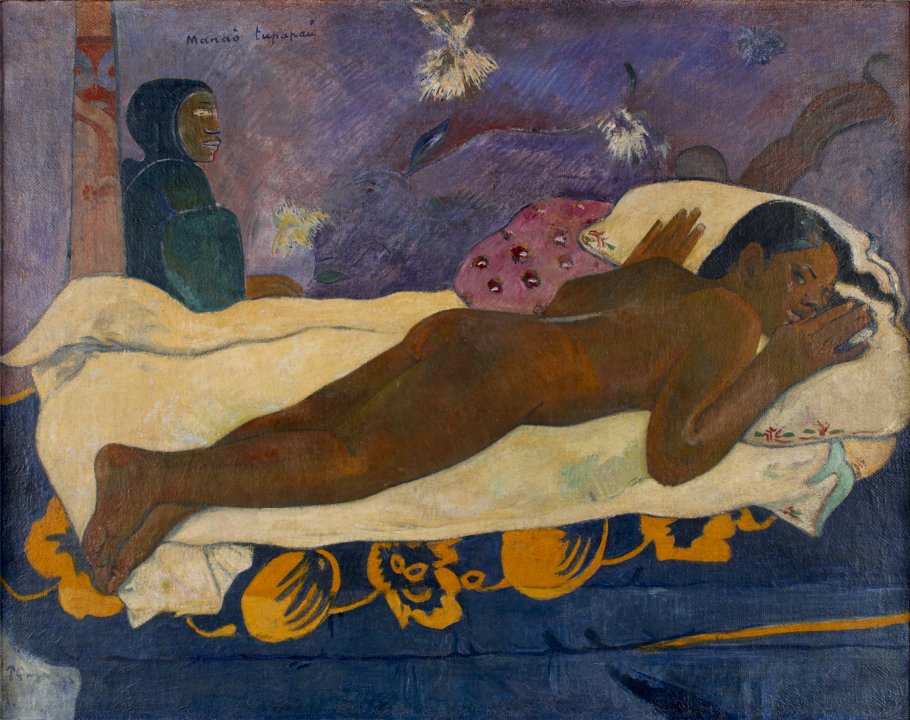
The painting that best exemplifies Perry’s view on how Gauguin infantilized Tahitians and their culture is Manaò tupapaú, or, Spirit of the Dead Watching. The inspiration for this piece was supposedly from when Gauguin returned to his home after a night of drinking, and found that the light in the hut had gone out. His young Tahitian lover, Tehura, was lying on the bed, naked, in “a state of superstitious terror.” The entity that Tehura was afraid of was a tupapau, an evil water spirit prevalent in Tahitian mythology. The way that Tehura is depicted with her back exposed turns her into a vehicle for all of Tahiti: naive, vulnerable, and ripe for the taking. The angle that the viewer sees the painting looks down at her, as if symbolizing the idea of rational Western power over the irrational non-Western savages. Perry argues that this idea plays into the narrative Western audiences are interested in seeing from exotic pieces. They are allowed to view the simplicity of the exotic from a safe distance, and feel empowered because of their intellectual superiority.
While Gauguin’s depiction of the “primitive” seems to be the main reason his art is so appealing, he also incorporated many symbolic references – a connection to a “sophisticated literary culture” that seemed to go against his values of primitive purity. The style of Manaò tupapaú is radical, but its subject matter is not. It’s clear that Gauguin pulled inspiration from other artistic depictions of female nudes, such as Manet’s Olympia. Even though his style is radical, he uses the decorations on the bed and rich color scheme to echo the “rhythmic compositions of Symbolist painters such as Bernard or even Puvis de Chavannes.” Gauguin intentionally uses this familiarity to secure the radicalness of his style as an offshoot of Manet’s legacy of “western anti-academic” art and complement the West’s budding interest in the exotic to make his paintings all the more appealing.
Though the evidence that Gauguin exploited Tahitian culture for his own gain seems damning, Eisenman provides evidence for a different perspective. He admits that Gauguin’s character could be questionable at times, yet he was a vocal advocate for indigenous rights. In 1903, Gauguin wrote a letter in support of Polynesian rights to the French colonial government that could very well have “jeopardiz[ed] his own life in the Marquesas.” Additionally, Gauguin titled all of his paintings in Tahitian, thereby helping to preserve a language that was being banned and erased. Eisenman argues that this shows Gauguin had sympathy for the plight of the Tahitian people and that his efforts were not self-centered.
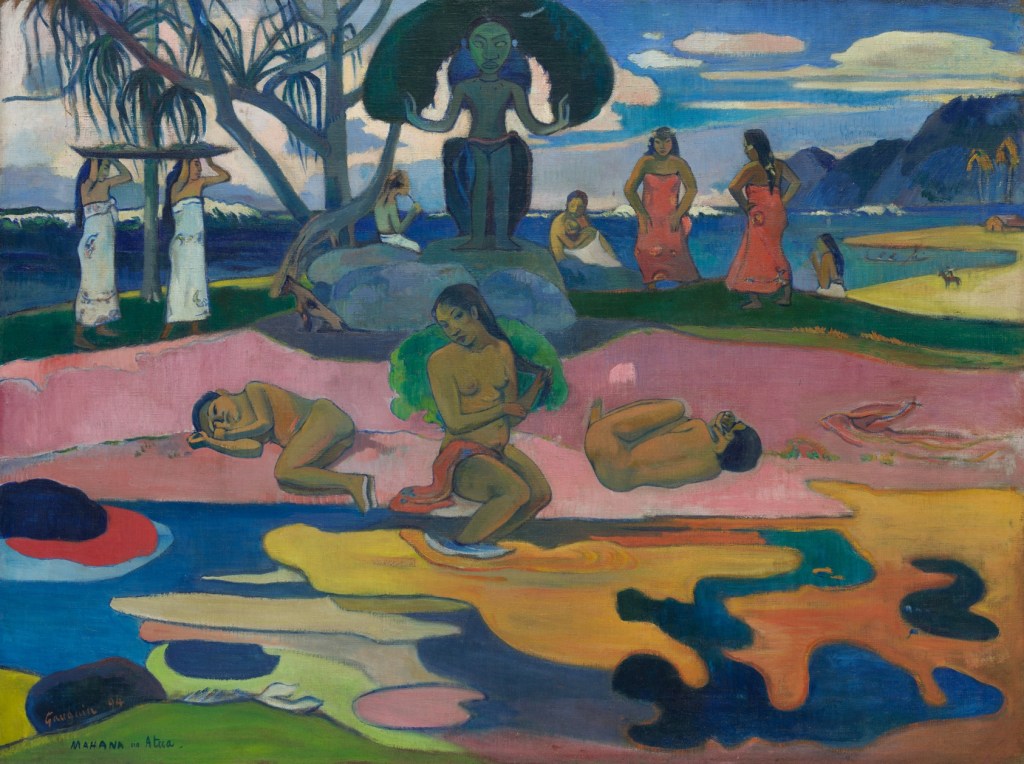
Out of Gauguin’s works, Mahana no atua, or Day of the God, best illustrates Eisenman’s view of the artist’s attitude towards Tahitian society. The painting itself is a patchwork of religious and artistic traditions “juxtaposed, without hierarchy or favor.” Gauguin divides the scene into three distinct sections.
In the background section, “naturalistically depicted” men, women, and children engage in traditional dances and activities that were banned by the French government. In the center is a large statue of a deity whose imagery pulls from “Easter Island mega-liths, Buddhist figures from the temple of Borobudur in Java, and the feminine Tahitian deity Hina.”In the middle section, there are three prominent figures; two of ambiguous gender and one decidedly feminine. The two on the ends lie facing away from the viewer in fetal position, while the woman in the center gazes directly forward as she sits “posed in a graceful contrapposto”reminiscent of classical painting. These figures represent the cycle of birth, life, and death. The foreground section consists of a mystical pool made of a “jigsaw-puzzle pattern”of colored shapes. Gauguin’s choice to supplement the typical colors of water for these vibrant, defined patches of color is a clear break away from the traditional Western standards of naturalistic coloring in painted pieces, regardless of style. Eisenman argues that this abstract lower third functions as a “Polynesian antipode to the illusionistic, European manner seen in the two upper registers.”The juxtaposition of the abstract and the realistic, or, the non-Western and the Western, serves to show the cultural conflicts Tahitians were experiencing at the time. With his usage of color in Mahana no atua,Gauguin liberates the painting “from the slavish labor of illusionism”while implying the same freedom must be given to the Polynesian people.
Aspects of both Perry and Eisenman’s analysis of Gauguin’s attitude towards Tahitian culture hold genuine merit. It is clear that the artist truly had a love for the culture and the people, but that love does not disqualify him from applying Western bias to his interactions with Tahiti. For this reason, Perry’s critical viewpoint on Gauguin’s objectification of Tahitian culture is supported as the more accurate perspective. Gauguin originally came to Tahiti to find a primitive and pure society, but once there, he also was enticed by the “sensual native women” Western explorers had often described. This interest can be easily seen in his art, as the figures he paints are primarily women. When men are featured in his work, they’re typically relegated to the sides while female figures are the focus. This trend of female dominated imagery in Gauguin’s art is actually quite common for European exoticism. Non-Western cultures were, and still are, often feminized as an attempt to demean them. This correlation can also be tied to how femininity is associated with nature — and therefore the “Other” — in Western culture, so “‘feminine’ Nature” gets pitted against “‘masculine’ Culture.” The misogyny prevalent in European society, in conjunction with feelings of Western dominance, was used as a kind of propagandistic tool to create a sense of security for Europeans; security in the fact that non-Western cultures were too weak to push back against Colonial authorities.
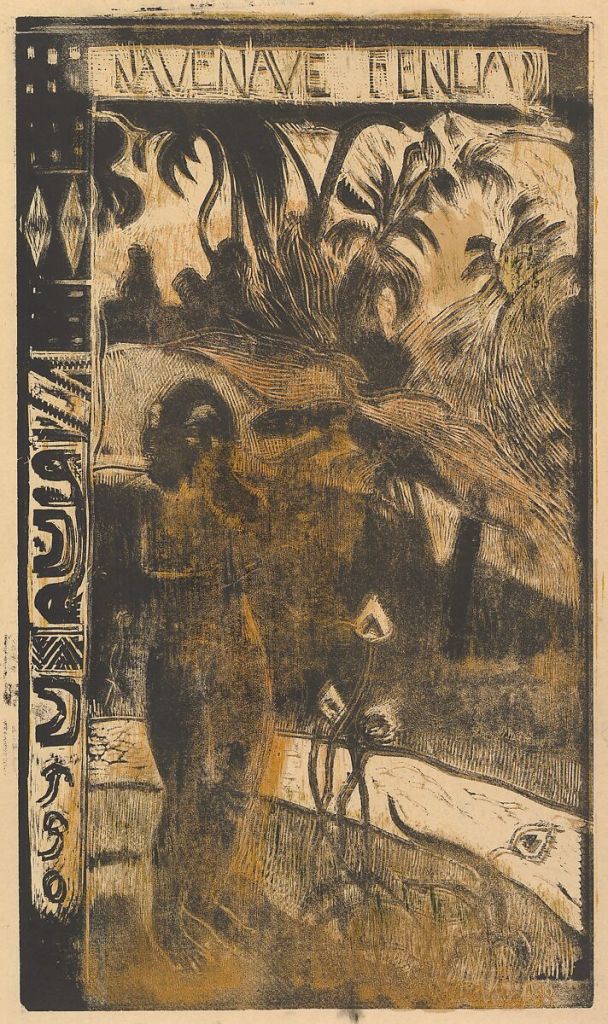
Gauguin not only exemplified the feminization of Tahiti in his art, he practiced it in his day-to-day life. Tehura, who is the figure in Manaò tupapaú and whose birth name is Teha’amana, was supposedly both a lover and a muse to Gauguin. He used her face as a reference for many of his works, a primary example being Te Nave Nave Fenua,25 or Delightful Land. According to Gauguin, they met when she was 13 and married the same day. To use Tehura as both an artistic muse and a sexual partner when she was roughly 1/4th of his age proves that Gauguin did not view Indigenous women as anything other than beautiful tools for his art, especially seeing as the paintings for which he used Tehura as a model depict her as nude, vulnerable, scared, or all three at once. Tehura’s wellbeing and consent were of no interest to Gauguin; her exotic primitive beauty was all he desired.
This pattern in Gauguin’s behavior is best seen in Te Nave Nave Fenua. When observing the imagery in this piece, it’s easy to see that Gauguin was selective in his Tahitian inspirations. The scene portrayed in this painting was recreated over and over by him; it is “among the most frequently elaborated of all his images.” The image itself depicts a nude female figure standing in a lush tropical paradise. The woman looks away from the viewer, almost secretively, as she reaches to pick a flower, and a “winged lizard” whispers into her ear. The woman is painted in a more naturalistic fashion while the background is abstracted, so she stands out as the focal point. This scene draws a parallel to a familiar subject in many Western paintings: the temptation of Eve. In fact, Gauguin “borrowed the composition from the 1890 canvas Eve exotique (Exotic Eve).” The background details, though, are rooted in Tahitian landscape and motifs, such as the abstract shapes on the left side of the painting that “loosely resemble the tapa (bark-cloth) designs Gauguin had seen in Polynesia,” or how the snake typical to a depiction of Eve is substituted for a winged lizard because there are no snakes in Tahiti. This superimposition of a Western religious theme over Tahitian imagery serves to Christianize Tahitian culture, something that Gauguin was against, at least verbally. Despite his supposed desire to preserve Tahitian culture, Gauguin’s work implies otherwise, as he cannot help but tell Tahitian stories through a Western lens.
Another example of Gauguin’s fetishization and feminization of Tahitian culture can be seen in his painting, Two Tahitian Women. Similarly to Te Nave Nave Fenua, the focal points of the piece are the bodies of Tahitian women. These two naturalistically painted women stand in front of an abstracted background of green and yellow colors, most likely representing foliage. Both of the women wear skirts, but their breasts are exposed to the viewer. The woman on the left is holding a platter of succulent tropical fruit level with her breasts, implying that she is a resource to be consumed just as the fruit is. Neither woman looks at the viewer. Gauguin, in his writings on his Tahitian works, was very clear that “children represented a lost and earnestly sought natural innocence, so indigenous women were associated in [his] mind.” This association is quite obvious in Two Tahitian Women. Both women’s features are intentionally painted to look youthful and innocent, and the way they bashfully look away from the viewer while displaying themselves shows an odd contrast of naiveté and sexual awareness. Gauguin uses bright colors to highlight the lush and fertile environment of Tahiti, and by extension, the exoticism and fertility of the women. Gauguin is heavily biased in his perception and depiction of Tahitian culture due to his attraction to the exotic as well as the colonialist tendencies he exhibits.
Gauguin evidently admired and had affection for Tahitian culture, but this admiration came from a perspective of assumed superiority. Gauguin viewed Tahiti as a place for him to explore his infatuation with the “primitive,” and only wanted to protect it in order to keep his artwork and career safe. Of course, we will never know the intricacies of the artist’s ideologies on the island and its people, but by dissecting his paintings and published books, the most well supported viewpoint is that Gauguin valued Tahiti for its physical and intellectual resources over the well being of its people.
Bibliography
Eisenman, Stephan F. Nineteenth Century Art: A Critical History. New York, New York: Thames & Hudson Inc., 2019.
Gauguin, Paul. Mahana no atua, 1894. Oil on linen canvas, 68 × 91 cm; Framed: 87.7 × 110.5 × 6.4 cm. Chicago, Art Institute of Chicago. Accessed January 23, 2026. https://www.artic.edu/artworks/27943/mahana-no-atua-day-of-the-god.
Gauguin, Paul. Manaò tupapaú, 1982. Oil on jute mounted on canvas, 73.02 x 92.39 cm; Framed:
115.89 x 134.78 x 13.33 cm. Buffalo, Buffalo AKG Art Museum. Accessed January 23, 2026. https://buffaloakg.org/artworks/19651-mana%C3%B2-tupapa%C3%BA-spirit-dead-watching
Gauguin, Paul. Te Nave Nave Fenua, 1982. Oil on canvas, 91.3 x 37 cm. Kurashiki, Ohara Museum of Art. Accessed January 24, 2026. https://www.ohara.or.jp/collection_detail/?product_id=70
Gauguin, Paul. Two Tahitian Women, 1899. Oil on canvas, 94 x 72.4 cm. New York, Metropolitan Museum of Art (Met). Accessed January 24, 2026. https://www.metmuseum.org/art/collection/search/436446
Manet, Edouard. Olympia, 1863. Oil on canvas, 130.5 x 191 cm; Framed: 177.5 x 239 cm. Paris, Musée d’Orsay. Accessed January 24, 2026. https://www.musee-orsay.fr/en/artworks/olympia-712
Perry, Gill. “Primitivism and the ‘Modern’.” In Primitivism, Cubism, Abstraction; The Early Twentieth Century. New Haven: Yale University Press, 1993.
Wright, Alastair and Brown, Calvin. Gauguin’s Paradise Remembered: The Noa Noa Prints. New Haven: Yale University Press, 2010.

