Ezra Alpasan
John Steinbeck’s Of Mice and Men is an indisputable addition to the American literary canon, one that found its place through the kaleidoscope of American perspectives that it provides. From topics like the American Dream, misogyny, loneliness, and race relations, Of Mice and Men is situated at the center of literature concerned with “the haves and have nots” (Meyer ix). Despite the prevalent disabled population in the book, disability is seldom explored in its scholarship. It is right in front of our faces, yet invisible. An even less obvious approach to Of Mice and Men is through monster theory, which relies heavily on and works in tandem with a disability studies perspective. The literary monster and the disabled character are both constructions based on cultural fears, and the monster is often characterized by qualities that would mark them as disabled in the material world. The monster is fundamentally deformed, insane, deviant. When we see a monster we see disability, and when we see disability we see a monster. The conjunction of monster theory and disability studies provides a sometimes positive and sometimes negative understanding about disability in the real world. Bringing these two approaches together highlights the inescapable ambiguity of disabled identity and its representations. In my paper, I argue that in John Steinbeck’s Of Mice and Men, Lennie’s disability is used to facilitate his animalization and subsequent monsterization, revealing unstable conceptions around both disability and the monster.
Lennie’s introduction to the story through his physical description sets the tone for a nonhuman understanding of Lennie: “The first man was small and quick, dark of face, with restless eyes and sharp, strong features. Every part of him was defined: small, strong hands, slender arms, a thin and bony nose. Behind him walked his opposite, a huge man, shapeless of face, with large, pale eyes, with wide, sloping shoulders; and he walked heavily, dragging his feet a little, the way a bear drags his paws. His arms did not swing at his sides, but hung loosely” (Steinbeck 2). The “shapeless[ness]” of Lennie’s face comes just a few sentences after the mention of the “shapeless hats” worn by the duo, relegating Lennie to the world of objects (2). Lennie’s bear-like appearance is juxtaposed against George who is clearly “defined” as human (2). The differentiation between George as human and Lennie as something other than human is essential to the making of Lennie as an animal, and later as a monster.
Lennie’s affinity for animals places him further into the category of animal, and as he contends with that kinship he loses the hold he has on his identity. The pleasure he derives from petting animals is a characteristic that also shapes his ambiguous intellectual disability. But his early characterization also includes a squabble between George and Lennie concerning Lennie’s desire to keep a dead mouse. In the midst of it, Lennie’s behavior is once again attributed to an animal: “George’s hand remained outstretched imperiously. Slowly, like a terrier who doesn’t want to bring a ball to its master, Lennie approached, drew back, approached again. George snapped his fingers sharply, and at the sound Lennie laid the mouse in his hand” (Steinbeck 9). Lennie’s reluctance to part with the dead mouse is one that is fueled by a subconscious understanding of his place in society. George and Lennie share an understanding that animality is associated with a lack of control, and it is when Lennie loses autonomy at different points throughout the novel that his actions leave him appearing more like a monster than an animal. He seeks a sense of connection with mice, one that he is hard pressed to find with other humans. But if he completely accepts the animal label, he will completely give up the chance to integrate into society. George, Lennie’s lifeline to humanity, reminds him what is at stake if he does not reject animality, telling him: “‘But you ain’t gonna get in no trouble, because if you do, I won’t let you tend the rabbits’” (Steinbeck 16). Lennie’s long-held desire to mind the rabbits is part of a dream he shares with George to work toward the creation of a home sustained by the work they put into it. Here, George suggests that if he falls further into an animal nature, he will lose the privilege of power afforded by dominance over animals. By presiding over animals and being tasked with the responsibility of their care, Lennie can play the role of the human. But the control required for that job is something Lennie lacks. Though he cares for the animals, he repeatedly puts them in harm’s way, blurring the line between predator and prey. This same lack of control bleeds into his interpersonal relationships, making him a monster among humans.
This understanding of Lennie’s identity creates a bridge between disability studies and monster theory, particularly in relation to Jeffery Jerome Cohen’s “Monster Culture (Seven Theses)”. Cohen’s seven theses on monster culture provide a framework for the cultural understanding of a monster, one that fits Lennie almost perfectly. Thesis III states that “The Monster is the Harbinger of Category Crisis” (Cohen 6). The monster refuses “to participate in the classificatory ‘order of things’…they are disturbing hybrids whose externally incoherent bodies resist attempts to include them in any systematic structuration. And so the monster is dangerous, a form suspended between forms that threatens to smash distinctions” (Cohen 6). This is exactly what begins to happen as Lennie juggles between the world of animals and the world of humans. And perhaps it is that middle space, the void between worlds, that morphs him through the eyes of others and through his own, into a monster. Cohen says that “the monster always escaped to return to its habitations at the margins of the world” (Cohen 6). This existence on the outside, on the edges, is something that is foreshadowed right at the beginning, when George tells Lennie to “‘[h]ide in the brush’” if there was any trouble. Though only a quarter mile away from where the rest of the story takes place, this brush is culturally situated much further away. George gives Lennie these instructions as a way of protecting him, but he also inadvertently creates a place where Lennie can be banished quite literally to the outskirts of society, a verdict that puts the last nail into the monster-shaped coffin.
Lennie’s struggle to balance the animal and human culminates in the death of his puppy, and the murder of Curley’s wife, moments that make him a monster in the eyes of men and animals alike. George provides many chances for Lennie to prove his personhood, and the others residing in the bunkhouse give him the same benefit of the doubt. But despite how hard Lennie tries to fit himself into one category, he loses control of his actions, one instance being the crushing of Curley’s hand: “Curley’s fist was swinging when Lennie reached for it. The next minute Curley was flopping like a fish on a line, and his closed fist was lost in Lennie’s big hand” (Steinbeck 63). In this moment of domination, Lennie renders Curley into an animal, but this transformation is also informed by the simultaneous disabling of Curley. Though this grab at power would ordinarily give Lennie access to the human world, his lack of control of his actions turns him toward animality. But because his actions make Curley an animal, an act of violence against another animal and the lack of control involved puts Lennie between the unopened doors of the animal and human worlds. He must exist outside of the two distinctions, in the vastness of the outside. Instead he must be placed in that unsavory third category, the one that is both in between and outside. Throughout this scene, Steinbeck oscillates between calling Lennie’s hands “paws” and “hands,” as well as shifting between bear characteristics and sheep characteristics (Steinbeck 63). This refusal to make Lennie either a big predator or a small prey reflects the same struggle to categorize him. Catherine Pugh’s essay follows similar themes around disability and control. She notes that: “[disability] represent[s] a lack of control of the body; therefore, ‘these representations become discomforting to many individuals who prefer to believe they are in total control of their bodies and, by extension, themselves…the excessive and uncontrolled nature of disability representing not only the undesirable body, but damaged psychology and evil intentions” (Pugh 54). Lenny’s disability and lack of control go hand in hand, but that association is fundamentally aligned with cultural and literary notions of evil. This makes it easy for the other characters staying at the bunkhouse, even other disabled characters, to see Lennie as a monster. Their fear of the uncontrolled, and of the impending monster trumps any sensitivity they might have had for him.
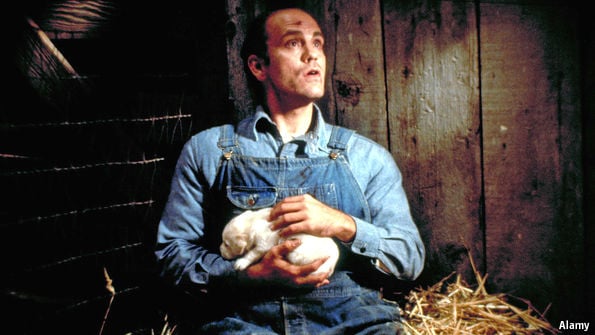
The events leading up to Lennie’s death and the reasons behind it are the culmination of Lennie’s ever-shifting identity and how he and others understand it. When Lennie accidentally kills the puppy he desperately loved and cared for, he struggles to understand how his actions have led to its death: “‘He was so little,’ said Lennie. ‘I was jus’ playin’ with him…an’ he made like he’s gonna bite me…an’ I made like I was gonna smack him…an’… an’ I done it. An’ then he was dead” (Steinbeck 87). Lennie contends with what he’s done in the setting of the barn, a place he has spent a lot of time during the course of the novel. The presence of the puppy is what initially drew him to spend so much time there, but perhaps it also served as a form of self-exile. This is an attempt to define himself even if it means aligning himself with animals rather than humans. Lennie’s lack of control makes an untimely appearance. Just moments after, the death of the puppy is reimagined in the death of Curley’s wife: “he shook her; and her body flopped like a fish. And then she was still, for Lennie had broken her neck. He looked down at her, and carefully he removed his hand from over her mouth, and she lay still. ‘I don’t want ta hurt you,’he said, ‘but George’ll be mad if you yell.’ When she didn’t answer nor move he bent closely over her. He lifted her arm and let it drop. For a moment he seemed bewildered. And then he whispered in fright, ‘I done a bad thing. I done another bad thing’” (Steinbeck 91). Lennie recognizes his lack of control, and though he does not explicitly say so, he does not understand how to take control. What he does understand is that he is different and that there are consequences for that. In the end, Lennie is put down by George, a mirror to the putting down of Candy’s dog. George exiles him to the place of animals, but because he cannot exist among animals either, the only other logical place anyone can think to send him is to his death. And just before his death, Lennie hallucinates for the first and only time. It operates as a self-fulfilling prophecy of sorts, a way of confirming for both Lennie and the reader that Lennie is sick and disabled.
Lennie’s inability to exist under a label, instead accessing some ambiguous identity, reflects the way monstrosity functions as a multifaceted representation of culture. This is the same way disability functions in literature; it is perhaps impossible to create one clear and acceptable understanding of disability, because of the prevailing ethical ambiguity of disability representations. Sami Schalk, a prominent name in disability studies, introduces the idea of “totalizing approaches.” She argues that there are typically four different approaches to how disability is understood in literature, that they “[ignore] disability entirely, read it as primarily negative, read it as primarily positive, or read it as a metaphor for something not related to disability” (Schalk 90). Instead she proposes an approach based on context. Lennie’s disability limits his control of his actions, especially at times of distress, but his disability is also what allows him to dream. His conviction in his dream encourages George to contemplate the possibility of owning their own land. It inspires Crooks and Candy, two other disabled characters, to imagine the same future for themselves. By rejecting a totalizing approach, I cannot concretely say whether Lennie is a human, animal, or monster. His identity changes by the minute, in a state of perpetual motion. Cohen states, “the monster’s body is both corporeal and incorporeal; its threat is its propensity to shift” (Cohen 5). This non-answer of an answer is certainly an unsatisfying one, but it aligns perfectly with the complex understanding of disability. Lennie’s inability to be labeled is situated at the center of cultural fear, scarier than a monster, because he is more than that. There is no clear consensus on how disability in literature should be understood; representations of the disabled population are almost always simultaneously positive and negative. Disability and the animal are used to create a monster in Lennie, but the conditions and qualities of that monster are uncertain. Lennie is a shape-shifting monster/animal/human, oscillating between endearing and dangerous.
Bibliography
Cohen, Jeffery Jerome. “Monster Culture (Seven Theses).” Monster Theory: Reading Culture. University of Minnesota Press, 1996.
Meyer, Michael J., editor. The Essential Criticism of John Steinbeck’s Of Mice and Men. Scarecrow Press, 2009.
Pugh, Catherine. “Beautiful Monsters: Sickness, Disability, and the Extraordinary Body.” Studies in Gothic Fiction, vol. 6, no. 1, Jan. 2018, pp. 53–63. EBSCOhost, research.ebsco.com/linkprocessor/plink?id=f098a263-f1f2-338e-8881-2754ed39eecb.
Schalk, Sami. “The Future of Bodyminds, Bodyminds of the Future.” Bodyminds Reimagined: (Dis)ability, Race, and Gender in Black Women’s Speculative Fiction. Duke University Press, 2018.
Steinbeck, John. Of Mice and Men, Penguin Books, 1993.

