Megan Bogner
Although the Oresteia and Harry Potter and the Deathly Hallows (hereafter Deathly Hallows) may not seem to have much in common at first glance, upon closer examination, it becomes clear that both treat women in similar ways. Even the author of Deathly Hallows, J. K. Rowling, encourages the reader to draw connections between the two stories with the addition of an epigraph from the Oresteia at the beginning of her novel. In these stories, women are expected to fulfill the role of mother; however, when that role is challenged, these women start to become dangerous and masculine, which poses a
threat to the men in their respective societies. The mothers of both titular characters have their motherhood challenged and respond to that challenge in a way that opposes the traditional masculine and feminine gender roles that are otherwise laid out. The Oresteia and Deathly Hallows both establish a world in which women are expected to fill the role of mother, and where deviation from that role becomes dangerous.
Eleanor Spencer’s essay “Lost Boys, Found Boys: Masculinities and Families in J.K. Rowling’s Harry Potter” describes John Stephens’ schema for masculinity and femininity, which will be used as a framework for which to evaluate and understand the female characters in Deathly Hallows and the Oresteia. Among other things, men are expected to be “authoritarian,” “violent,” and “protective,” while women are expected to be “non-violent,” “compliant,” and “powerless” (Spencer 2024, 198-199). This schema aims to lay out a series of traits used to determine “whether a character successfully performs hegemonic masculinity” or, conversely, femininity, in a “socially desirable” way (Spencer 2024, 199).
This argument begins with the quintessential mother in the Harry Potter series, the one whose selfless sacrifice sets off the premise of the whole book: Lily Potter. Though her death occurs before the series begins, her influence is felt throughout the books. She appears multiple times in ghost form to help Harry in difficult moments; her loving sacrifice places a charm on Harry that remains strong until nearly the end of the series (DH 4.43-54); and most of all, Harry constantly receives comments that he has his mother’s eyes (i.e., SS 5.88, from Ollivander). Inarguably, what Lily is known best for in the series is her sacrifice – and yet, following Spencer’s schemata for masculinity and femininity, Lily’s sacrifice becomes distinctly masculine because it is “protective.” For a character that otherwise is known exclusively as a mother, this masculine role may seem surprising. However, it is precisely because she is a mother that she has the ability to become masculine. When her motherhood is challenged (e.g. when Voldemort tries to kill her child), Lily is allowed to throw off her constricting femininity and step into a masculine role, which makes her dangerous to the male antagonists of the novel.
When Voldemort arrives at Godric’s Hollow to kill the Potters, it is first James Potter, Harry’s father, who stands in Voldemort’s way to protect his family (DH 17.343-344). When James is killed and Voldemort moves
to kill Harry, Lily throws herself in front of her child, begging Voldemort not to kill him (DH 17.344). In doing so, Lily is not only exhibiting masculine traits through being “protective,” but also defying feminine traits by refusing to be “compliant” and “powerless.” When Voldemort asks her to move aside three separate times in their interaction, and each time, she refuses; she is simultaneously refusing to be feminine and “compliant.” Her death places a charm of protection on Harry so strong that it prevents Voldemort from touching him at first, and is only able to be broken in the final book (DH 4.43-54). In this, she continues to defy expected powerlessness.
When Voldemort arrives at Godric’s Hollow to kill the Potters, it is first James Potter, Harry’s father, who stands in Voldemort’s way to protect his family (DH 17.343-344). When James is killed and Voldemort moves to kill Harry, Lily throws herself in front of her child, begging Voldemort not to kill him (DH 17.344). In doing so, Lily is not only exhibiting masculine traits through being “protective,” but also defying feminine traits by refusing to be “compliant” and “powerless.” When Voldemort asks her to move aside three separate times in their interaction, and each time, she refuses; she is simultaneously refusing to be feminine and “compliant.” Her death places a charm of protection on Harry so strong that it prevents Voldemort from touching him at first, and is only able to be broken in the final book (DH 4.43-54). In this, she continues to defy expected powerlessness.
Of course, it should be noted that femininity is not necessarily a bad thing. In the book chapter “‘How Dare You Defy Your Masters?’: Rules, Roles, and Resistance in the Potterverse’s Domestic Realm,” Beth Sutton-Ramspeck conflates house-elves and women in the Harry Potter world as two identities who both conform to strict, predetermined societal roles (Sutton-Ramspeck 2023, 85) – roles which line up neatly with the previously listed schema of femininity. Sutton-Ramspeck uses these identities to argue that house-elves and women have some enhanced, innate power from “lov[ing] their families and sacrific[ing] themselves to serve them” (Sutton-Ramspeck 2023, 115). However, it is important to note that, in the case of women, the reason why they are ‘sacrificing’ and ‘serving’ is for their families – ergo, in pursuit of motherhood. Therefore, rather than some innate, driving force of femininity, women show power through their motherhood – and in the Harry Potter series, usually when it is challenged or removed[1].
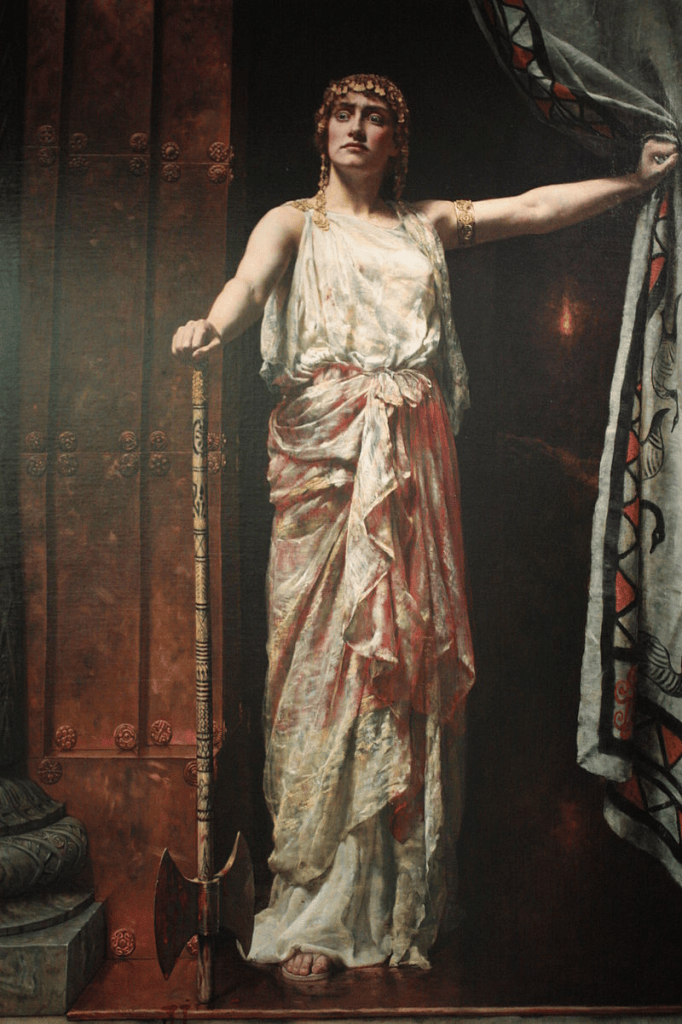
This theme of protecting motherhood continues through the Oresteia. Though written in and about very different societies, the inherent attitude towards motherhood is similar. The quintessential mother in this story is Clytemnestra, the mother of Orestes. The first play of the triad, Agamemnon, is set just after the Trojan War ends. Significantly, in order to launch his fleet to pursue Paris and begin the war, Agamemnon had to sacrifice his and Clytemnestra’s daughter, Iphigenia. Like Lily’s sacrifice, Iphigenia’s death happens before the main tale, but its ramifications are felt throughout. Agamemnon left Clytemnestra in charge of his kingdom, and she has been ruling it alone[2] for ten years. In doing so, she is displaying the distinctly masculine trait of being “authoritarian”. She is not dependent on her lost husband for help; she rules the kingdom and is, in fact, said to speak “like a man” (Agamemnon 355), and when Agamemnon does finally return, he asks her, “Where’s the woman in all this lust for glory?” (Agamemnon 935). In the absence of her daughter[3] and husband, Clytemnestra takes on an authoritative, masculine role.
As Clytemnestra becomes more masculine in Agamemnon’s absence, “command[ing]… [and] maneuver[ing] like a man” (Agamemnon 12-13), she gains more masculine traits, most notably “violent”. When Agamemnon returns from war, Clytemnestra kills him (Agamemnon 1368-1431). Her reason for doing so is that he “sacrificed his own child, our daughter, / the agony I laboured into love” (Agamemnon 1442-1443). In other words, because Agamemnon killed her daughter and therefore challenged her motherhood by removing the child, Clytemnestra is angered into adopting masculine traits, which make her a threat to the men of the story.
Of course, this role and the ensuing violence would not be possible without the loss of her daughter. On one level, had Agamemnon not sacrificed Iphigenia, he would not have been able to leave to fight, therefore not allowing Clytemnestra to rule in his stead. On another level, Iphigenia’s sacrifice is what causes Clytemnestra to become masculine and therefore a threat to men, so without it, Clytemnestra would not have become the dangerous force she becomes. It is the death of Iphigenia that leads to the death of Agamemnon.
In Froma I. Zeitlin’s essay “The Dynamics of Misogyny: Myth and Mythmaking in Aeschylus’ Oresteia,” Zeitlin states that “For Aeschylus, civilization is the ultimate product of conflict between opposing sources, achieved… through a hierarchization of values… [such as] male over female on the social level” (Zeitlin 1996, 87). Essentially, Zeitlin is making the case that Aeschylus is using the Oresteia in order to establish and support social values such as male superiority. Though less overt, the same establishment of patriarchal social values can be seen in Deathly Hallows: repeatedly, the female characters are irrelevant and subjugated until their motherhood is in question[4]. The danger that ruined motherhood poses to men creates the moral that women must be kept in motherhood to retain feminine, submissive traits. In both the Oresteia and Harry Potter and the Deathly Hallows, the mothers of the titular characters have their motherhood challenged by the loss (or threatened loss) of their child. In response to this challenge, both of the mothers take on masculine roles that prove disastrous to the men who challenge their motherhood.
[1] In today’s world, women, men, and people who do not conform to the traditional gender binary are free to choose the ways in which they conform or defy traditional gender roles. Many women do choose to become mothers and adopt that as their main identity, which is an admirable and difficult choice that is often underappreciated in the modern world. My argument is not meant to detract from the frankly difficult and thankless job that is being a mother. Instead, I mean to critique two stories in which women are not given a choice other than to be mothers. Feminism is the freedom of choice.
[2] There is, of course, technically her boytoy (Aegisthus) present during this time. However, since Aeschylus does not give him much credit, neither will I.
[3] Does she have 2 more children? Yes. But again, as Clytemnestra does not pay much attention, neither shall I.
[4] See: Molly Weasley and Tonks.
Works Cited
Fagles, Robert, tr. 1966. Aeschylus: The Oresteia. Penguin Classics.
Rowling, J.K. 1997. Harry Potter and the Sorcerer’s Stone. Scholastic.
Rowling, J.K. 2007. Harry Potter and the Deathly Hallows. Scholastic.
Spencer, Eleanor. 2024. “Lost Boys, Found Boys: Masculinities and Families in J.K. Rowling’s
Harry Potter.” In Family in Children’s and Young Adult Literature, edited by Eleanor Spencer and Jade Dillon Craig. Routledge.
Sutton-Ramspeck, Beth. 2023. Harry Potter and Resistance. Routledge.
Zeitlin, Froma I. 1996. Playing the Other: Gender and Society in Classical Greek Literature. University of Chicago Press.

