Nola Walston
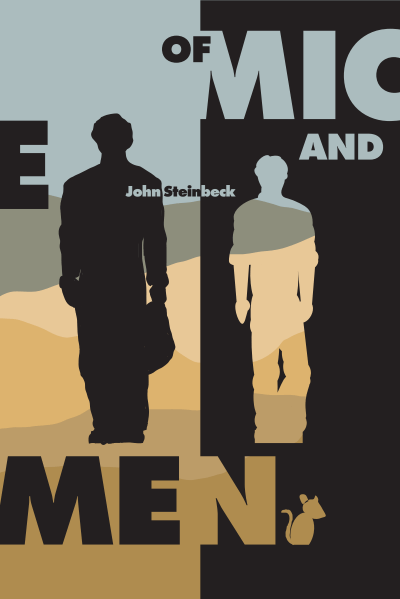
The majority of interpretations and works of literary criticism have read Lennie Small and Of Mice and Men as a problematic representation of intellectual disability, particularly in its eugenic implications. Critics such as Clare Lawrence and Sonia Freeman Loftis discuss the negative impacts of Lennie’s representation as animalistic, lacking subjectivity, and how “the ‘cure or kill’ trope of disability studies and real-life events tragically reinforces cultural attitudes that regard neurotypical subjectivity as the only subjectivity” (Loftis 62).
Additionally by depicting him as potentially or uncontrollably (even sexually) violent, “Lennie’s death is ‘authorized’ by cultural discourses” lending itself to a eugenist interpretation of events (64). Loftis argues that Steinbeck is justifying Lennie’s lynching/death and thus the sterilization of the mentally disabled because he (and others like him) are dangerous (67).
It’s true that Lennie’s death has been a longstanding topic of ethical debate, as he has committed acts of violence, which often leads to this negative interpretation of Lenny’s representation. I argue that, in more subtle and complex ways, we can read Of Mice and Men as focused on disability justice and societal commentary. Robert Dale Parker discusses two common models of thinking about disability: the social and the medical. While the medical model is about the disabled person and often seeks a “cure,” the social model “is about the social world that constructs a person as disabled” (Parker 12). Steinbeck writes a harsh and realistic 1930s world, and includes stereotypes, violence, eugenic societal structures/motivations, and problematic language. By using harmful language and these tropes he makes the modern reader uncomfortable and is able to draw attention to the negative implications and applications of our culture, such as euthanasia, institutionalization, lack of agency, and criminalization of the mentally different. Barabara A. Heavilin analyzes some of Steinbeck’s own commentary and claims that “Of Mice and Men points to a background culture in which there is a troubling gender and racial bias, together with a strongly prejudiced lack of compassion for the mentally handicapped” (Heavilin 13). Therefore the underlying disability justice themes only gain weight by the gravity and oppression of the realistic world that Steinbeck portrays. Ultimately, though the book may still perpetuate harmful stereotypes in some ways, Steinbeck uses these ableist constructions to illuminate and condemn the failings of our society rather than endorse them.
In order to analyze the disability justice inherent in Of Mice and Men, I will take a closer look at how Steinbeck creates a dream of a disabled future, and shows Lennie as a multifaceted and sympathetic character. One important facet of disability studies is the idea of creating “crip futures: futures that embrace disabled people, futures that imagine disability differently, futures that support multiple ways of being” (Kafer 45). Steinbeck engages with this idea of creating a “crip future” by showing Lennie and George’s dream for their future, which includes money for a house, land, and animals. By adding and emphasizing this desire and goal in the novel, Steinbeck is engaging readers in critiquing the society where this realistically achievable dream is not possible. In “Time for Disability Studies and a Future for Crips,” Alison Kafer discusses the importance of imagining crip futures:
To put it bluntly, I, we, need to imagine crip futures because disabled people are continually being written out of the future, rendered as the sign of the future no one wants. This erasure is not mere metaphor. Disabled people . . . have faced sterilization, segregation, and institutionalization; denial of equitable education, health care and social services; violence and abuse (46).
Here Kafer highlights the importance of having a future for disabled people, and the detriments that people with disabilities face in an ableist society. Lennie specifically has either directly faced, or been faced with the threat of “sterilization, segregation, and institutionalization; . . . violence and abuse” (Kafer 46). Crucially, as Kafer says, imagining crip futures is the first step to creating the reality and writing disabled people into the future. Not only does it show disabled people that they are valued and deserve a fulfilling life, it also shows able-bodied people that there can be positive (non-threatening) space in the world for everyone.
In Of Mice and Men, Lennie and George spend time imagining this future together. They dream of a farmstead to themselves where they can “live offa the fatta the lan’ ” and grow their own food and raise their own animals, including rabbits, as Lennie specifically requests (Steinbeck 57). They repeat it several times throughout the book, giving them hope and motivation, as well as reinforcing the idea within their minds and the readers’ minds. They go farther and actively create a plan to make it happen by looping in Candy, another ranch worker, who is physically disabled and old, but has the money to make it happen. In the moment of realization, Steinbeck writes:
George stood up. “We’ll do her,” he said. “We’ll fix up that little old place an’ we’ll go live there.” He sat down again. They all sat still, all bemused by the beauty of the thing, each mind was popped into the future when this lovely thing should come about. […]
“An’ put some grass to the rabbits,” Lennie broke in. “I wouldn’t never forget to feed them. When we gon’ta do it, George?”
“In one month. Right squawk in one month.” (Steinbeck 60-61)
This moment is important because it is the first time the dream comes anywhere close to a reality. Previously it has just been a hope and comfort, but here they make the plan and timeline. By showing they are “bemused by the beauty of the thing” and their commitment and energy when they believe it can come true, Steinbeck shows the impact of having a safe future for disabled people. Not only is this an important moment for the characters who now have real hope for a future, it is also hope felt by the readers. We have seen the less than ideal conditions of a migrant worker, such as the loneliness, lack of a stable home, and intense manual labor—all amplified by the challenge of disability—but now we can believe in their dream too.
One notable part of this dream is that it takes place outside of societal constraints. This may be construed as segregation or confinement of people like Lennie, implying that this life far-removed from society might be the only one conceivable. However, George and Lennie make it clear that while it would be a remote and relatively self-sufficient system, it is somewhere that they could both thrive independently. As George says: “We’d jus’ live there. We’d belong there. There wouldn’t be no more runnin’ round the country” (Steinbeck 57). For himself George wants the self-sufficient and idealized lifestyle so that he can be free from the migrant worker life. He himself is placed outside of society as he cannot easily fulfill the American ideals of home and family. This parallels Lennie’s experience of not being able to conform to the “normal” life timeline because of his disability. For Lennie, he could just be on the farm, and take care of the land and his rabbits, without being labeled and discriminated against as a mentally disabled person. This is an integral part of the dream—the belonging they seek—because it frames it as an actual positive alternative, not just a haven to escape or be removed from society. Leah Lakshmi Piepzna-Samarasinha discusses the importance of futures where everyone can thrive, creating not just accessible but alternative options. The dream and plan George and Lennie are cultivating creates a space for truly cohesive living and acceptance, of able bodied alongside and in community with disabled. By actively working towards this, and being specific in their hopes and aims, they are fulfilling the first step of achieving that for greater society.
The very fact that Lennie is able to dream about a future and work towards it, and then it gets taken away by the able-bodied, is indicative of the grip societal prejudices have in the world. For as Piepzna-Samarasinha points out, “a major way ableism works is to erase us from ideas of the future. . . . the everyday future of having any idea of what a disabled adulthood or elderhood could look like. Ableism isolates” (12). Steinbeck is showing this erasure deliberately, to contrast it with the peace and happiness that their dream inspires. And, by George presenting this dream and Lennie and Candy engaging with it, they are actively considering disabled adulthood and old age in the future, which is the first step to directly working against the ableist agenda of erasing disabled futures. The futility of their success is only an indicator of how hard we must fight for a disabled future because the impulse to sterilize, institutionalize, and euthanize runs strong. While there are ableist elements to the book, if it was truly intended as ableist it would not be a story about Lennie and how his future is taken away by the able-bodied.
While it is true that Lennie has accidentally killed someone, it would be extremely hard to view the ending as happy in any way, as it is terrible for both Lennie and George. Steinbeck spends a lot of time making Lennie likable and sympathetic to create a nuanced and complex character, and causes most readers to feel a lot of sympathy or pain for Lennie’s fate. Because of this, “Lennie seems like a very real and unique individual” rather than a stereotype, and “is kind, friendly and possesses hopeful desires for a pleasant future, like everyone else” (Hicks 66, 69). For example, Steinbeck does this by showing Lennie’s care for small animals, both rabbits and dogs (Steinbeck 36). It is apparent throughout and is in his dreams for the future that it is personal, for while he shares the homestead dream with George as it is mutually beneficial, he himself dreams of (and works towards) having and caring for rabbits. In terms of friendship, he sticks up for George, ready to protect him when he may be threatened, saying: “Ain’t nobody goin’ to talk no hurt to George” (72). Even after he accidentally kills Curley’s wife, we can see his regret and confusion: “ ‘I done a real bad thing,’ he said. ‘I shouldn’t of did that’ ” (92). When George sees the evidence he insists that “[a]ll the time [Lennie] done bad things, but he never done one of ’em mean” (95). With these consistent details, as Kathleen Hicks claims, “Steinbeck is careful to highlight Lennie’s humanity, leaving readers with no doubt that Lennie deserves compassion as much as any other human being” (Hicks 74).
Overall, Lennie’s good qualities, his participation in a dream of the future where he can thrive, and the harmful ableist society portrayed, show a disability justice reading of Of Mice and Men. Lennie himself is the one to say early on, “Le’s go, George. Le’s get outta here. It’s mean here,” and shows the desire to find and create a better place for himself and George (Steinbeck 33). The cruel representation of society at the time paired with the hopeful peaceful dream is a criticism and call to action as it highlights the inherent tragedy within society’s structures.
Bibliography
Heavilin, Barbara. “The [wall] of background’: The Cultural, Political, and Literary Contexts of Steinbeck’s Of Mice and Men.” Critical Insights: Of Mice and Men, edited by Barbara A.(ed.) Heavilin and Robert(introd.) DeMott, Salem Press, 2017, pp. 13-30.
Hicks, Kathleen. “‘Which Way Do We Go, George?’: Intellectual Disability in Steinbeck and the American Consciousness.” Critical Insights: Of Mice and Men, edited by Barbara A.(ed.) Heavilin and Robert(introd.) DeMott, Salem Press, 2017, pp. 64–79.
Kafer, Alison. “Time for Disability Studies and a Future for Crips.” Feminist, Queer, Crip, 2013.
Loftis, Sonya Freeman. “The Autistic Victim: Of Mice and Men and Flowers for Algernon.”
Imagining Autism: Fiction and Stereotypes on the Spectrum, Indiana University Press, 2015, pp. 61–78.
Parker, Robert Dale. “Disability Studies.” How to Interpret Literature: Critical Theory for Literary and Cultural Studies. Oxford University Press, 2011.
Piepzna-Samarasinha, Leah Lakshmi. “Introduction: Writing a Disability Future, in Progress.” The Future is Disabled: Prophecies, Love Notes, and Mourning Songs, 2022.
Steinbeck, John. Of Mice and Men. Penguin Books, 1993.

