Brandon Roberts
In twenty-first century America, it is common to conflate American religiosity with American nationalism. The “Protestant Ethic” and the “American Dream” are historically intertwined to such an extent that they may seem inseparable—Christianity appears everywhere in American life, from foreign policy to household structures, and every American president in recent memory has been sworn into office on a Christian Bible, reciting the words “so help me God” as they do. These “American-Christian” connections are ever-present, but they can also feel inauthentic, as when a congressman “cites scripture” in his defenses of war, restrictions to health care, or voter suppression. In modern America, one could argue that religion is the charming mask which hides the ugly faces of nationalism and capitalism; a disguise which alienates more and more voters (and believers) every election cycle.
Such critiques may be persuasive in our own time, but the trouble begins when we impart these standards into history. This process is twofold: first, one must presuppose a consistency in “Christianity” and its place in American life; and second, one must presuppose a firmly identifiable “Americanness” which this “Christianity” is latching onto. Such presuppositions are obviously anachronistic, but they remain shockingly pervasive, even hegemonic, in studies of the First Great Awakening. Most maligned by this retrojection of the nation is Jonathan Edwards, the pivotal theologian of the Great Awakening whom scholars often turn to when searching for the origins of our modern “American Christianity.” This search is not foolish in itself, but it is susceptible to misrepresentations of the source material, especially when the intention lies in “finding America” rather than reading the primary texts for what they are.
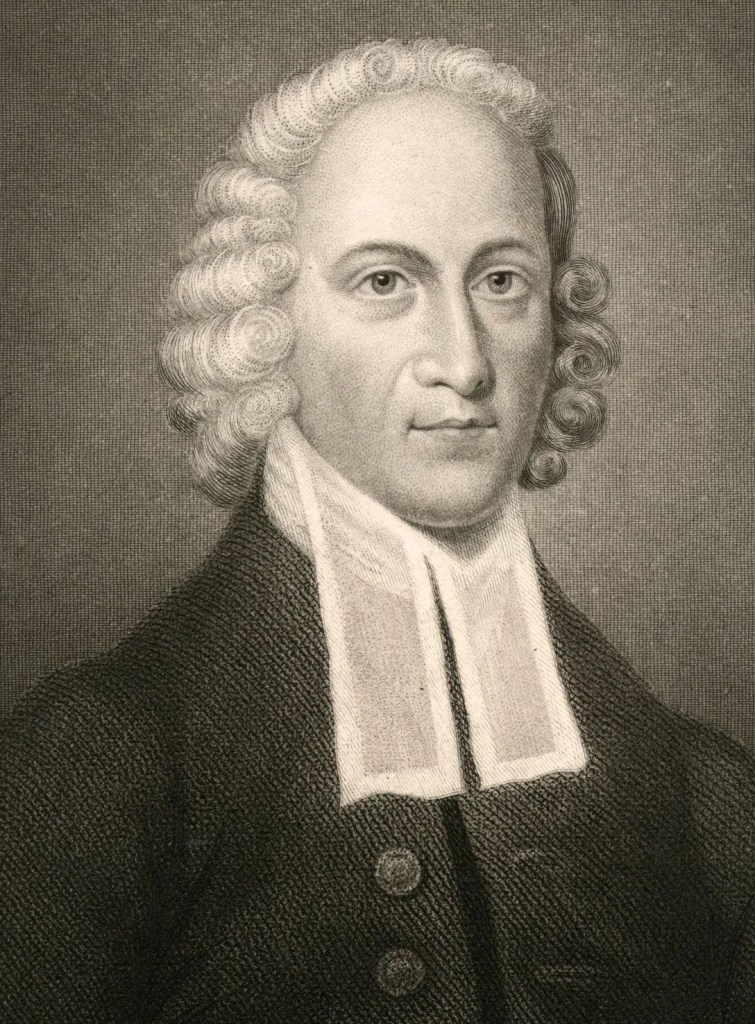
That noted, analyses of Jonathan Edwards and the First Great Awakening which presuppose an “American people” do more than merely perpetuate an anachronism; they actively misconstrue both the man and the movement. Edwards did not position himself as an “American philosopher”—his writings from the Awakening make no gesture to America as a national entity, and he uniformly characterized himself as a British subject.
By dispelling the nation from Edwards’s writing, we unlock his theological geography, which reckoned “America” as the continent of revelation—a future which points not to some great national character, but instead to the Apocalypse.
The First Great Awakening
Before we can conduct a meta-analysis of the Great Awakening, its thinkers, and its consequences, we must establish a historical groundwork. The First Great Awakening was a series of loosely connected religious revivals in Colonial America between 1735 and 1760, with the most intense period being in New England from 1740-43. These ‘revivals’ often took the form of what we would now describe as “Evangelical,” or even “Pentecostal,” revelations in religious feeling. This emphasis on feeling was a core tenant of revivals everywhere, even before the Great Awakening: the goal of such revival being the rejection of the established church in favor of “true religion,” which reveled in piqued emotion and populist preaching. The revival tradition was robust in England and Scotland throughout the seventeenth and eighteenth centuries, but it would only explode into “Awakenings” in 1740-43. After this peak, the revivalist spirit smoldered in New England through the Revolutionary period, only to be sparked again in the early nineteenth century (Ahlstrom, 2004, 281-7; Lambert, 1999, 13-32; Smith, 2015, 2-4; cf. Crawford, 1991, 13-14).
New England revivalism was inextricable from the Puritan project. The Puritan colonists who settled in New England envisioned a pseudo-theocratic state, one which governed according to the Ten Commandments first, and ‘earthly’ laws second. This project had essentially proven a failure by the 1740s for a variety of reasons, the most important of which being religious pluralism—that is, Protestant pluralism. The Protestant Reformation was, at its core, a factionalist concept: the sixteenth century reformers proposed a radical break with the socio-religious norms which had defined Medieval Catholicism. That impulse to reject tradition has remained a core tenant of Protestant ideology, as seen in the current American religious landscape and its truly uncountable Protestant ‘denominations,’ all of which espouse subtly unique theologies (Crawford, 4-8; Smith, 300-1; Noll, 2016, 177-8).
In the time of the Puritans, their movement was already one of many expressions of Calvinistic Reformed theology, named for its intellectual father, John Calvin. Calvin split from Martin Luther rather early in the Reformation, centering his particular movement in Geneva, Switzerland, and railing against what he considered a still-too-Catholic reform in the new Lutheran Church. Most important of these critiques, at least to the Puritans, was the doctrine of Predestination. To be predestined meant you were a member of the “elect,” a rigidly exclusive group of Christians whom God had chosen, before even the beginning of time, to be “saved.” Calvinism therefore necessarily denies the existence of Free Will, the ability of an individual’s actions to earn salvation, or the potential for the elect to “fall away” from salvation. For Calvin, this was the logical conclusion to Luther’s tenets of sola fide (by faith alone): if we believe in salvation through faith at the hands of an omnipotent God, how then could one’s election be questioned, let alone changed? (Lambert, 26-28; cf. Weber, 104-28).
The theological justification for Calvin’s doctrines are, of course, far more complex than could (or should) be explored here. The point is simply that these doctrines were incredibly salient in Puritan minds, and deeply affected their experiences of Colonial life and the Awakenings in particular. For revivalists, this meant a belief in what is known as “Dispensationalism:” the belief that God ‘dispenses’ particularly intense “Out-pourings” of the Holy Spirit for his people, at which point they shall receive the Spirit and repent of their sinfulness. According to Lambert, “what distinguished eighteenth-century revivalists from other evangelicals was their belief that God periodically pours out his grace in an extraordinary way to redeem a sinful people, and that they were participating in one of those unusual outpourings.” For Puritans observing revivals across New England, it would be hard not to see these revivals as one such dispensation of the Holy Spirit (Lambert, 43).
Jonathan Edwards, Revivalist Theologian
This was certainly the theological conviction of Jonathan Edwards, of whom a brief biographical sketch must be made. As mentioned, Edwards (1703–58) was a preacher first and foremost. He lived in Connecticut for most of his life, but spent brief periods elsewhere in New England and the Middle Colonies, most notably as president of the College of New Jersey (now Princeton). An early graduate of Yale Theological Seminary in New Haven, Edwards was trained in Calvinist theology, and was licensed to preach in New York in 1722. In 1727 he was ordained in Northampton, where he would spend the next twenty-three years of his life preaching and theologizing (Ahlstrom, 298-301).
Not long after taking the helm in Northampton, Edwards began to notice “surprising conversions” among his parishioners, an account of which was published in 1737 following correspondences on the matter in 1735. This publication, A Faithful Narrative of the Surprising Work of God, recounted the astonishing revival which Edwards witnessed in 1734-35, with additional accounts from colleagues across New England (Edwards, 2013: A Faithful Narrative, 1-83; Ahlstrom, 301-2). A Faithful Narrative is the first textual work to engage in what Lambert refers to as the “invention” of the “Great” Awakening, a process which would thereafter explode in the 1740s. In a prime example, the printers of A Faithful Narrative attached a preface to Edwards’s text where they vouched for the veracity of his account: “We are abundantly satisfy’d of the Truth of this Narrative, not only from the pious Character of the Writer, but from the concurrent Testimony of many other Persons in New England; for this Thing was not done in a corner” (Watts and Guyse in Edwards, 2013: A Faithful Narrative, 3). What Edwards and the publishers did not yet know (though certainly hoped) was that their account would be the first of countless such narratives of astonishing conversion, many of which were exceedingly supernatural in character. For Edwards and his revivalist colleagues, the Awakenings were “quite inexplicable works of the spirit,” happenings which could only be explained through divine revelation and absolute faith (Ahlstrom, 302)—in which case, the publication of such accounts was used to bolster said faith across the Colonies.
This absolute faith in the power of the Holy Spirit points to Edwards’s particular location in the Calvinist-Reformed theological landscape. As mentioned above, Calvinism is defined by a firm belief in predestination and a necessary rejection of Free Will; which is to say, a rejection of humanity’s ability to “earn” divine grace. Grace (that is, the forgiveness of sins) is freely given, and should therefore be freely received—the Awakenings represented one such “dispensation” of grace, a free gift which God’s people needed to welcome with open arms. Edwards agreed that mankind was not free, but this was not a cause for despair: instead, it made room for the pious to focus on receiving the dispensations of grace and responding accordingly, secure in their own “election” as members of God’s people.
As a public intellectual, Edwards’s theology was incredibly influential, especially in his descriptions and analyses of the Awakenings. Although he was not as widely known in his own time as the ‘Grand Itinerant’ George Whitefield, his publications were well circulated, and modern historians recognize him as the presiding intellect of revivalist theology (Woolverton, 189-98; Whitefield, 1960). I have therefore chosen Edwards as the site of my thesis precisely because of this hegemonic position in scholarship: every scholarly monograph concerning the Great Awakening (or American Evangelicalism more broadly) must devote at least a few pages to the works of Jonathan Edwards, categorizing him most often as a theological genius, or else as a moral philosopher.
The issue with this devotion is that many analyses of Edwards’s work take his writings from after the Awakenings as their starting point—perhaps due to the more sophisticated arguments contained in the latter writings (e.g. Ahlstrom, 303-4). This has left Edwards’s writings from during the Awakenings under-analyzed, or else analyzed only from the perspective of his later work. My analysis therefore pointedly excludes Edwards’s post-Awakening writings as irrelevant to the present issue: my concern is with how Edwards reckoned the nation during the Awakenings, not how he theologized their events in hindsight. This position is a result of my larger thesis on the historical present: the texts we analyze to determine the contours of the Great Awakening must be contemporaneous, or else we make fools of ourselves. Even Edwards’s own publications from the late-1740s and 1750s, fascinating as they may be, will necessarily appear ‘anachronistic’—his reinterpretations of the events of the Awakenings were theological in nature, less interested in the preservation of contemporary details than the construction of a compelling spiritual narrative.
Theological Geography and Edwards’s “America”
Thus, we turn at last to those works which were published during the Awakenings, roughly spanning 1737–43. In searching Edwards’s writings from this period, we find a direct discussion of “America” in only one publication: Some Thoughts Concerning the Present Revival of Religion in New England, published in 1742 (Edwards, 2013: editor’s note, 722). The pinnacle of his Awakening-era work, Some Thoughts is a culmination of revival accounts and theological interpretations which Edwards had been working on and publishing throughout the Awakenings, beginning with the aforementioned Faithful Narrative in 1737, and including his 1741 publication, The Distinguishing Marks of a Work of the Spirit of God. All of these writings share an imminent concern with the trajectory and theological significance of the revivals, and take great pains to justify their status as “a Work of the Spirit,” one which certainly qualified as a ‘dispensation’ of divine Grace’ (Edwards, 2013: editor’s note, 721-3; cf. Ahlstrom, 301-2). For Edwards, it was important to interpret these spiritual phenomena as they were happening—if this was indeed “a Work of the Spirit,” the believer could not afford to miss the moment.
In Part I of Some Thoughts, Edwards describes the extent of revival in the colonies (referred to subsequently as “the Work”) and the degree to which it was clearly an “Out-pouring of the Spirit.” Since this section is primarily observational and not interpretational, “America” is introduced simply as a geographic signifier:
The Work is very glorious if we consider the Extent of it; being in this Respect vastly beyond any former Out-pouring of the Spirit that ever was known in New-England. … But now GOD has bro’t to pass a new Thing, he has wrought a great Work of this Nature, that has extended from one End of the Land to the other, besides what has been wrought in other British Colonies in America. (Edwards, 221; italics here and in following quotes are in original)
Note first the use of “British Colonies in America,” rather than simply “‘America”—the geographic scope of “America” is presumably broader than the section controlled by Great Britain, and must be clarified by the parameter of “British Colonies.” This is supported by the comment “one End of the Land to the other, besides what has been wrought”—here, “the Land” is ambiguous, but at the very least refers to North America, if not the Americas more broadly; or for that matter, the entire Earth. In any case, the point of the passage is not to litigate the boundaries of “America,” but to relish in America’s having received “a great Work of this Nature” from God.
Later in Part I, this savoring of divine providence is clarified and expanded in the context of Edwards’s eschatology:
In this Respect also, The Land in all Parts has abounded with such Instances, any one of which, if they had happen’d formerly, would have been thought worthy to be taken Notice of by GOD’s People, throughout the British Dominions. The New-Jerusalem in this Respect has begun to come down from Heaven, and perhaps never were more of the Prelibations of Heaven’s Glory given upon Earth. (Edwards, 223)
In this case, “British Colonies” has expanded to “British Dominions,” perhaps to include Scotland, whose concurrent revivals were well publicized in American revivalist circles (see Crawford, 13; Lambert, 9). It could also refer more expansively to Britain’s global empire, or simply as a synonym for the “Colonies” in the prior passage. Regardless, the “British Dominions” does not connote a national relationship between the colonists and “America,” and instead does quite the opposite, attaching the colonists’ identity explicitly to the British Empire.
That noted, it is clear even in Part I that Edwards’s treatment of “America” is uniquely theological, freighted as it is with the promise of the “New-Jerusalem.” This theological significance is clarified in Part II, where he develops his theological justification for this special “Out-pouring” of God’s Spirit in America:
‘Tis not unlikely that this Work of GOD’s Spirit, that is so extraordinary and wonderful, is the dawning, or, at least, a Prelude of that glorious Work of God, so often foretold in Scripture, which in the Progress and Issue of it, shall renew the World of Mankind. …
… And there are many Things that make it probable that this Work will begin in America. ‘Tis signified that it shall begin in some very remote Part of the World, that the rest of the World have no Communication with but by Navigation, in Isai. 60. 9. [“]Surely the Isles shall wait for me, and the Ships of Tarshish first, to bring my Sons from far.[”] I can’t think that any Thing else can be here intended but America by [“]the Isles that are far off,[”] from whence the First-born Sons of the glorious Day shall be brought. (Edwards, 228, 229)
This passage is followed by extended exegesis (that is, biblical-textual analysis) of the noted passage in Isaiah 60, before arriving at the thesis: “This Prophecy therefore seems plainly to point out America, as the first Fruits of that glorious Day” (Edwards, 229). The “American exceptionalism” here is a peculiar one, rooted in Edwards’s theological geography as it relates to the “American” continent, rather than some sort of cultural superiority found in “the American people.” Edwards constructs “America” as a geographic space, not a socio-cultural group, identical in usage to his discussions of Europe and Asia (e.g. Edwards, 274). In every case, these continents are reckoned through theological-geographic terms, justified through his exegesis of Isaiah 60.
This prior definition of “America” is somewhat diluted by his scriptural analysis, but it is synthesized later in Part II:
I apprehend God’s Dealings will be with the two Continents. America has received the true Religion of the old Continent; the Church of ancient Times has been there, and CHRIST is from thence: but that there may be an Equality, and inasmuch as that Continent has crucified CHRIST, they shall not have the Honour of communicating Religion in its most glorious State to us, but we to them. (Edwards, 231)
Setting aside the placement of guilt for the Crucifixion on an entire continent, we find here an interesting dichotomy between the Old World and the New World. This bifurcation is followed by the formation of an “us,” but one which is freighted by theological geography—the “us” in question is defined simply and explicitly as ‘those Christians who inhabit the continent of America,’ to be contrasted with ‘those Christians who inhabit the continent of Europe.’ It is a work of divine providence, not of human migration flows, that those dwelling on the American continent are fit to receive this “true Religion.” Put simply, “America” is the chosen land for three reasons: 1) it is “remote” and “from far” in relation to the land of Israel; 2) it forms the second part of a dichotomy between Europe/Asia, where Christ was incarnated, and America, where he shall be revealed again; and 3) as the “New” world, it is fit to deliver the “true Religion” back to the “Old” world.
Edwards’s focus on “America” has, up to this point, been continental in scope. However, at least according to his own observations, there was something unique about the revivals in New England. Consequently, Edwards must explain New England’s particular place in this “great Work:”
And if we may suppose that this glorious Work of God shall begin in any Part of America, I think, if we consider the Circumstances of the Settlement of New-England, it must needs appear the most likely of all American Colonies, to be the Place whence this Work shall principally take its Rise.
And if these Things are so, it gives us more abundant Reason to hope that what is now seen in America, and especially in New-England, may prove the Dawn of that glorious Day. (Edwards, 234)
Although this passage may appear to be a naked endorsement of social exceptionalism on behalf of New England, I would caution against such a leap. Edwards’s analysis in this instance is strictly pragmatic: it is based on “what is now seen.” In the prior passages, Edwards has justified the presence of “this glorious Work” through exegetical interpretation, unpacking a theological geography which places “America” in the right place at the right time. In this passage, his argument is clearly based on the apparent visible evidence: that the revivals, widespread as they may have been across the colonies, were concentrated in New England. Although he admits the “Circumstances of the Settlement of New-England” do convey a certain importance (being founded, as it was, on Calvinist-Puritanical principles), this too requires no exegetical justification. For Edwards, the primacy of “America” was a phenomenon in need of theological explanation; the primacy of New England within that phenomenon, on the other hand, was seemingly obvious.
To summarize Edwards’s position in Part II; “America” (including New England) was not the chosen land because of any especial Christian piety, as this would contradict Calvinistic Providence in general and the theological position of Edwards in particular. Instead, this ‘chosenness’ is justified theologically by his exegesis of Isaiah 60, and practically by his observation of the “great Work” of God which has abounded in “this Land” (cf. Lambert, 37). The role of Christians in this plan is not to deserve the role or to have brought it about in any way. Rather, Christians in America (not “American Christians”) must prepare themselves for the coming “first Fruits” in order to be reckoned as the Lord’s “visible people,” duly prepared to “openly appear to acknowledge him [Jesus] in such a Work, and bow before him, & join with him” (Edwards, 247). The apocalyptic edge of Edwards’s theology is therefore clearly visible: these Revivals are merely preludes to a grand “Revelation” of divine providence, the so-called “Second Coming” of Jesus. This “apocalypse” is to be understood in the classical sense; that is, as the moment in which the true nature of the divine is revealed to those who know where to look and how to listen. Edwards’s concern, therefore, is to exhort his fellow revivalists to look and listen carefully.
This concern takes its most complete form in Part V, where Edwards turns to “Shewing positively, what ought to be done to promote this WORK.” In this section, which concludes the treatise, Edwards turns his theological arguments into explicit exhortations:
I have often thought it would be a Thing very desirable, and very likely to be follow’d with a great Blessing, if there could be some Contrivance, that there should be an Agreement of all GOD’s People in America, that are well affected to his Work, to keep a Day of Fasting & Prayer to God; wherein we should all unite on the same Day, in humbling our selves before GOD. …
… and together with Thanksgivings to GOD, for so glorious and wonderful a Display of his Power and Grace, in the late Out-pourings of his Spirit, to address the Father of Mercies, with Prayers & Supplications, and earnest Cries, that he would guide and direct his own People, and that he would continue, and still carry on this Work. (Edwards, 402, 403)
The specific language here is once again critical, hinging on “all GOD’s People in America.” In this case, there is a clear order of priority for the facets of identity: “all GOD’s People” is the signifier of identity and a core tenant of the Christian self, whereas “in America” is the signifier of their incidental geographic location, albeit one with a more freighted theological significance. To refer to “God’s People in America,” rather than “all American Christians,” should make this distinction obvious. Edwards does not speak to “Americans,” he speaks to Christians “in” “America.”
To conclude our analysis, I wish to reinforce my notion of theological geography. Most modern biblical interpreters (even apologetic ones) do not approach texts like Isaiah 60 literally: it is common to refer to a “historical meaning” as well as a “metaphorical meaning,” but in neither case is the text read as referring to modern geographies. Edwards must therefore be understood as a product of his particular moment in the history of biblical interpretation, albeit an especially ambitious one. His exegesis has more in common with his late-medieval predecessors like Martin Luther and John Calvin than with his nineteenth century successors. Indeed, to expand Kuklick’s earlier observation, only after medieval exegesis had vanished could Edwards be seen as its “final representative.” His writings exhibit the medieval impulse to read biblical prophecy as relentlessly relevant, always-already referring to the present. In this sense, he perpetuated a method which originates in the New Testament itself: early Christians took Hebrew prophesy as their starting point for understanding the birth, ministry, crucifixion, and resurrection of Jesus. Modern interpretation has departed from this obsession with “relevance,” but part of the motivation for this work has been to show the potency of Edwards’s theological geography and its historical-exegetical legitimacy, even when it betrays our modern interpretive tendencies.
Conclusion
If Edwards’s interpretive method is more medieval than it is modern, why then has the secondary literature focused relentlessly on the “Americanization” of his work, and why have I used Edwards himself to resist this notion? To the latter question, the answer is unfortunately recursive: to prove the flaw inherent in another’s argument, one must use their own evidence against them. In this case, the very individual who has been deified as the progenitor of the “American Mind” must be used to prove that no such thing existed in his writings; and the very movement which has been called the origin of American Evangelicalism must be read as the last chapter of Colonial religion, not the first chapter of American national ideology. Jonathan Edwards was not only unconcerned with such national frivolities, he actively preached a very different system of self-identification, and thus of self-image: the Christian shall be reckoned as such, and shall reckon oneself as such; all other distinctions are, at best, of secondary importance. At worst, national identification is an impediment to the cohesion of the Christian community, a consequence of hedonistic obsession with earthly, rather than heavenly, concerns—as Bruce Kuklick tritely puts it, “the kind of self attributable to Franklin became one of the guiding positive ideals of the postcolonial culture…but it is a nearly exact description of the Edwardsean sinner” (Kuklick, 1991, 109).
Edwards was certainly an intellectual who lived in what he in his own time referred to as “America”—but to reckon him an “American Intellectual” is a profound misunderstanding of his thought and ministry. When Edwards dealt with “America,” which he did only rarely, it referred to a continental location, a geographic term which belonged with the likes of “Europe” and “Asia.” These treatments of “America” are in line with Edwards’s theological geography, a component of his thought which took America’s role in divine revelation quite seriously. However, such seriousness never translated into a quantitative, qualitative, or even socio-cultural definition of “Americans”—peoples of the continent were simply the British, French, or Native Indian populations who happened to live there. One might more accurately say these peoples lived atop America, not in it.
Through this explication of Edwards’s non-nationalism, I have attempted to rehabilitate his Christianity, and treat it as the “sturdy piece of furniture smack in the middle” of his character. This rehabilitation does not require a “justification” of his theology, let alone an endorsement of it. Such a claim would completely miss the historical point: one does not need to be “religious” to recognize the undeniable centrality of religion in historical narratives and figures. When the shadow of “Americanness” is cast over Edwards, his Christianity is no longer visible, and his intellectual works are transformed from theological treatises into “American philosophy.” Such a transformation should be rejected outright by the transnational scholar: if we wish to critically examine and undermine the haunting specter of the nation, we must prepare for the possibility that the mask of “America” obscures the face of religion.
Such a formulation may feel backwards in our own time—the last century of American history abounds with paper-thin masks of religiosity obscuring nationalistic fervor and outright violence. But we must not read our modern critiques of American religion backwards into the Colonial period. We must challenge this anachronism on transnational grounds, but even more basically on historical-ethical grounds: what is left of the historical method if we revoke temporal subjectivity? We are not asked to justify the past, but we are asked to understand it on its own terms. The First Great Awakening therefore deserves to be exonerated from the cage of the nation—let it be the first step in dismantling that cage in our own time.
Bibliography
Ahlstrom, Sydney E. A Religious History of the American People. 2nd ed. New Haven, CT: Yale University Press, 2004.
Arnal, William. “The Collection and Synthesis of ‘Tradition’ and the Second-Century Invention of Christianity.” Method and Theory in the Study of Religion 23 (2011): 193–215.
Belcher, Joseph, ed. George Whitefield: A Biography, with Special Reference to His Labors in America. New York: American Tract Society, 1857.
Briggs, Laura, Gladys McCormick, and J.T. Way. “Transnationalism: A Category of Analysis.” American Quarterly 60, no. 3 (September 2008): 625–48.
Burns, Susan L. Before the Nation: Kokugaku and the Imagining of Community in Early Modern Japan. Asia-Pacific: Culture, Politics, and Society. Durham, NC: Duke University Press, 2003.
Butler, Jon. “Enthusiasm Described and Decried: The Great Awakening as Interpretative Fiction.” The Journal of American History 69, no. 2 (September 1982): 305–25.
Copeland, David A., ed. Debating the Issues in Colonial Newspapers: Primary Documents on Events of the Period. Westport, CT: Greenwood Press, 2000.
Crawford, Michael J. Seasons of Grace: Colonial New England’s Revival Tradition in Its British Context. Religion in America Series. New York: Oxford University Press, 1991.
Edwards, Jonathan. Jonathan Edwards: Writings from the Great Awakening. Edited by Philip F. Gura. Library of America 245. New York: Library of America, 2013.
Hesselink, I. John. “Calvin’s Theology.” In The Cambridge Companion to John Calvin, edited by Donald K. McKim, 74–92. Cambridge Companions to Religion. Cambridge, UK: Cambridge University Press, 2004.
Howe, Daniel Walker. Making the American Self: Jonathan Edwards to Abraham Lincoln. New York: Oxford University Press, 2009.
Kuklick, Bruce. “The Two Cultures in Eighteenth-Century America.” In Benjamin Franklin, Jonathan Edwards, and the Representation of American Culture, edited by Barbara Oberg and Harry S. Stout, 101–13. New York: Oxford University Press, 1993.
Lambert, Frank. Inventing the “Great Awakening.” Princeton, NJ: Princeton University Press, 1999.
Noll, Mark A. In the Beginning Was the Word: The Bible in American Public Life, 1492-1783. New York: Oxford University Press, 2016.
Smith, John Howard. The First Great Awakening: Redefining Religion in British America, 1725-1775. Madison, NJ: Fairleigh Dickinson University Press, 2015.
Weber, Max. The Protestant Ethic and the Spirit of Capitalism. Translated by Talcott Parsons. Mineola, NY: Dover Publications, 2003.
Whitefield, George. George Whitefield’s Journals. London: The Banner of Truth Trust, 1960.
Woolverton, John Frederick. Colonial Anglicanism in North America. Detroit, MI: Wayne State University Press, 1984.
Zahra, Tara. “Imagined Noncommunities: National Indifference as a Category of Analysis.” Slavic Review 69, no. 1 (Spring 2010): 93–119.

