Nathan Brooks
The Haudenosaunee, otherwise known as the Iroquois, or the Six Nations, is a confederacy of six sovereign Indigenous tribes in what is today New York and Canada, around the Hudson River. Their ancestral territory stretched across much of what is today New York state, as far as modern-day Maine and to the Great Lakes.
The Confederacy is made up of the Six Nations of the Cayuga, Oneida, Onondaga, Mohawk, Seneca, and Tuscarora. The Iroquois were a strong nation throughout their history, well into their interactions with the British and later the United States government. Part of what made the Iroquois so strong was their long-lasting set of laws and structure of government called the Great Law of Peace, created sometime before the year 1500. European and Euro-American colonists, including figures like Benjamin Franklin, George Washington and other contributors to the U.S. Constitution, were deeply influenced by the Great Law of Peace.
The Iroquois contributions to the United States Constitution have been recognized on various occasions by researchers and the U.S. government. In his article, “From the Great Law of Peace to the Constitution of the United States: A Revision of America’s Democratic Roots,” Professor Gregory Schaaf discusses the peculiarities of the influence of the Iroquois (Schaaf 1989, 323-331). He discusses the relationship between some of the founding generation and the literary similarities between the Great Law of Peace and the U.S. Constitution. However, the question of whether these contributions are historically accurate remains debated among experts.. The Iroquois Confederacy were themselves no strangers to democratic values, and they were directly influencing the colonists from their first arrival on the continent. When analyzing the Great Law of Peace and the U.S. Constitution, as well as the historical context and the relationship between the Iroquois and the founding generation, the influence is clear. Furthermore, when looking at contentions against the claims of Iroquois influence, one can deconstruct the arguments through proper primary source analysis and understanding of the historical framework.
By examining the Great Law of Peace and the Constitution of the United States of America, we can see how they are tied. The Great Law of Peace details the organization of the Iroquois Confederacy, established by Deganawedah, otherwise known as the Peacemaker. According to the law made by Deganawedah, whenever there is a critical decision to be made in the confederacy, all nations must meet at the Central Fire. There are two bodies made up of representative chiefs (also called sachems) from two tribes. One side represents the Mohawk and the Seneca, or the older brothers, while the other is the Oneida and the Cayuga, the younger brothers. The older brothers deliberated amongst themselves, before speaking to the younger brothers to propose a decision on a given matter. The younger brothers then speak among themselves to decide their verdict. If at any point during the deliberations there is not complete unanimity, the process starts over at the point of contention. When all the sachems from both groups are in favor, they propose the decision to the Onondaga sachems, who have the power to veto the decisions made by both groups, starting the process over (Portland State University, n.d.). In this document, there is an establishment of separation of powers, bicameral legislation, an executive branch, representational government, and checks and balances: a strong foundation for a long-lasting government.
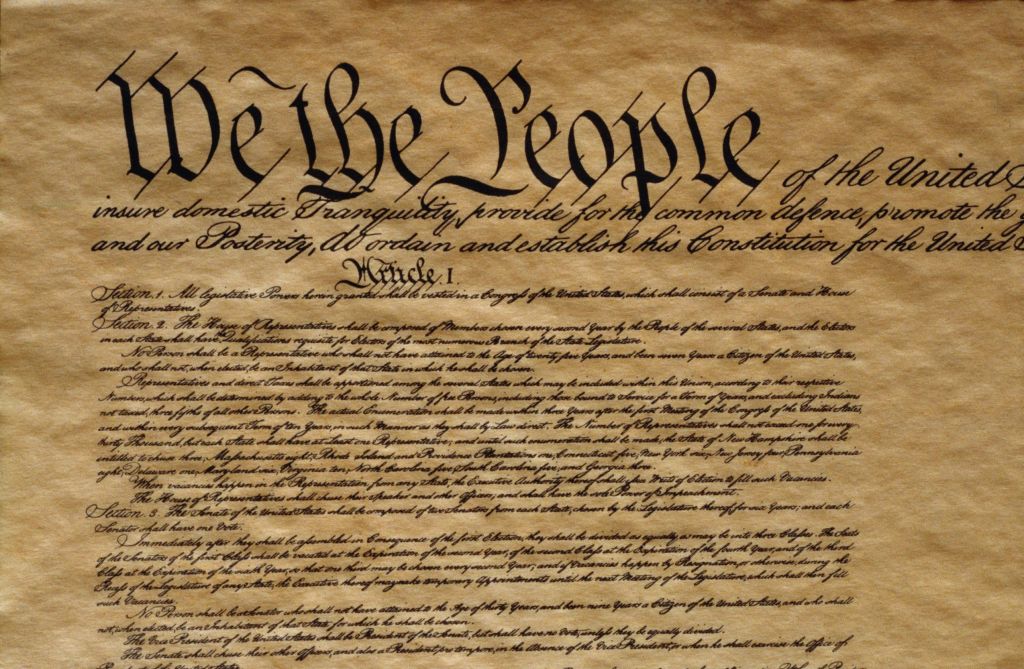
In the U.S. Constitution, the powers are split into three branches of government: executive, legislative, and judicial. The executive branch includes the President, his cabinet, and the military. All responsibilities of lawmaking and legislation rests upon a bicameral congress, which includes two groups: the Senate and the House of Representatives. The judicial branch is made up of the U.S. Supreme Court and lower courts. The process for law creation requires all three of these branches to work together and approve the proposed legislation. The framework of the Constitution provides separation of powers and proper checks and balances to all branches of government, ensuring that no party can have total control of the government and its laws (Constitution Annotated, n.d.).
Looking at these two texts together, the influence on the founding generation is clear. Many of the same governmental policies appear in both the Great Law of Peace and the U.S. Constitution. When isolating the fact that some of the most influential of the thirteen colonies (such as New York, Pennsylvania, etc) sat directly next to Iroquois land, it seems incredibly unlikely that there was no inspiration drawn from the Six Nations. Although actors such as George Washington and Benjamin Franklin were not particularly vocal during the Constitutional Convention debates, they had undoubtedly discussed it with the other Founding Fathers. They were highly influential individuals, and their ideas and thoughts were informing those of the Constitutional Convention members.
George Washington had a history with the Iroquois Confederacy to draw inspiration from. Beginning in the 1750s, when he served in the British army, Washington had interactions with the Iroquois during a journey to the French Commandant. He arrived at an Onondaga village to request information about the best path to the French forces. Washington stayed for several days in the village before traveling with some leaders to the French (National Archives, n.d.). He continued to have various interactions with them, such as a speech he gave to the Tuscarora people in 1756, where he discussed the friendship between the Six Nations and the British government (National Archives n.d.). He remained in communication with them closer to the revolution (National Archives, n.d.) There are countless examples of good and close relations between George Washington and the Six Nations, such as speeches and diplomatic visits. Washington would have been intimately familiar not only with their people and leaders, but with their policies and system of government.
The influence of the Iroquois on the founding generation can be clearly seen in the Albany Plan of Union of 1754, described by historian Beverly McAnear.In September of 1753, the Lords of Trade instructed a continental congress in the British colonies in North America to establish a treaty with the Six Nations. This direction came during the buildup to the French and Indian War, which began just before the actual establishment of the congress in Albany in mid-June of 1754 (McAnear 1953, 727-746). During the Albany Congress, as it would come to be known, Benjamin Franklin proposed the Albany Plan of Union, an attempt to establish a continental union in the North American colonies. The plan included an elected president, and a Grand Council of elected representatives from the colonies with a House Speaker. The president was elected by the Grand Council and would be replaced by the Speaker in the event of his death. The number of representatives from each colony on the Grand Council ranged from 1-7, depending on the size of the colony. The Albany Plan also contains various other articles, numerous of which are similar to the policies found in the current U.S. Constitution (National Archives, n.d).
Franklin and his Albany Plan of Union had a domino effect leading to the U.S. Constitution. As historians Carol L. Bagley and Jo Ann Ruckman write, the line from the Albany Plan of Union to the Articles of Confederation to the U.S. Constitution is a widely accepted series of events. However, what is less discussed is the heavy influence of the Six Nations on the development of the Albany Plan of Union (Bagley and Ruckman 1983, 60). As Grinde writes, in the months leading up to Benjamin Franklin’s drafting of the plan, he was heavily exposed to the Iroquois nations and their customs (Grinde 1993, 158). Indeed, as Franklin recorded in his autobiography, representatives from the Six Nations were present at the Albany congress, where the plan was introduced. “In 1754 […] a Congress of Commissioners from the different Colonies, was […] to be assembled at Albany, there to confer with the Chiefs of the Six Nations, concerning the Means of defending both their Country and ours.” Franklin even goes on to say that the proceedings of the Albany congress proceeded closely with the Six Nations on a daily basis (Franklin Papers, n.d.). Franklin’s Albany Plan of Union itself shares similarities with the Great Law of Peace, with representational government and other smaller aspects. Thus, with their good relations with the Iroquois, practiced implementation of Iroquois policies in government documents, and similarities between the Great Law of Peace and the U.S. Constitution, one can see how clearly the Iroquois influenced and informed the living document of the United States of America. Even minute details like the Grand Council mimic the names given to the Iroquois councils when they convene (Great Council, Council of Fire, Grand Council, etc.). The Iroquois nation was vital in the development of the Albany plan, both through the occurrence of the Albany congress and influence of the structure of the Constitution.
The Iroquois Confederacy, aside from being physically present at the Albany congress, were on the minds of other Founding Fathers aside from Franklin. James Wilson (the eventual author of the first draft of the U.S. Constitution) admired the Iroquois model and spoke highly of it during such important meetings as the writing of the Declaration of Independence (Grinde 1993, 160). Furthermore, Washington, Franklin, and Wilson were all delegates at the Constitutional Convention. Franklin had long-lasting dealings with the Iroquois throughout his life and professional career. He published Native American treaties, and he witnessed various ceremonies and cultural events. However, like many of the founding generation, Franklin had little respect for the people of the Iroquois Confederacy. Yet, he seemed to have respect for the nation that they had built, referring to it as “indissoluble” (National Archives, n.d.). Although he followed the trend of the time period of the racist rhetoric of the Indigenous people being savages, he clearly recognized the strength of the Six Nations and the government they had built.
Despite these points, the question of Iroquois influence on the United States Constitution remains a matter of contention among historians. One primary critic of the Iroquois influence is Erik M. Jensen, who wrote a response to Gregory Schaaf’s exposé expressing disapproval of the congressional resolution and outlining why the Six Nations were not, in fact, critical to the creation of the U.S. Constitution (Jensen 1991, 295-308). Jensen has the following primary arguments. There was no mention of Iroquois influence at the Constitutional Convention, and figures like George Washington and Benjamin Franklin who had relationships with the Iroquois contributed little to the actual writing of the Constitution. The founding generation saw the Native Americans as “savages” and thus would not want to draw from their ideas. The Iroquois were seen as threats, not as models, by colonists. These arguments don’t hold much weight when put under scrutiny.
Let us examine Jensen’s arguments point-by-point, beginning with his frustration with the lack of primary sources in Schaaf’s essay. Primary source analysis is vital to historical research and writing. The lack of primary sources in Schaaf’s argument is a major focal point of Jensen’s argument. However, primary sources cannot tell us everything. Sometimes, we must read between the lines and use correspondence, grants, orders of payments, and other documents to fill in our legal, social, and cultural understanding. There will never be a perfect primary source that shows every detail about a topic being studied. Furthermore, some primary sources should not be taken at face value. Often, these documents are riddled with biases and prejudices. Thus, we have to read between the lines, think about what else was going on during the creation of the source, and come to an educated conclusion.
The founding generation certainly saw the Iroquois as savages, and perhaps as threats; however, that did not stop the Iroquois from being models to the founders. The Iroquois were quite well known for their warfare and military tactics. In his book The History of the Five Nations of Canada, which are Dependent on the Province of New York, New York Governor Cadwallader Colden provides a brief overview on the tactics used by Iroquois warriors. “As to the first […] their warlike Expeditions are almost always carried on by surprising each other, and their whole Art of War consists in managing small parties” (Colden 1747, 12). Today, we might call these tactics Fabian Strategy or guerrilla warfare. Small groups of soldiers use unconventional methods of attack and knowledge of landscape to their advantage. This strategy proved particularly effective, as the Iroquois were able to gain significant military victories over tribes such as the Huron, Khionontateronon, and the Erie (Richter 1983, 539). During the course of the revolution, several generals employed similar tactics when faced with the overwhelming force of the British Army. One such general was Nathanael Greene. Historian Terry Golway writes, “Greene [formulated] an unconventional campaign employing guerrilla tactics of hit and run, never risking the all-or-nothing battle that might end the war” (Golway 2006, 231). Colden states that the results of the Iroquois war methods influenced the colonists at the time to imitate their tactics (Colden 1747, 12). Thus, if the colonists were already inspired by Iroquois war tactics in the period of early contact, and employed similar strategies during the course of the revolutionary war, we can read between the lines and say that most likely the Patriots were inspired, at least in part, by the Iroquois military doctrine specifically, even though there is no document explicitly stating just that. Although the Iroquois could have been viewed as a threat and were seen as savages, the colonists were not ignorant of the value of their strategies and adopted them accordingly. It is thus completely feasible that similar adaptations were made regarding the Constitution, without explicit mention of the Six Nations.
As much as it is true that the Iroquois were capable of being threats and models at the same time, during the Constitutional Convention, they were not a threat to the colonists. In his article, Jensen states, “Not once, however, in Madison’s […] notes of the Convention is mention made of the Iroquois Confederacy as a model for the American Constitution” (Jensen 1991, 300). The convention itself began on May 14th, 1787, and continued until September 17th of the same year, according to the notes of James Madison (Madison and Hunt 1900). Jensen is correct when he states that there is no mention of the Six Nations in the notes of the Constitutional Convention, nor was it necessary. At this point, the revolution was over, the British and their Iroquois allies had been defeated, the Treaty of Fort Stanwix (1784) had been concluded for three years, and much of the Iroquois land had been forcibly ceded. However, the U.S. government felt confident enough in the weakness of the torn confederacy to allow the Oneida and the Tuscarora to maintain their lands (Smithsonian National Museum of the American Indian, n.d.). Yes, they were allied with the Patriots during the war, but allowing them to keep their lands here is not a show of gratitude but a confidence in the weakness of the nations compared to the U.S. This does not spell out a delegation faced with the threat of Iroquois military might. Their lack of mention here shows continued erasure based on a perception of Iroquois inferiority, rather than a lack of influence.
The split in the Iroquois Confederacy during the revolution might also have had an impact on the lack of mention at the Constitutional Convention. While they might have been seen as models for military tactics, that did not make them less of an enemy during the war. Of course, the Iroquois initially maintained neutrality, much as the bequest of the American colonists. However, the pressure from both sides was too great to ignore. The Iroquois relied heavily on merchants and trading, especially from the British. When deliberating on what decision to make regarding the American revolution, the Iroquois Confederacy split. The Mohawk, Seneca, Onondaga, and Cayuga tribes sided with the British and Loyalists, while the Oneida and the Tuscarora provided support to the Patriots (Johnson 2003, 6-7). After the war and consequentially the defeat of the British and their Iroquois allies, the United States treated with the British and the Six Nations separately. As stated above, much of the Iroquois land was reduced in the Treaty of Fort Stanwix, and for years after, the Iroquois would be continuously pressed to cede their lands to the U.S. government. This can be seen in examples such as the Treaty of Canandaigua (1794), where the Iroquois land was supposed to be protecte (Smithsonian National Museum of the American Indian, n.d.) However, expansionism in the United States violated the terms of the agreement. Countless treaties would follow the same narrative, and the degradation of Iroquois lands saw no end.
The founding generation erased the Iroquois’ presence through land cession. There are three important stages to consider about the erasure of Iroquois. The first is the pre-revolutionary stage, the second is the revolutionary stage, and the third is the post-revolutionary stage. The pre-revolution stage really begins through landscape. In the grievances about the King of England listed on the Declaration of Independence, Thomas Jefferson writes, “He has endeavoured to prevent the population of these States […] refusing to pass others to encourage their migrations hither, and raising the conditions of new Appropriations of Lands” (National Archives, n.d.). This passage is most likely in reference to documents such as the Royal Proclamation of 1763 and Treaty of Fort Stanwix of 1763 (Oklahoma State University Libraries, n.d.). This grievance against expansion into Native territory set the tone for the following years of the revolution. A further aspect of this stage comes from cartography. Chad L. Anderson gives an excellent example of this process through his analysis of early maps of the New England area, “On maps [the decline of Iroquois political power] meant the erasure of Native American towns” (Anderson 2020, 11). Anderson also emphasizes erasure through book titles, referencing Cadwallader Colden’s book on the Iroquois (Anderson 2020, 6). However, we can also see this progression through the title of maps, such as Colden’s A Map of the Five Nations, Belonging to the Province of New York, from 1750 (Colden 1750). We already see land claims from the European colonists in the titles of the maps and history books alone.
The revolutionary stage of erasure came from the physical destruction of Iroquois sites.. Among the most harmful of military expeditions towards the Iroquois during the Revolutionary War was the Sullivan-Clinton expedition. On May 31, George Washington wrote to General John Sullivan, “The immediate objects are the total destruction and devastation of [Iroquois] settlements and the capture of as many prisoners of every age and sex as possible” (National Archives, n.d.). This was not a simple military operation, but a full force attack on Iroquois villages and tribes. Washington wrote later in his orders, “But you will not by any means listen to any overture of peace before the total ruin of their settlements is effected” (National Archives, n.d.). The tone for the handling of the Six Nations is clearly set from these orders from Washington. Holy sites, villages, crops, and people would be destroyed in the following months (Anderson 2020, 11). The lack of consideration for the people of these nations and their livelihoods goes to show how colonists thought of the Native people, and these practices continued beyond the Revolutionary War.
The third phase of the Iroquois erasure, post-revolutionary, pulls together the previous two phases by continuing land cessation and physical destruction of the Iroquois people. It is important to look at how the Iroquois themselves felt about the situation. In 1790, Seneca chiefs wrote to George Washington, inquiring about injustices brought upon their people by the U.S. government. “At fort Stanwix we agreed to deliver up those of our people, who should do you any wrong […] But instead of trying them according to your Law, the lowest of your people took them from your magistrate, and put them immediately to death” (National Archives, n.d.). Washington wrote back, expressing his lament for this and other actions; however the behaviors of the government remained unchanged. The Seneca also complain of Americans expanding into Iroquois land against terms of signed treaties. These complaints and other progressions of tensions eventually culminated in the Treaty of Canandaigua. However, much like treaties of the past, it was violated by the U.S., primarily on the state level, with continued expansion into Iroquois land. The primary offender was the state of New York through various government acts after 1794 (Graymont 1976, 463).
These three stages put the erasure of Iroquois into the context of the lack of reference during the Constitutional Convention. The colonists came to the “New World,” with some manner of respect for the Native Americans; however, with every intention of claiming their lands through mapping. As the colonies progressed and longed for independence from the British, among their chief complaints (important enough to be written on a document that is preserved to this day) was the restriction of expansion into Iroquois territory. Then, during their war for independence, the colonists proceeded to erase Iroquois villages and sites, kill their people, and destroy their livelihood. After the war, they signed treaties with the Iroquois, taking away vast quantities of their land, and then went on to violate those treaties by continuing to cede land away from the Six Nations. They intended to erase Iroquois life before, during, and after the Constitutional Convention. I see no reason as to why the Founding Fathers would want to mention the Iroquois, as they did not care to immortalize them in any way. Furthermore, as explained previously, the Iroquois system of government would have already been well known by the Constitutional Convention delegates, as discussed with the relationship between some of the Founding Fathers and the Six Nations. They knew the Great Law of Peace, they were familiar with its policies, and they had no intention of keeping the Iroquois around. Therefore, there was no need nor desire to explicitly mention the Six Nations.
The United States Constitution is categorically tied to the concepts of the Great Law of Peace. There is no primary source evidence explicitly stating the Iroquois influence. However, in analyzing historical documents and events, it is vital to read between the lines. There will not always be the perfect document to support a thesis or argument. One must analyze all the evidence, consider the relationships between the individuals and nations involved, and make an educated inference. Relying solely on explicit evidence is a fickle and potentially dangerous method of thinking about history. Writers of primary sources did not always have the best interests of all parties in mind. Often there are many things left unsaid, particularly in official government documents. Thus, when there is no clear answer to a question – such as whether the Iroquois influenced the Constitution or not – one must analyze other relationships and sways between the concerning parties. The importance of these historical methodologies cannot be understated. It is abundantly clear that the true democratic vision of the Founding Fathers came from the Native people of the continent they settled in. In doubting and pushing down the influence of Iroquois laws and policies on the Constitution, we ignore the successes of such minority groups and claim them as achievements of the Europeans and Euro-Americans. I do not believe that Erik Jensen was consciously attempting to push out the influences of the Iroquois. However, it is imperative that we investigate these situations copiously and push back against erasure of the Haudenosaunee – and indeed all Indigenous – contributions to the United States.
Bibliography
American History Central. “The Royal Proclamation of 1763 — Full Transcript and Text.” Accessed February 19, 2025, https://www.americanhistorycentral.com/documents/royal-proclamation-of-1763-text/.
Anderson, Chad L. The Storied Landscape of Iroquoia: History, Conquest, and Memory in the Native Northeast. University of Nebraska Press, 2020.
Bagley, Carol L., and Jo Ann Ruckman. “Iroquois Contributions to Modern Democracy and Communism.” American Indian Culture and Research Journal 7, no. 2 (1983): 53-72.
Colden, Cadwallader. A map of the country of the Five Nations, belonging to the province of New York; and of the lakes near which the nations of far Indians live, with part of Canada. 1750.
Colden, Cadwallader. The History of the Five Nations of Canada, which are Dependent on the Province of New York. London, 1747.
Constitution Annotated. “Constitution of the United States.” Accessed February 20, 2025, https://constitution.congress.gov/constitution/.
Franklin Papers. “Autobiography, Part 14.” Accessed February 24, 2025, https://franklinpapers.org/framedVolumes.jsp.
Golway, Terry Washington’s General: Nathanael Greene and the Triumph of the American Revolution. Henry Holt and Company, 2006.
Graymont, Barbara. “New York State Indian Policy After the Revolution.” New York History 57, no. 2 (1976): 438-474.
Grinde, Donald A. “The Iroquois and the Nature of American Government.” American Indian Culture and Research Journal 17, no. 1 (1993): 153-173.
Jensen, Erik M. “The Imaginary Connection Between the Great Law of Peace and the United States Constitution: A Reply to Professor Schaaf.” American Indian Law Review 15, no. 25 (1991): 295-308.
Johnson, Michael. Tribes of the Iroquois Confederacy. Osprey Publishing, 2003.
Madison, James and Gailliard Hunt, ed. 1787, vol. 3 of The Writings of James Madison: Comprising his Public Papers and his Private Correspondence, Including Numerous Letters and Documents Now for the First Time Printed. G. P. Putnam’s Sons, 1900.
McAnear Beverly. “Personal Account of the Albany Congress of 1754.” The Mississippi Valley Historical Review 39, no. 4 (1953): 727-746. https://doi.org/10.2307/1895397.
National Archives. “Declaration of Independence: A Transcript.” Accessed February 19, 2025, https://www.archives.gov/founding-docs/declaration-transcript.
National Archives. Founders Online. https://founders.archives.gov/.
Oklahoma State University Libraries. “Treaty of Fort Stanwix, 1768.” Tribal Treaties Database. Accessed February 19, 2025, https://treaties.okstate.edu/treaties/treaty-of-fort-stanwix-1768-21783.
Portland State University. “The Great Law of Peace.” Accessed February 20, 2025, https://www.pdx.edu/iroquois-democracy/great-law-peace.
Richter, Daniel K. “War and Culture: The Iroquois Experience.” William and Mary Quarterly 40, no. 4 (1983): 528-559.
Schaaf, Gregory. “From the Great Law of Peace to the Constitution of the United States: A Revision of America’s Democratic Roots.” American Indian Law Review 14, no. 2 (1989): 323-331.
Smithsonian National Museum of the American Indian. “Treaty of Fort Stanwix, 1784.” Nation to Nation: Treaties Between the United States and American Indian Nations. Accessed February 19, 2025, https://americanindian.si.edu/static/nationtonation/treaty-of-fort-stanwix.html.

