Hazel Carroll
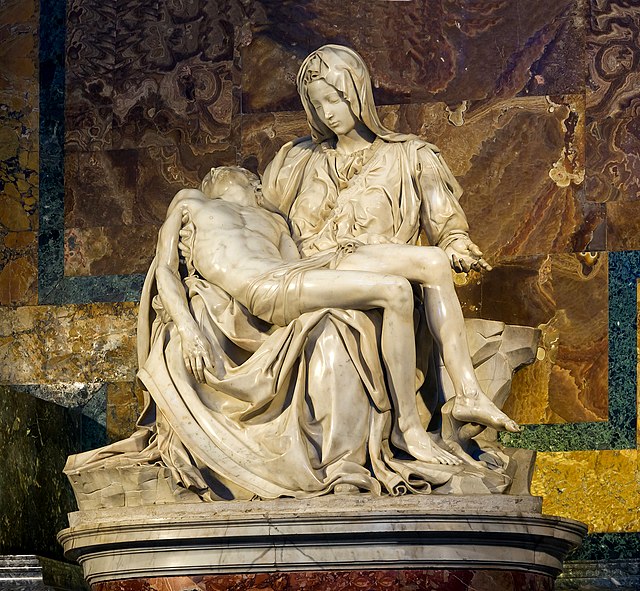
Over the centuries, the general meaning of the word mother as a female parent has remained largely the same. Despite this, the connotations of the term have shifted clearly over time. Throughout the Middle Ages into the early period of the English Renaissance, we see the word mother appear particularly in two connotations: the monstrous and the divine. The difference
between the two is often informed by the body and religious denomination. The most well-known monster mother of this period is Grendel’s Mother from the Old English Epic Beowulf, whose status as a mother makes her violence horrifying and informs her environment. A later example of monstrous mothers in British Literature is the Beast of Errour in Edmund Spenser’s The Faerie Queene. On the other end of the spectrum are the divine mothers such as the Mother Mary, Eve, and, to monks in the 12th century, Jesus. These depictions of divine mothers go through a clear shift with the English Reformation as emphasis in the Anglican Church draws away from the Virgin Mary and focuses more on Christ and God.
As it is used today, Mother is primarily both a noun and a verb. One of the oldest definitions of the word is its use to refer to a female parent, which originates in Old English. It then stands to reason that, when encountering the term in Medieval and Renaissance British Literature, this is the definition one can assume is being used unless context dictates otherwise. The idea of the word mother meaning a female ancestor (particularly Eve as the original mother), the Mother Mary, or a high-ranking woman within the church (a Mother Superior for example) also all originate and have records of their use since Old English (“Mother, N. (1).”). Beginning in the 1300s, we also begin to see examples of the word mother being used in medical contexts. This mostly refers to the uterus or disorders involving the uterus. In John Webster’s The Duchess of Malfi, the titular Duchess, being secretly pregnant, refers to herself as being “so troubled with the mother” (Webster 2.1.106). This, however, is not referring to her pregnancy but rather a medical condition known as “the mother” which is a, now historical, term used to describe a disorder believed to be caused by the uterus’ “upward displacement against other organs” (“Mother, N. (1), Sense II.9.”).
When the term mother is used as a verb in Medieval and Renaissance Literature it is likely referring to the act of giving birth, rather than the rearing and looking after of a child as it is more commonly used today, as there isn’t much evidence to the latter definition having been used prior to the late 19th century (“Mother, V. (1).”). This is not to say that the word mother didn’t have the connotations of caring for or bringing up a child. In fact, in the 12th century, many religious authors associated motherhood with instruction, pastoral responsibility, and nurturing (Bynum 127).
Within English literature of the Medieval and Renaissance periods, the word mother was occasionally connected to the idea of the monstrous. The connection is often drawn through the physical act of birth that makes a woman a mother rather than the raising of a child. Often in these monstrous portrayals the womb–whether physical or metaphorical–and the breaching of it play some role in the conflict of the story. It is true that the contrast of the mother as a caring figure with
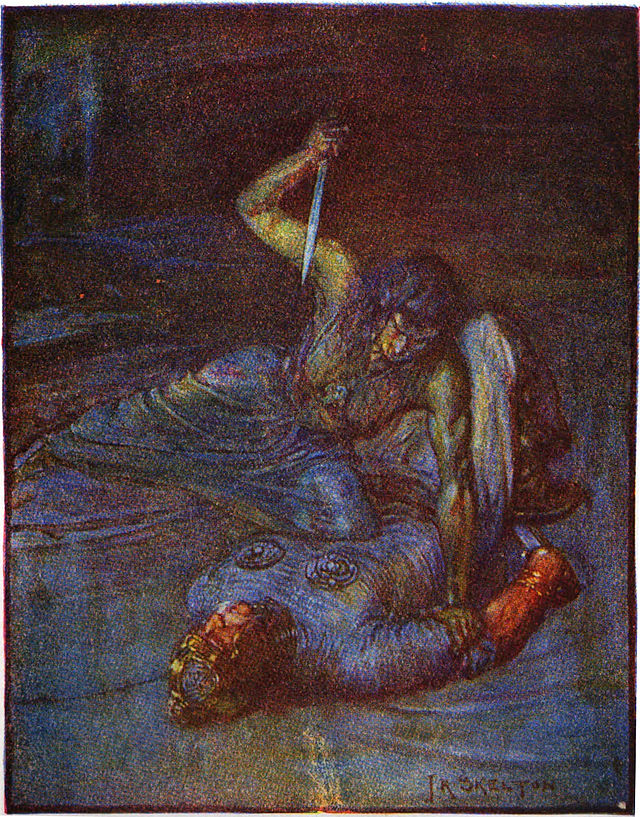
the violent creatures in these stories may have been a way to emphasize the horror. However, particularly in texts such as the Old English epic Beowulf, the way in which the word “mother” is almost always used to refer to the monstrous Grendel’s Mother may be telling of a wider societal idea.
Beowulf is the oldest and one of the very few examples of Old English poetry. It may be the sole survivor of a larger tradition of Old English long epics (Greenblatt 38). The story is believed to have been written down in the 8th century from an oral tradition. The word mother is used eight times within the text; seven of those times it is used in reference to Grendel’s Mother.
The first mention of Grendel’s Mother is when she avenges her son, who had just been killed by the titular Beowulf. Her son Grendel had been slaying the men of the Danish king Hrothgar; so, in an act of vengeance, the Geat warrior Beowulf slew him. This act is framed by the narrative as morally righteous. Grendel had been slaying the men of Hrothgar’s hall, an act that had to be answered for in either gold or blood. As Grendel had no means of paying for his actions in gold, the decision was made that he must die in revenge. It’s in this same way that Grendel’s Mother appears to be justified (Beowulf lines 1337-1340). Her son had been slain, which is a crime that must be answered for, and so she does. This said, the argument can be made, and indeed it has been made, that Grendel’s Mother’s monstrosity does not come from her wish for revenge, but rather from her acting on this wish.
In his essay “Horror and the Maternal in Beowulf,” Paul Acker argues that the contrast between the evil Grendel’s Mother and the general idea of a mother as a good figure is what makes her monstrous and thus increases the horror (Acker 705). However, there is no other mother significantly present within the story to provide a contrast to Grendel’s, and neither are there any other surviving epics from the tradition that Beowulf was likely a part of to look to. Understanding this, Acker looks to other closely related traditions: Old Norse and Old Icelandic family sagas. When examining these traditions in comparison to Beowulf, he finds that “inciting is women’s business, but revenge is men’s business,” and so a woman taking the actual act of revenge into her own hands in the way that Grendel’s Mother does would be seen as “distinctly deviant” (Acker 705-706). However, when looking at Beowulf as a sole text, it remains notable that the word mother is used almost exclusively in reference to Grendel’s Mother and the only time it is not referencing the monster, it is referencing the mother of Onela the Swede who was an enemy of the heroes of the story: The Danes and Geats (Beowulf line 2931).
The maternal aspect of Grendel’s Mother extends beyond the literal fact that she is the mother of Grendel; it becomes her environment. Grendel’s Mother lives in a cave at the bottom of a lake so deep that it takes Beowulf a day to sink to the bottom. Erich Neumann posited that the lake in which Grendel’s Mother lives, as well as the lake in which Beowulf is attacked by monsters earlier in the story, are representative of the “primordial womb of life” (qtd. in Morgan 56). Thus, Beowulf’s emergence from these waters could be argued as a kind of birth. The argument, then, can also be made that birth within Beowulf is an act of the masculine breaking free from the feminine, as Beowulf must escape Grendel’s Mother’s underwater lair and the earlier sea monsters. Beowulf’s battle with Grendel’s Mother is more than a battle with a monster, it is framing birth as a conflict with “the female principle” and the “archetypal mother” (Morgan 57). The villainous mother aspect of Grendel’s Mother is more than the fact that she is a woman acting upon a need for revenge; it is that her womb represents the first prison that men must escape.
Another monstrous mother comes in the form of The Beast of Errour in Canto 1 of Edmund Spenser’s 1590 epic The Faerie Queene. The Faerie Queene is an English epic that details the journey of the Knight of the Red Cross as he travels through allegory to examine different holy virtues. The Beast of Errour is the first monster he comes across and must slay. The Beast is a mother, but is special in that she is only once referred to as such. She is, undeniably, a mother. Her children, who live in her mouth, are referred to as her “spawn” and her “brood” (Spenser 1.1.22,25). Both words, while holding negative connotations, still maintain that the Beast is their parent, indeed, she is referred to as such in the 25th stanza of the first canto. In this same stanza is also the only time that she is referred to as a mother. However, the term mother is still distanced from her as the way she is called a mother is through relation to her children rather than addressing her directly, “[a]nd suckéd up their dying mothers blood”. Through this distancing of language, the term mother isn’t quite equated with the monstrous so much as the act of birth itself is.
How the Beast’s children emerge from her mouth is similar to labor. The Beast’s mouth resembles the womb, with the opening being the birth canal. The blood on which the children feed is reminiscent of the amniotic fluid and placenta, which provide the fetus with nourishment; both are expelled during birth. The Beast, the mother, also dies during this process, resembling the very real dangers that labor presented. While the Beast was slain by the Knight and not the victim of a dangerous childbirth, this fact doesn’t dispel the image of a dead mother surrounded by her newborn, rather, it gives childbirth a further violent connotation.
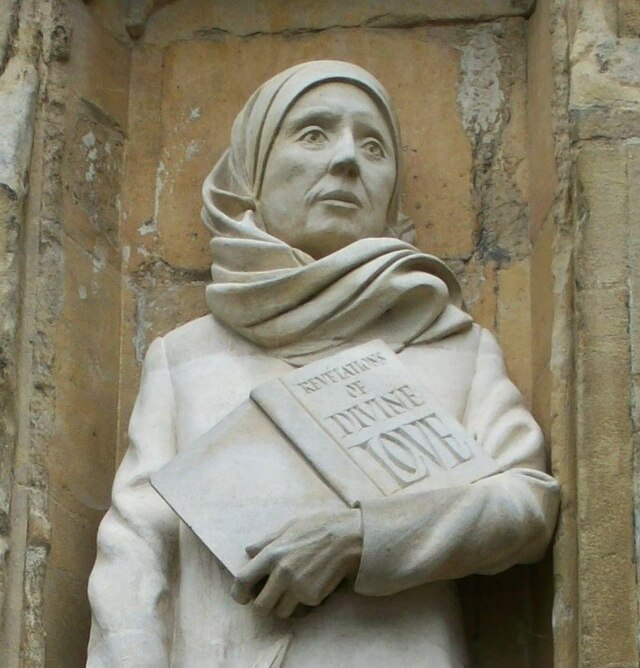
The other, more common, context in which the word mother appears is a religious one. While there’s the expected references to the Virgin Mary as the mother of Christ and Eve as the ancestral mother, in the Middle Ages there was a trend of using the term mother to refer not just to the literal mothers (Mary, Eve, etc.) of the Bible but
Jesus and the male prophets as well. One of the more famous instances of the idea of Jesus being a mother is in Julian of Norwich’s A Book of Showings to the Anchoress Julian of Norwich. Julian believed that within God, as well as Christ, there were three aspects. These were “the property of the fatherhood, the property of the motherhood, and the property of the lordship in one God” (Julian of Norwich 228). The properties of motherhood that she believed God bestowed upon humanity were love, wisdom, intelligence, restoring, saving, and the physical body, which she calls sensuality.
The tie that Julian of Norwich created between motherhood and wisdom was not without precedent. In the Old Testament, God’s wisdom was deemed to be a feminine aspect (Bynum 125). Along with this, there are several maternal metaphors within the books of the Bible. These metaphors are present in the Greek texts, however seem to have been suppressed in later Latin translations (Bynum 126). The idea of the Virgin Mother was also becoming more popular prior to Julian of Norwich’s showings, and “although it is not a female image applied to a male figure, it suggested to twelfth-century authors an association of instruction and pastoral responsibility with maternity and nurturing” (Bynum 127). The idea that love is an aspect of motherhood rather than fatherhood is also supported by other literature of the period, which stressed the father “as one who rules and produces, the mother as the one who loves” (Bynum 113).
The other main idea brought up by Julian of Norwich is that of Christ and God as mother being what grants humanity their physical body. This, too, has precedence, though not in the Bible. Instead, this idea comes from medieval medical theory in which it was thought that the mother provided the child with a physical body, whilst the father provided it with its life and soul (Bynum 133). By making Christ a mother, Julian of Norwich ties him to the physical realm and, in doing so, makes Christ more human. The image of Christ made human through motherhood can also be seen in The Book of Margery Kemp, wherein Margery Kemp is often moved to weeping at the sight of mothers and their children, as it reminds her of the Mother Mary and how Christ’s mortal body was killed (Kemp 239).
The divine mother a modern reader may be much more familiar with is the Virgin Mary. However, how the Virgin is referred to shifts with the English Reformation. Throughout the High Middle Ages, the focus of worship had slowly shifted towards the Virgin Mary as well as other female saints. The Virgin Mary was seen as a more human figure and thus more accessible to the average worshipper. The same happened with female saints, and the number of female saints canonized rose in this period (Bynum 137). However, the English Reformation and the Protestant Reformation in general led many converts away from images of saints as well as of the Virgin Mary, as they were deemed idolatrous by some denominations, most notably Calvinists and Puritans. The focus on divine motherhood also began to die out.
This shift is quite noticeable in John Milton’s poem “On the Morning of Christ’s Nativity”. The poem consists of two sections: An opening of four stanzas of seven lines and a 27-stanza hymn wherein each stanza contains eight lines. In the 31 stanzas that make up the poem, Milton only mentions the Virgin twice, once at the beginning and once at the end. The rest of the poem is devoted to other divine reactions to the newborn Christ. Nature is personified several times to demonstrate her awe, Lucifer is mentioned as well (this work was published over two decades before Paradise Lost), along with quite a sum of pagan gods who have all come to recognize the sovereignty of Christ. Echoing the shifting styles of worship of the period, the Mother Mary is largely ignored, only spoken of first in reference to her relation to Jesus and then to her actions with the babe (Milton stanzas 1, 27).
Though the general meaning of the word mother as a female parent has stayed relatively the same, excusing a more modern shift from the term being tied to the act of birth to meaning the rearing of the child, the connotations have shifted. In the Middle Ages and early English Renaissance, mother had two particular significances, that of the monstrous and that of the divine. The monstrous mothers, such as Beowulf’s Grendel’s Mother and Spenser’s Beast of Errour, often have strong ties to the body and the act of birth. Alongside transgressing against social standards for women, Grendel’s Mother turns her environment into her womb, a physical manifestation of her motherhood. In turn, Spenser’s Beast of Errour exemplifies the bloody dangers of birth and motherhood. On the other side of the spectrum, divine mothers are most often given focus in literature before the English Reformation, and, though depictions do exist after this, they are more rare.
Works Cited
“Mother, N. (1).” Oxford English Dictionary, Oxford UP, September 2024, https://doi.org/10.1093/OED/9542393614.
“Mother, N. (1), Sense II.9.” Oxford English Dictionary, Oxford UP, September 2024, https://doi.org/10.1093/OED/4859776811.
“Mother, V. (1).” Oxford English Dictionary, Oxford UP, March 2024, https://doi.org/10.1093/OED/1206549041.
Acker, Paul. “Horror and the Maternal in ‘Beowulf.’” PMLA, vol. 121, no. 3, 2006, pp. 702–16. JSTOR, http://www.jstor.org/stable/25486349.
Bynum, Caroline Walker. Jesus as Mother: Studies in the Spirituality of the High Middle Ages. University of California Press, Ltd., 1984.
Greenblatt, Stephen, editor. The Norton Anthology of English Literature: The Middle Ages. 11th ed., vol. A, W. W. Norton & Company, Inc., 2024.
Heaney, Seamus, translator. Beowulf: A New Verse Translation. W. W. Norton & Company, Inc.
Julian of Norwich. “A Book of Showings to the Anchoress Julian of Norwich.” The Norton Anthology of English Literature: The Middle Ages, edited by Stephen Greenblatt, 11th ed., vol. A, W. W. Norton & Company, Inc., 2024, pp. 222-32.
Kemp, Margery. “The Book of Margery Kemp.” The Norton Anthology of English Literature: The Middle Ages, edited by Stephen Greenblatt, 11th ed., vol. A, W. W. Norton & Company, Inc., 2024, pp. 233–46.
Milton, John. “On The Morning of Christ’s Nativity.” The Norton Anthology of English Literature: The Sixteenth Century and the Early Seventeenth Century, edited by Stephen Greenblatt, 11th ed., vol. B, W. W. Norton & Company, Inc., 2024, pp. 1385–93.
Morgan, Gwendolyn A. “Mothers, Monsters, Maturation: Female Evil in Beowulf.” Journal of the Fantastic in the Arts, vol. 4, no. 1 (13), 1991, pp. 54–68. JSTOR, http://www.jstor.org/stable/43308100.
Spenser, Edmund. “The Faerie Queene.” The Norton Anthology of English Literature: The Sixteenth Century and the Early Seventeenth Century, edited by Stephen Greenblatt, 11th ed., vol. B, W. W. Norton & Company, Inc., 2024, pp. 263–452.
Webster, John. “The Duchess of Malfi.” The Norton Anthology of English Literature: The Sixteenth Century and the Early Seventeenth Century, edited by Stephen Greenblatt, 11th ed., vol. B, W. W. Norton & Company, Inc., 2024, pp. 1080–155.

