Chieko Dunham
I’m going to begin with a little-known fact: the Texas Court of Criminal Appeals up until 2017 used Lennie to assess the intellectual ability of defendants who may be sentenced to the death penalty (Loftis 62). The court felt that “[m]ost Texas citizens might agree that … Lennie [and individuals like him] … should be exempt” from the death penalty because of his “…lack of reasoning ability and adaptive skills,” even though Lennie is ultimately sentenced to a death penalty at the hands of George, his guardian, for the exact reasons he should be exempt (Loftis 62).
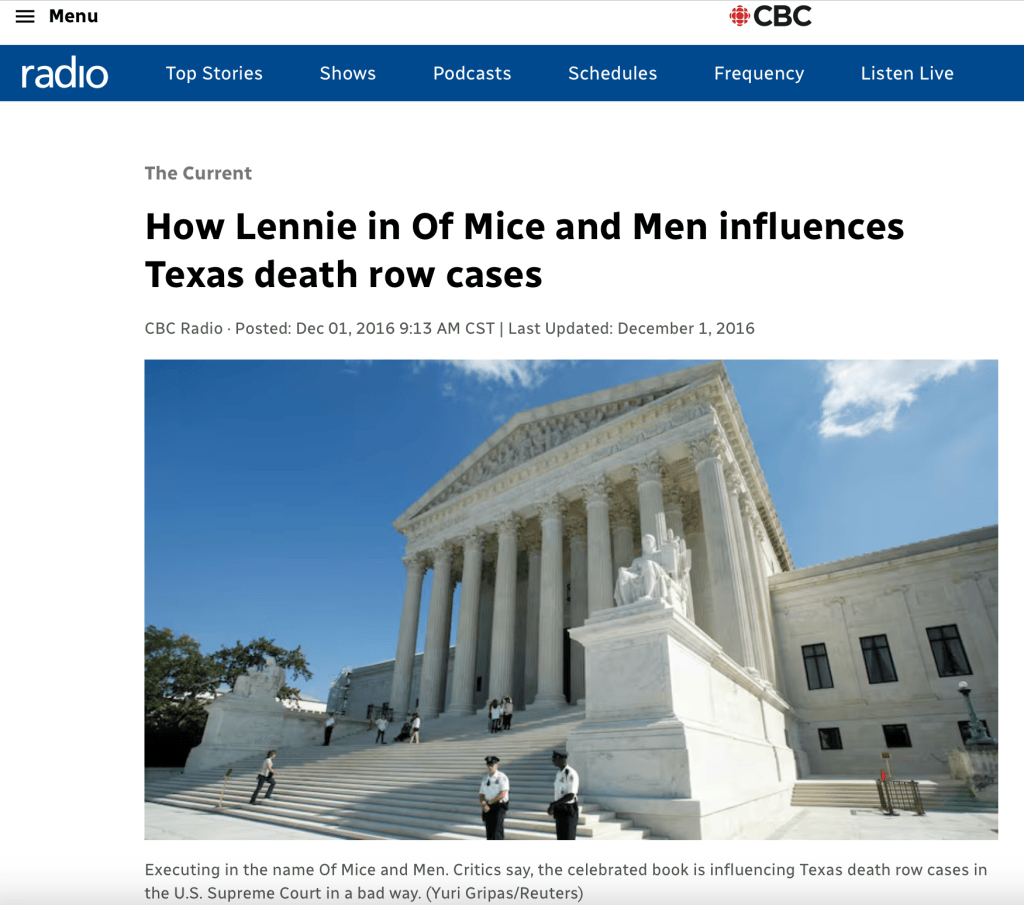
The ending of the novella as well as the Texas Court, despite their discrepancy, both lean into a medical model of disability that Steinbeck’s novella seems to endorse by ignoring Lennie’s agency. The medical model of disability views disability “in terms of individual impairments to be corrected and cured” in which the disability is viewed as a hindrance and personal failing of the individual’s fault (Adams 2).
However, disability studies pushes a social model of disability, one which understands disability as a social and environmental phenomenon where disability is a result of a “body’s interaction with the social and physical environment” rather than the body’s condition itself (Adams 2). For example, a wheelchair user who is barred from their education due to inaccessible campus buildings. I will be using the social model in my analysis, however, with a focus on the natural environment found within Of Mice and Men by asking the question: what happens when our focus in Of Mice and Men shifts from disabled individuals and instead toward the environment and the natural objects–trees, ponds, animals, etc.? Through a social model of disability, I will read read animals and natural objects that are deemed inefficient as disabled nonhumans. While readers very easily pick up on the social hierarchy within the farm, a “natural order” is also being negotiated within Steinbeck’s environmental descriptions and rhetoric. I will explore the environmental objects and language within the book to uncover Steinbeck’s construction of the “natural order” of the novella’s world. In this exploration, I plan to uncover the subtle workings “behind the scenes” of the novella that complicate its construction of disability: where disabled people are incapable of independence and easily disposable. In doing so, I am in part proposing a new way of reading for disability in natural environments that informs our “natural” humanity.
What first piqued my interest in the natural world of Of Mice and Men was George and Lennie’s entrance in the novella. George and Lennie have been dropped off at the edge of the new ranch where they will be working. They happen upon a field and find a green pool:
His huge companion dropped his blankets and flung himself down and drank from the surface of the green pool; drank with long gulps, snorting into the water like a horse. The small man stepped nervously beside him.
“Lennie!” he said sharply. “Lennie, for God’s sakes don’t drink so much.” Lennie continued to snort into the pool. The small man leaned over and shook him by the shoulder. “Lennie. You gonna be sick like you was last night.”
Lennie dipped his whole head under, hat and all, and then he sat up on the bank and his hat dripped down on his blue coat and ran down his back. “Tha’s good,” he said. “You drink some, George. You take a good big drink.” He smiled happily.George unslung his bindle and dropped it gently on the bank. “I ain’t sure it’s good water,” he said. “Looks kinda scummy” (Steinbeck 3).
Instead of focusing on the narrator and George’s treatment of Lennie (of which there is a lot to focus on), I’m going to draw your attention to the green pool. George assigns the word “scummy” to the pool after his hesitation about whether or not the pool is “good.” George’s use of the term “scummy” is in reference to the “extraneous” or “impure” matter that forms on the top of a liquid. However, the phrase “scum” or “scummy” can also refer to a “low, vile, or worthless person or group of people” (“Scum”).
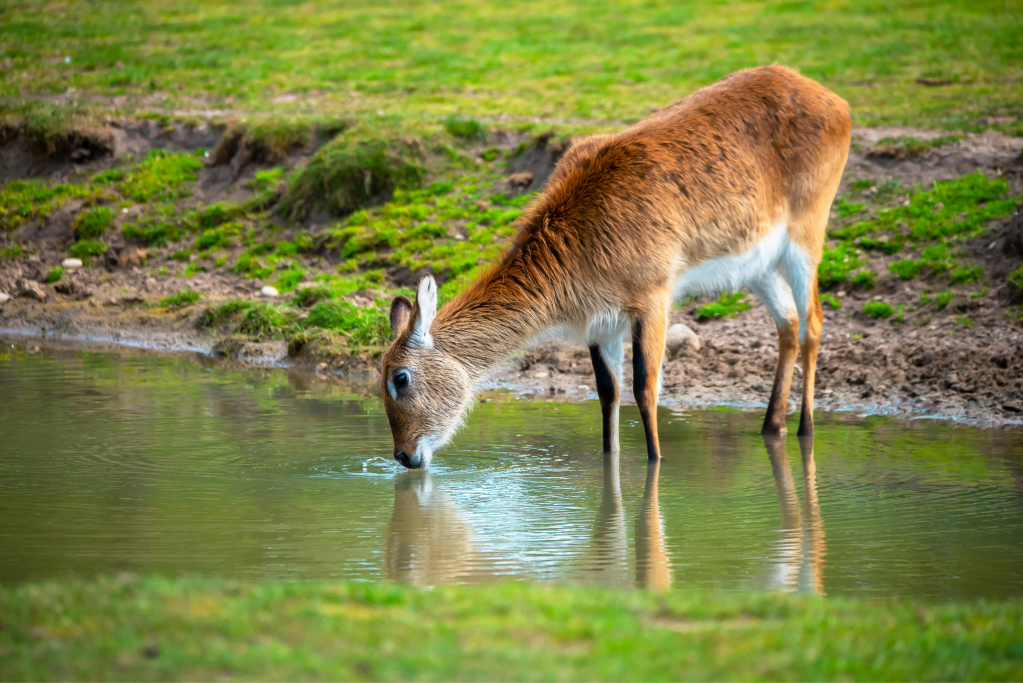
Lennie submerges his entire head below the surface of the pond, his mind becoming one with the “scummy” water. For Lennie, a mentally handicapped character, dipping his head into the water signifies Steinbeck’s understanding of the imperfect Lennie as “scum.”
Lennie even invites George to take “a good big drink,” and George does, but only “from his hand with quick scoops” (Steinbeck 3). George only drinks the water once it is removed from the scummy pond and taken above it (above the “scum”) towards his mouth. His refusal to stoop down to the same level as Lennie and drink directly from the pond along with his “quick” rushed scoops show his hesitation towards becoming part of an impure nature. Earlier, I was being very specific when I said that George “assigns” this notion of “scum” to the pool. Before George inserts this word into the conversation, the pool and the natural bacteria within it are not operating under labels of “pure,” “contaminated,” or “scummy.” They are simply engaging in their natural function. Lennie’s possible sickness from this “scummy” pool (which never comes to fruition after this scene) is one only contrived by George, the character in the novel whom the reader is expected to trust when it comes to keeping Lennie healthy. Through this, we can see that possibilities of disablement are ones that humanity contrives, not nature.
While Steinbeck, through George, offers the reader a picture of a contaminated pond, let’s consider the green pool on its own without the presence of George or Lennie. Steinbeck offers this description before George and Lennie enter the scene:
A few miles south of Soledad, the Salinas River drops in close to the hillside bank and runs deep and green. The water is warm too, for it has slipped twinkling over the yellow sands in the sunlight before reaching the narrow pool. On one side of the river is the golden foothill slopes curve up to the strong and rocky Gabilan mountains, but on the valley side the water is lined with trees—willows fresh and green with every spring, carrying in their lower leaf junctures the debris of winter’s flooding; and sycamores with mottled, white, recumbent limbs and branches that arch over the pool. On the sandy bank under the trees the leaves lie deep and so crisp that a lizard makes a great skittering if he runs among them. Rabbits come out of the brush to sit on the sand in the evening, and the damp flats are covered with night tracks of ‘coons, and with the spread pads of dogs from the ranches, and with the split-wedge tracks of deer that come to drink in the dark (Steinbeck 1).
In the absence of humanity, the green pool and everything around is flourishing. Based on how Steinbeck refers to each, it seems that many of them do not conflict with each other. This opening paragraph displays a sense of natural harmony, every piece is moving exactly as it should. The deer come to drink the water from the pool, never fearing the possibility of sickness from “scum” because it is engaging in a natural operation: hydration. It is peculiar, then, that Lennie, a human, engages in the same operations and instincts as these animals, participating in the same harmonious picture.
Doubly peculiar is how Lennie also arches over the pool (albeit arching so far his head goes in) in the same way that the “limbs” of the sycamore tree do. Additionally, Steinbeck heavily reinforces Lennie’s identification with and mirroring of nature by going so far as to describe Lennie as a “bear” and a “horse” (2-3).
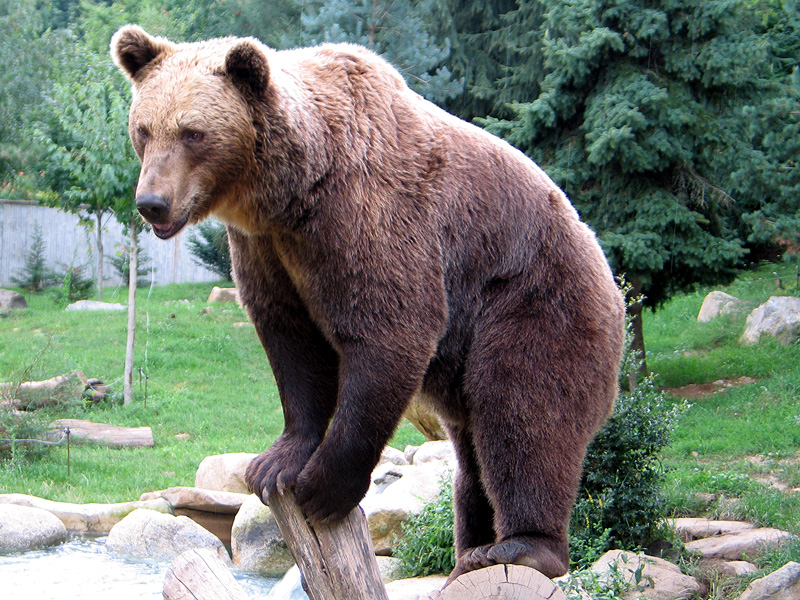
Through these environmental details arise a possibility of reading Lennie not through the social dynamics we are inclined to but instead through natural images. I will note: I am extremely wary of describing disabled individuals as “animals” or “animal-like” due to its quick slide into eugenic thinking, but Steinbeck readily does so with Lennie. Engaging in this harmful association, however, Steinbeck aligns Lennie with nature, to a point where his position within the “natural order” becomes confused. The book might suggest that Lennie is an agent of nature and its natural order. However, considering Lennie as an agent of nature alongside his animal-like descriptions puts Lennie in an awkward place in the hierarchy of nature. He becomes stuck in limbo between man and nature, but in this limbo is the suggestion that Lennie’s disability allows him to act as an “arbiter” between humanity and nature. If one considers this reading of Lennie’s character then his pivotal scenes with Curley and Curley’s wife, in which both lead to impairment or death, are loaded in an entirely different way. Curley’s impairment at the literal hands of Lennie can now be read as “nature taking its course.” As calming and comforting as nature can be, death is as much a part of the natural cycle as life is, and perhaps Lennie puts Curley’s wife in that phase of the natural cycle prematurely. This does not negate the violence that Lennie engages in nor does it negate the horror that it incites, but with a natural reading it simply exposes the truth that nature can indeed be a destructive force acting on itself as opposed to fearmongering the “dangers” of mentally disabled people.
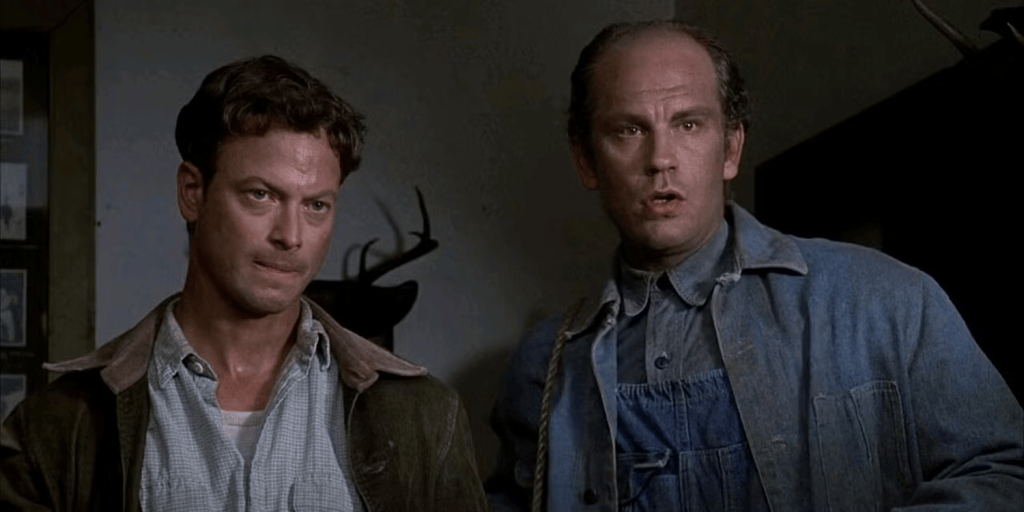
While I’ve discussed what Lennie’s animal-like descriptions and alignment with nature mean for him, we can also discuss what these associations mean for the natural world within Of Mice and Men. If an intellectually disabled man is so closely aligned with nature, then what does that say about nature? Taking everything into account (Lennie arching like the sycamore tree, Lennie drinking from the pond like the deer, and his animal-like description), nature, as it is constructed in the novella, is disabled. If nature is disabled, then disability is a natural condition and natural occurrence that holds a certain status within the “natural order.” If disability is an accepted part of nature, then any disavowal of disability can be seen as a form of rejecting the “natural order.” George disavows nature by calling the green pond “scummy” and continues to disavow nature as the novella progresses by speaking for Lennie, controlling Lennie’s actions, and killing Lennie because of his disability—betraying his relationship with Lennie and severing his alignment with nature. However, George’s killing of Lennie is justified and reasoned as inevitable by the fellow able-bodied characters of the novella, most notably by the lawful and honorable Slim. Suddenly, noble and morally “good” characters like George and Slim can be read as disavowing nature, a disavowal that fuels the tragedy in Steinbeck’s morality play, suggesting that an investment in ableism goes against nature. By focusing on the natural environment and language in Of Mice and Men, Steinbeck’s notoriously offensive novella is given a new progressive life!
By prioritizing nature in my analysis, I’ve uncovered the complications of disability as it is constructed within Of Mice and Men. Focusing on the natural objects and environmental language, Lennie’s possible role as an agent of the natural order is uncovered as well as the possibility Steinbeck suggests that nature itself is disabled. Suggesting that nature is disabled pushes a progressive message that disability is a natural condition accepted by nature, and that disavowing it will cause disharmony.
Bibliography
Adams, Rachel, et al. “Introduction.” Keywords for Disability Studies, edited by Rachel Adams et al., NYU Press, 2015, pp. 1–5. JSTOR, http://www.jstor.org/stable/j.ctt15nmhws.3. Accessed 13 Feb. 2025.
Loftis, Sonya Freeman. “The Autistic Victim: Of Mice and Men and Flowers for Algernon.” Imagining Autism: Fiction and Stereotypes on the Spectrum, Indiana University Press, 2015, pp. 61–78. JSTOR, http://www.jstor.org/stable/j.ctt17kmw55.7. Accessed 15 Jan. 2025.
“Scum.” Merriam-Webster.com Dictionary, Merriam-Webster, https://www.merriam-webster.com/dictionary/scum. Accessed 12 Feb. 2025.
Steinbeck, John. Of Mice and Men. Penguin Classics, 2000.

