Lyn Kress
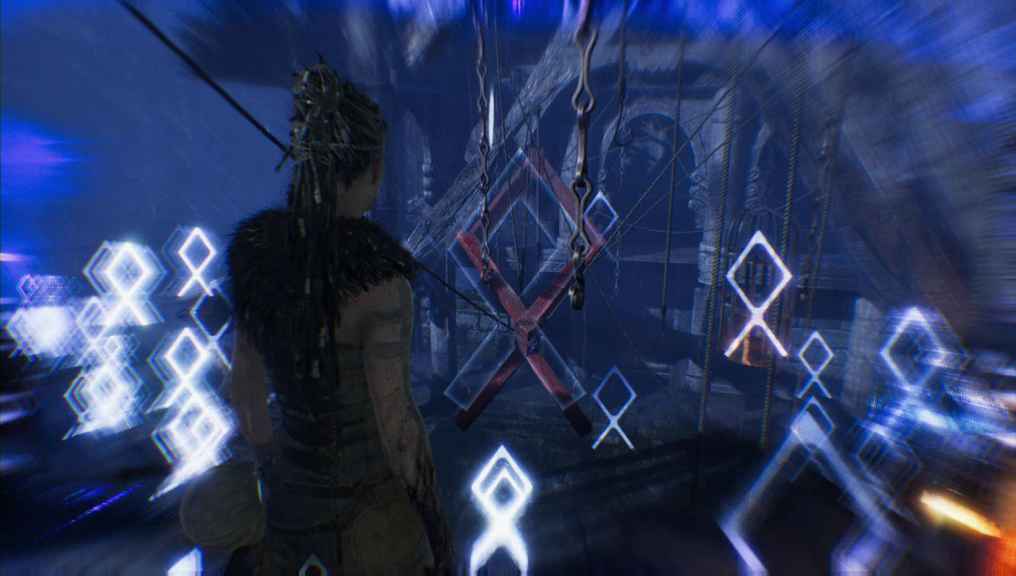
Hellblade: Senua’s Sacrifice is a 2017 action-adventure video game published by Ninja Theory that explores the topics of Norse mythology, mental health, and grief in a quick yet emotionally complex playthrough (Antoniades,
2017). Hellblade occurs in a fantastical world resembling Norse mythology and the culture of the Celts and follows protagonist Senua who suffers from a severe case of schizophrenia after the loss of her lover, Dillion, to sacrificial murder, for which she blames herself. Her mental health and religion are tied together due to psychosis-induced religiosity. Analyzing the narrative, design, and gameplay of Hellblade: Senua’s Sacrifice will reveal the connection between the game and its representation of religion, and the pertinent place religion holds in the lives of people with severe mental illness.
The narrative of Hellblade: Senua’s Sacrifice is a story of a woman wanting to retrieve her lover from the depths of Niflheim and Helheim, both being the Norse descriptions of the Christian “Hell” or Greek “Underworld.” To do this, Senua must defeat the princess of Hel, Hela, all while also fighting her battle with schizophrenia. The story is very akin to the Greek story of Orpheus and Eurydice, which follows Orpheus down to the underworld to convince Hades to let Eurydice come back to the living. The majority of the underlying narrative of the game is told verbally through voices Senua hears. These stories are unlocked by progressing through sections of puzzles that are arguably the most important function of the game, even if Hellblade is not advertised as a puzzle game. The stories, mainly told through a voice she hears named Druth, tell old stories of Norsemen and the violence that warriors in the Middle Age in Scotland had to endure. While a lot of the story is caked in fictional opinions of Druth, a lot of it could be considered reliable in the sense that it explains overarching concepts that were true for the Norsemen during the Middle Ages.
Senua experiences religion in a visceral sense, being close enough to touch it. She uses it to cope with severe traumas in her life, including the death of Dillion and her mental illness. She is suffering through a severe case of schizophrenia throughout the narrative of the game and, while her perceptions of herself and most things around her are skewed, Helheim, Niflheim, and Hela are grounded in what Senua understands to be reality because they are seemingly the world she finds herself pursuing. Her religiosity is a grounding technique for her, as it is for many people with psychosis or other psychological disorders (Siddle et al., 2002). Senua’s perception of reality being distorted due to her schizophrenia makes her somewhat unreliable as a narrator, yet the Norse mythological aspects of the game stay consistent. While it could very well be argued that none of this is actually being corporally experienced by Senua, her perception of reality might as well be as real as she sees it. The world around her could very well be a defense mechanism her brain is creating for her. The compensation hypothesis, as written by Hugulet et. al in Attachment and Coping in Psychosis in Relation to Spiritual Figures, proposes that attachment to God, or in Senua’s case, the deities and world of Norse Mythology, is a replacement for an insecure attachment the sufferer of psychosis has since lost (Huguelet et al., 2015). Putting this hypothesis into action in the context of Hellblade, Senua is using her religion to cope with the tragic, ritualistic murder of Dillion. Her overt religiosity throughout the gameplay is clearly an attempt to grasp onto anything she can. She truly believes that venturing deep into Helheim, something that seems to be detrimental to her health, is paradoxically the only way she can keep on living, because it allows her to believe she may be able to see Dillion again. This is her driving force, and she herself states that without him her life would be deemed meaningless.
Hellblade: Senua’s Sacrifice is a third person game with 3D graphics, but the most important and striking piece of this game is the sound design. Controlling a character who is suffering from schizophrenia, you can hear the voices in her head throughout the entire game. This remarkable sound design allows the player to project themselves onto Senua, experiencing exactly how she is perceiving her thoughts. It ranges from whispers to yells and gets more intense as Senua gets more stressed or scared. The audio works the hardest at making the game immersive, almost devastatingly so. Besides her own set of unnamed voices, she hears voices of a man from her past that has since passed, the aforementioned Druth, and for the entirety of the game it is unclear whether she is actually accompanied by his spirit or imagining them due to her mental illness. That being said, Senua, with her schizophrenia, also suffers from hallucinations. These are seen at various points during the game and a plethora of them are hallucinations of dangers that can seemingly hurt Senua, which makes the player lose track of what is and is not real. In Kelly Clancy’s Playing With Reality, she describes the idea of games that lean on the player having incomplete information (Clancy, 2024). Clancy sources card games, which speak on the player having to intuit their opponents next move; however, the same thing can be said about Hellblade.
The inclusion of Senua’s voices and hallucinations make the player unsure of what is real or not real, leaning on the psychological impact these designs can have on a player. The inclusion of such subversive qualities to the game design also calls attention to Karl Marx’s idea of alienation (Marx, 1958). Marx argued that the working class is so immersed into their jobs that it can be alienating, not only alienating them from their homelife but also from the job itself because the job becomes over-consuming. This argument can be echoed for the consuming qualities of Hellblade: by viewing these qualities as alienating the player from the world they actually live in, being so subversive and mesmerizing that it takes the player away from their life and into Senua’s, as if the player was her, not just playing her. This could actively disrupt the player from their own perception of the world as they focus on Senua’s understanding of the environment around her.
In between the fighting gameplay of Hellblade: Senua’s Sacrifice, there are chunks of the game where the objective is to complete puzzles. This makes up the bulk of the game because during these bits of puzzle, Senua listens to stories being told by Druth that push the narrative along as Senua works on making her way to Helheim. The interesting thing about these puzzle-based sections of the game is that they are the least structured part of the gameplay. Throughout every other part of the game, the player is being directly led where to go and told what to do by Druth or the unnamed voices in Senua’s head. However, during the puzzles, Druth’s only function is to tell stories to Senua, and the unnamed voices are silent. This is a clear difference from the rest of the game where choices are minimal with a lack of instruction, and it poses the question of what exactly the “game” is. Theoretically, if the player neglects to complete the unguided task of the puzzles yet continues to wander around the map without progressing through the narrative, it is unclear whether or not they are still playing the game because they are not completing the task, but are nonetheless actively immersed in the gameplay.
This can be circled back to the importance of rules in games, of which Bernard Suits speaks heavily in The Grasshopper, where he defines the difference between winning and playing (Suits, 1978). Suits describes winning as the overall outcome of the game and playing being the action that leads to it. His example is poker, writing, “the means for winning at poker, therefore, are limited, but not completely determined, by the rules. Attempting to win at poker may accordingly be described as attempting to gain money by using the most efficient means available, where only those means permitted by the rules are available” (Suits, p. 23). Suits continues to describe the act of winning compared to following the rules, where negating the rules completely will make the feat of winning impossible. That all being said, it would be fair to say that to avoid the outcome of finishing the puzzles in Hellblade, while an option, would mean the player is no longer playing because they are not seeking the goal of the game any longer. This makes the structured gameplay of Hellblade, as a narrative game, the most important aspect of playing it, unlike an open world video game where the rules and boundaries are more suggestive. In conclusion, Ninja Theory’s 2017 release of Hellblade: Senua’s Sacrifice is a complex game that inhabits traits that researchers dub the important aspects of a game. The game speaks on heavy topics by fully immersing the player in Senua’s mental illness, employing game design like sound and untrustworthy visuals to make the player feel uncertain of what the game is trying to tell them, intending to mirror what Senua is feeling onto the player. The game leans heavily on its structured gameplay to move the narrative forward, making the puzzles and actions something the player cannot avoid, unlike an open world game or one where multiple endings are achievable. The effective narrative of Hellblade investigates religion and its place in the mind of people with mental illnesses, mirroring the idea that people who suffer with these ailments tend to use religion to cope with their trauma. Ultimately, Hellblade: Senua’s Sacrifice allows more insight into the world of trauma, religion, and psychosis, allowing it to be seen in a perspective that is not regularly displayed and is most often stigmatized.
Bibliography
Tameem Antoniades. Hellblade: Senua’s Sacrifice. Ninja Theory. PC/Playstation/Xbox. 2017.
Siddle, Ronald, Gillian Haddock, Nicholas Tarrier, and E. Brian Faragher. 2002. “The Validation of a Religiosity Measure for Individuals with Schizophrenia.” Mental Health, Religion & Culture 5, no. 3: 267–84.
Huguelet, Philippe, Mohr, Sylvia, Rieben, Isabelle, Hasler, Roland, Perroud, Nader, and Brandt, Pierre-Yves. 2015. “Attachment and Coping in Psychosis in Relation to Spiritual Figures.” BMC Psychiatry 15, no. 1: 237.
Clancy, Kelly. “Playing with Reality.” New Yorker 100, no. 28 (September 9, 2024)
Marx, Karl. Economic & Philosophic Manuscripts of 1844. (Berlin, Germany. Progress Publishers, 1958) Suits, Bernard. The Grasshopper: Games, Life and Utopia. University of Toronto Press, 1978.

