Reagan Butler
In the horror film, a woman is often placed in one of two binary positions: a victim or a monster, the pursued or the monstrous pursuer. But there is one female character who notably complicates this binary: the nun, who often plays a surprisingly fluid role in horror—crossing the binaries to act as protagonist and antagonist, as aggressor and victim. Presumably, this is because the nun is first signified by an element of lack; she is nun before woman, her female attributes and desires forbidden, hidden and repressed. Within the subgenre of nunsploitation—of films that configure nuns as overly sexual or perverse—there are varying representations, and all remain popular. For example, released as a part of James Wan’s The Conjuring universe, The Nun stars scream queen Taissa Farmiga as Sister Irene, a devout novice working on her final vows. Though stockpiled with cliches and conventions, the film offers our two classic types: the pure nun and the evil nun: the former beautiful and submissive, aware of her sexuality, rejecting male advances; the other ugly, demonic, impure.
As a counter-example, Rose Glass directed Saint Maud (2019), an arthouse take on the horror nun. Described as “elevated horror,” Saint Maud is a psychological thriller in which the film’s titular nun is allowed to embody both nun types. She is pure and defiled, righteous and immoral—though obviously not at the same time. Perhaps the most socially relevant addition to nunsploitation is Immaculate (2024), starring Sydney Sweeney. Modern-day sex symbol and American meme sweetheart, Sweeney’s filmography is often confined to the role of a submissive busty blonde, and her biggest performances (HBO’s Euphoria and Sony Pictures’s Anyone But You) are marked by overt sexuality and effortless seduction. Immaculate subverts these expectations, though, by positioning Sweeney as a pious virgin in modest habit and veil, with a voiceover informing the audience that her body belongs only to God. The nun in horror has longevity, and if even sexy Sweeney can somehow become a “pure nun,” then the genre clearly has significant possibilities of inversion. In this paper, I am especially interested in the beginnings of this horror film trope and will argue that to comprehend the horror nun and her fluidity, we need to understand the melodrama or “woman’s film”—that is, we must return to its origins.
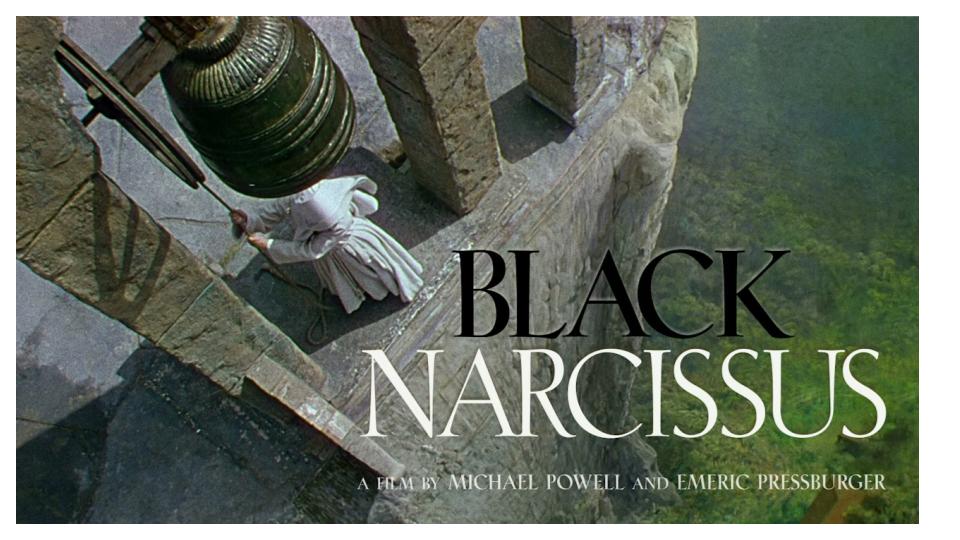
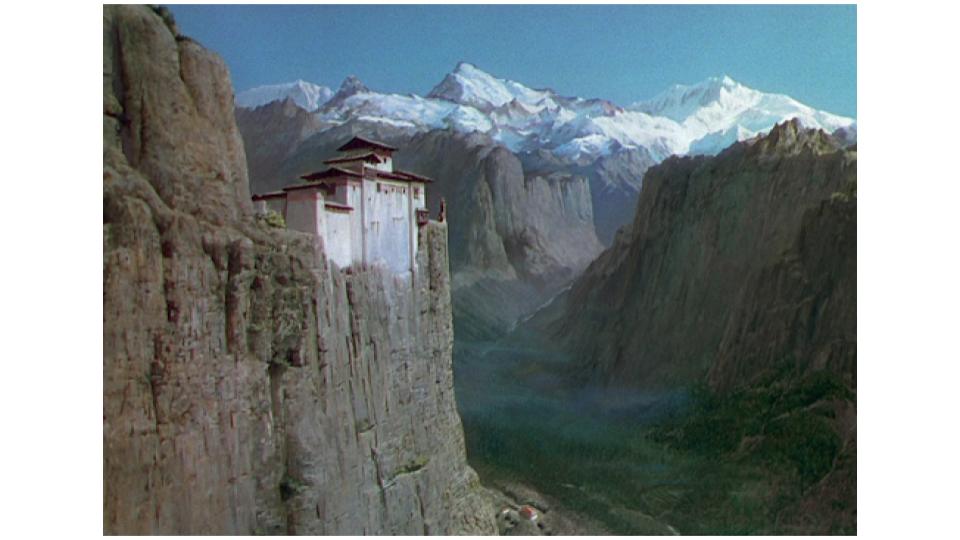
Black Narcissus is a Michael Powell-directed, Emeric Pressburger-penned melodrama that won the Academy Award and Golden Globe in 1947 for outstanding cinematography. Based on Rumer Godden’s 1939 eponymous novel, Black Narcissus concerns a group of Anglican nuns attempting to repurpose a deserted palace, formerly a brothel, atop an isolated mountain in the fictional Himalayan village of Mopu. They intend to build a school and dispensary. But troubles ensue as the nuns grapple with the hostile climate, the erotic imagery decorating the palace, and the handsome government worker appointed as their guide. Indeed, the relationship between these nuns—Sister Clodagh played by Deborah Kerr and Sister Ruth played by Kathleen Byron—becomes positively homicidal. The plot of Black Narcissus is that the nuns begin to lose their minds. To put it frankly, the sisters get horny. The atmosphere (both of India and of the film itself) is too intoxicating for them; indeed, it is sufficient to transform overnight an average nun into a wanton sex-craved murderer. The real issue, it turns out, is the fraught relationship between religious and sexual repression, and the film is constructed by oppositional binaries—England/India, chastity/sex, sacred/profane, and naturally man/woman.
Black Narcissus is often categorized as a melodrama and a “woman’s film,” a term used to classify films of the 1940s that incorporated female discourse and targeted a female audience. The idea of a female spectator, thus a female gaze, often complicates feminist film theories based on fetishism and voyeurism and the patriarchal implications that accompany such spectatorial perversions, as theorized by Laura Mulvey in her essay “Visual Pleasure and Narrative Cinema.” Mulvey explores how people’s desire in film exists in a patriarchal society. She uses psychoanalysis as a “political weapon” to demonstrate the way “the unconscious of patriarchal society has structured film form” (667). Pleasure in the visual sense, scopophilia, encompasses both the “pleasure of using another person as an object of sexual stimulation through sight” and the pleasure coming from “identification with the image seen” (Mulvey 670). In either case, the pleasure is distinctly male; that is, it arises from a “male gaze.”
Mulvey’s analysis underlies much of the critical work on viewing films in general and on conceptualizing a female audience in particular. Most notably, Mary Ann Doane infiltrates “phallocentrically organized discourse such as the classic Hollywood text” to dissect how film spectatorship changes across gender lines. She notes that “because female identity in the cinema is constructed in relation to object-hood rather than subject-hood, an investigation of the contradictions resulting from an attempt to engage female subjectivity in a textual process such as the ‘woman’s film’ can be particularly productive” (Doane 285). Critic John Lyden locates Black Narcissus firmly in the melodrama or “women’s film” category. This film’s concerns are those of the woman’s film: pent-up emotion, repressed individuality, and forms of normalized female control. The discursive space these themes are given within the melodrama typically acts as a corrective to society’s overvaluation of men. In Black Narcissus, the nuns’ responsibilities speak to an obedient, domestically-driven ideal of femininity, and their later descent into madness indicates a seething subterranean anger.
The colonial and political intricacies of the 1940s do complicate this reading of Black Narcissus as female melodrama. Notably, the film was released just a few months before Indian independence from Britain in 1947. Priya Jaikumar theorizes that popular British and Indian films in the years leading up to India’s independence foresaw decolonization in “utopian visions of realigned power” and that in doing so “their content and form negotiates the anxiety and exhilaration of impending socio-political changes in the imperial metropolis and its colony” (3). Jaikumar cites the film as having helped to expose the “fragility of a British nation-state that was constituted on internally schismatic—simultaneously liberal and imperial—political philosophies” (3). Indeed, Dave Kehr claims the final visuals of the film, which depict the sisters abandoning the Himalayas, could be interpreted by British viewers as a “last farewell to their fading empire” (2). Jaikumar makes the case for the “social significance of such masculine melodramas to British society in the 1930s” noting that this is “illuminated by existing theorizations of Hollywood and British ‘women’s films’ of the 1940s and 1950s, because the foreign frontier of colonial place functions ideologically and symbolically for the white male in much the same way as does the domestic sphere of family for the white female” (145). She explains that, for the male, the colony represents a hostile setting where desires have been unsatisfied. The gender binary inevitably overlaps the British/Indian colonial binary. I am attracted to the reading of Black Narcissus as both a female melodrama about gender and a male melodrama about colonization, but given the particular significance of the nun to my reading, I will only discuss the former in relation to “utopian visions of realigned power.”
In the Mopu convent, the nuns are caught between the sacred and the profane and struggle to remain chaste amid an atmosphere of sweltering sexuality. Albeit trapped in a former harem, they are expected to maintain piety. In her “Femininity by Design,” Tania Modleski notes that femininity is a “male construct” and something akin to a trap. In the case of these nuns, overt expressions of femininity are stripped away: hair, makeup, and clothing as signifiers of femininity are replaced with white cloth that covers head to foot, revealing only un-made up faces. But if reconstructed as “pure” and stripped (or relieved) of their gendered duty to be romantic prospects, the nuns are still shaken by the intrusive memories of their past lives before they took vows of poverty, chastity, and obedience. The nuns are who they are, but also who they were.
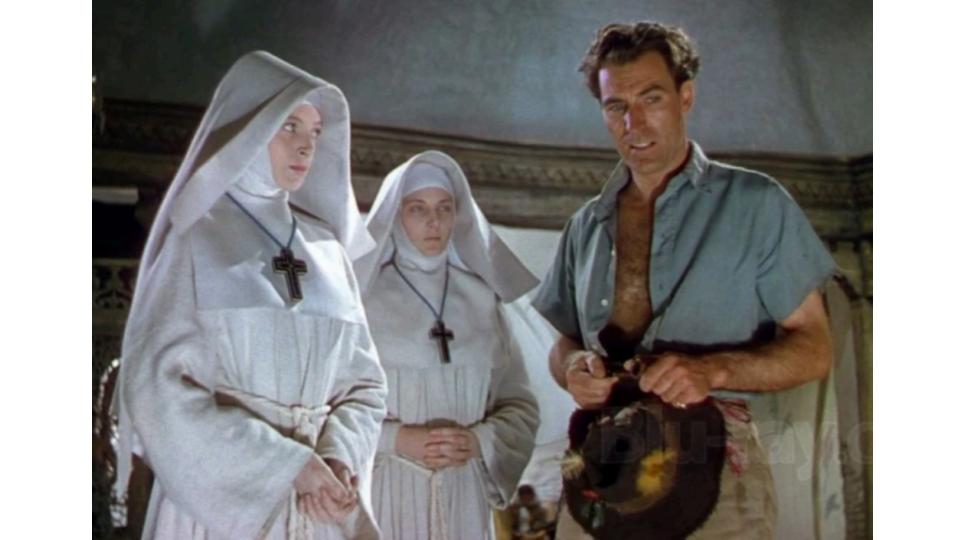
This duality emerges further in the figures of Sisters Clodagh and Ruth, who come to occupy the roles of “pure” and “evil” nun respectively. In Barbara Creed’s “Horror and the Monstrous-Feminine: An Imaginary Abjection,” she studies the gendering of the source of horror and concludes that female killers and monsters are found to be horrifying precisely because of their gender.
In the case of Ruth, her monstrosity is connected to her being a sexual subject. When the carnal environment of the brothel-turned-convent (and Mr. Dean’s provocatively unbuttoned shirt) becomes too intoxicating, Ruth deserts her religious faith and plunges headfirst into libidinal madness. Clodagh’s breakdown is less spectacular, but she too is faith-waveringly affected by sexy Mr. Dean. His presence thus awakens something untoward in each of our sisters. If causing Clodagh to vividly recall a past relationship and driving Ruth to insanity, jealousy, and murder indicate very different levels of female response, it also points to the fact that, over the course of the film, the two nuns become gothic doubles.
The binary splitting of the nun signifies the birth of the film’s horror and is not merely symbolic; it also becomes a formal element, a technical effect impacting the camera and implicating the audience.
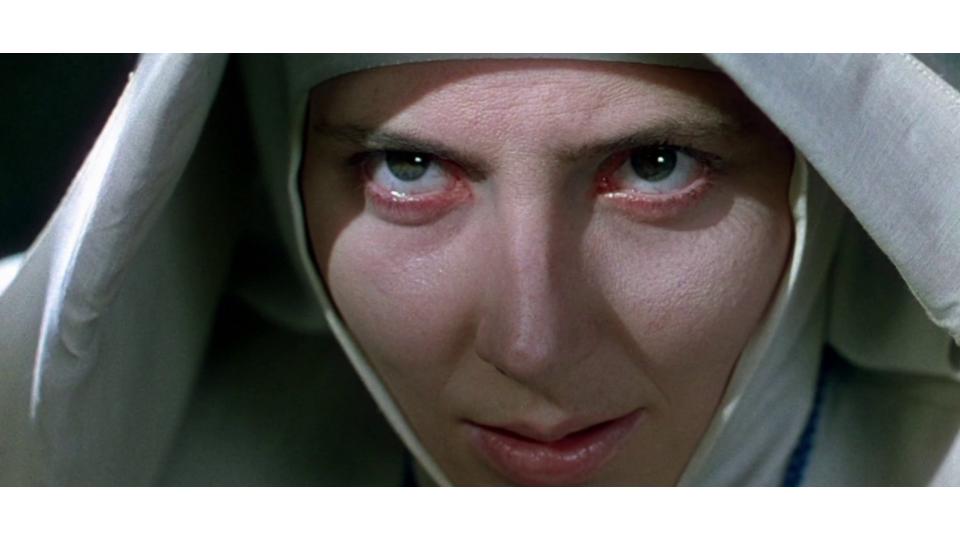
The point of view is largely occupied by Clodagh for the majority of the film, but once Ruth becomes monstrous and stalks her rival, we come to occupy her position, adopting her point of view as she stalks Mr. Dean (with sexual intent) and Clodagh (with murderous intent). Desire, gender, and murderous monstrosity all become conflated as spectacle. But if initially Clodagh functions as Ruth’s double—notably in the infamous lipstick scene—by the climactic sequence of the film it is the spectator who functions as her double, looking through her eyes. As the genre drifts inexorably from melodramatic to pure horrific, the point of view and camera perspective shift accordingly.
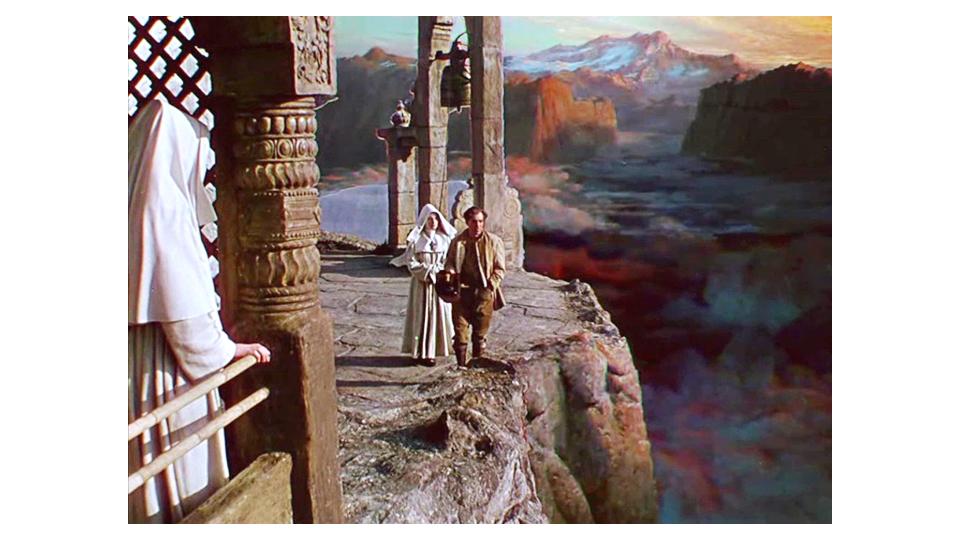
Notably, and even without a consideration of the gothic psychoanalytic, the feminine erupts into monstrosity under the sign of the mother.
The nuns lament the incessant winds and altitude of the great mountain looming overhead as the cause of their vacillating efforts and waning focus. The mountain is called the Bear Goddess. The nuns may hide their bodies, but as Clodagh observes, they could not hide the mountain or, perhaps, mother. The strange atmosphere awakens all that was forgotten: all the memories made before they became Servants of Mary. But in choosing to never become mothers, the nuns do not escape the overwhelming presence of the forgotten mother in a landscape conceived of being feminine and “of the goddess.” Indeed, the initial impetus for the nuns’ relocation and reconstruction of its palace is none other than the Anglican sisters’ Mother Superior. At the outset of the film, the Mother Superior appoints Clodagh as Sister Superior, but also immediately evidences her distaste for her subordinate and doubts her abilities to assume a leadership role (or be an effective babysitter for unstable Ruth). In this film, there is no escaping the judgment of the mother. If motherhood is precisely that which is denied the nuns, the specter and spectacle of motherhood (and its gothic horror) is everywhere. There is no escape. When it comes to the mother, these nuns have it even worse than Norman Bates.
In the figure of the nun we can locate religious guilt, sexual repression, and physical restriction; trapped in her vows and veil, the nun is also trapped in a significant discursive space. Add an element of colonial exoticism to the mix, and you have something explosive.
Modleski’s presumption that “femininity” in society has been constructed by the patriarchal male equates this ideal nature of women with a trap. On the other hand, the melodrama can be a progressive space for a female audience or it can uphold and abide by the patriarchy. In Black Narcissus we get both in the forms of female agency and colonial hubris. By understanding this dualistic quality, we come to understand nunsploitation as a subgenre created to vilify specifically female spaces that qualifies the horror nun as active subject rather than object. The melodrama and the horror nun also coalesce into examples of fluidity in the film. Most strikingly in this film is how a form of gothic doubling and splitting mutates into an experiment in a stalker’s point of view and audience implication and identification—key elements of the evolving horror genre.
In this paper, I’ve argued that the earlier female melodrama of the 1940s made space for a female gaze in the “monstrous feminine” of horror films and, furthermore, that in the figure of the “nun”—specifically in the nun as conceived in Powell and Pressburger’s Black Narcissus—we can see how questions of gender and horror coalesce. In the circumstances of Black Narcissus, the “trap” is twofold: it refers to the trapping of the nun through the use of religious guilt, sexual repression, and physical restriction, and through the tension between the female melodrama and the colonial male melodrama. It is perhaps noteworthy that, after directing Black Narcissus, Michael Powell went on to make the derided cult classic Peeping Tom—another film that integrates these key elements by focusing on a deranged director who kills female spectators. The only surprise, perhaps, is that none of them were sexually repressed nuns.
Bibliography
Black Narcissus. Directed by Michael Powell and Emeric Pressburger, General Film Distributors, 1947. (Stills via The Criterion Collection)
Creed, Barbara. “Horror and the Monstrous-Feminine: An Imaginary Abjection.” Screen, vol. 27, no. 1, Jan. 1986.
Davidson, Roberta, and Mary Ann Doane. “The Desire to Desire: The Woman’s Film of the 1940s.” Tulsa Studies in Women’s Literature, vol. 12, no. 2, 1993.
Jaikumar, Priya. Cinema at the End of Empire: A Politics of Transition in Britain and India. Duke University Press, 2006.
Kehr, Dave. “Review of Black Narcissus.” The Criterion Collection, Jan. 2001. Lyden, John. Film as Religion : Myths, Morals, and Rituals. New York University Press, 2019.
Modleski, Tania. The Women Who Knew Too Much: Hitchcock and Feminist Theory. Routledge, Taylor & Francis Group, 2016.
Mulvey, Laura. “Visual Pleasure and Narrative Cinema.” The Critical Tradition, Bedford/St. Martin’s Press, 2016.

