Jude Reed
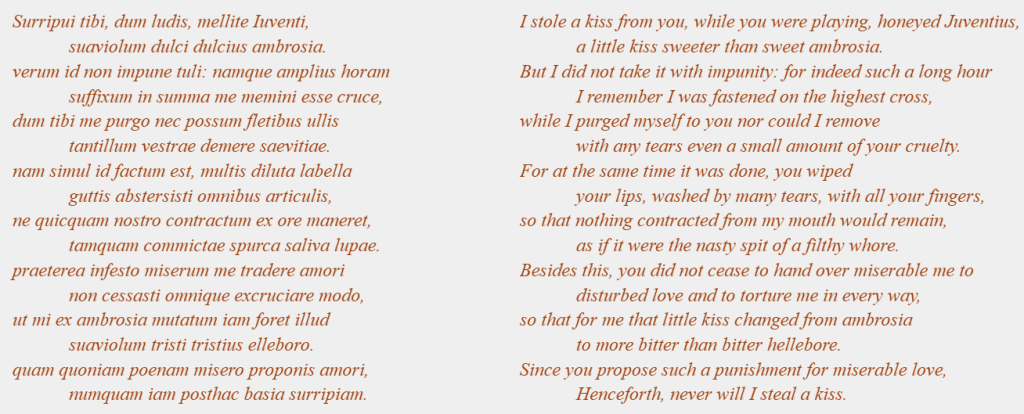
Catullus 99; Translated by Jude Reed
Intellectuals who are well-versed in ancient Roman history might suggest that Roman relationships were based on power dynamics. The figure of the “pater familias” reigned supreme over the voiceless, voteless woman of the Roman world. Almost the entire development of a heterosexual relationship involved the woman becoming the man’s property, whether that be through a financial transaction or the “conquest” of frequent sexual intercourse (Brooten, 1996, 144). These gender norms of conquest and ownership were also haphazardly transplanted onto homosexual relationships. There was no loss of social status for Roman men who took a penetrative role in same-sex relations, but men of a receptive role were seen as similar to women—sex objects; possessions of the stronger, more virile top; effeminate “unmen” (Moore, 2001, 135-136).
As artists tend to do, Roman poets subverted the cultural norms of the time through the written word. The poetic archetype of the puella (girl or maiden) is a well-known facet of erotic elegy. A typical way to subvert gender norms through these puella characters was to reverse the societally imposed power dynamics. Catullus specifically does this many times throughout his writings about Lesbia, his puella and usual romantic interest. Catullus doesn’t just write about Lesbia, however. Catullus writes in numerous poems about a same-sex relationship between himself and a boy named Juventius. A particular poem, Catullus 99, is a famous example of this relationship where Catullus seems to create the image of Juventius as his “domina.” Some scholars (Hubbard, 2003, 351) believe it to be partially, if not wholly satirical, but this poetic characterization of Juventius as a poetic puella reveals Catullus’s earnest homosexual love for the boy.
Catullus begins by setting the scene: while Juventius is playing, Catullus steals a kiss, “dulci dulcius ambrosia” (line 2). The image of ambrosia could be an allusion to Tantalus, who in Pindar’s Olympian Odes 1 stole ambrosia from Zeus’s table and was punished severely. To continue with this allusion, Catullus does not go unpunished: he is “suffixum in cruce” in line 4, fastened to a cross for his transgression against Juventius. The image of Juventius inflicting capital punishment against Catullus is a culturally significant one. Crucifixions served as common punishments for escaped slaves; they were a warning, a spectacle (Ehrman 2022). Catullus, then, is suffering this great torture as a warning to other lovers. A fitting parallel would be to the great Catullus 85, in which Catullus’s hate and love make him feel “tortured.”
Line 6 continues the total domination of Catullus at the hands of Juventius. “Vestrae saevitiae” [your cruelty] seems to imply this dynamic, a cruelty performed on Catullus that is exactly to Juventius’s liking. Catullus’s reference to himself as a dirty “lupae” in line 10 serves to reinforce the societally-contradicting power imbalance between him and Juventius. “Lupae” is a derogatory term meaning “whore,” and by this Catullus associates himself with the “infamia,” the untouchables of the Roman world. The language of line 10 is also meant to recall the poem fragment Catullus 78b (Garrison 2012, 249), in which Catullus finds himself agitated that the kisses of a “pura puellae” [pure girl] have mixed with the “spurca saliva” [tainted saliva] of an impure woman. The reuse of “spurca saliva” in Catullus 99 makes the parallels quite clear: Juventius is Catullus’s “pura puellae,” and Catullus’s impurities make him a lesser man.
Juventius is depicted as a domineering master again in line 11, “infesto tradere Amori,” evoking the image of Catullus bound, as a slave or prisoner, given to the spiteful Cupid. Again, the metaphor here is Catullus powerless to oppose the tortures of love. Like Catullus’s poems about Lesbia’s rejection (such as Catullus 76 or 85), this torture seems to recontextualize the previous images of love within the poem, as the kiss turns from “dulci dulcius ambrosia” to “tristi tristius ellboro” [more bitter than bitter hellbore].
In line 15, Catullus describes himself as “misero,” or miserable. This may seem like a typical word choice of a lover’s lament, but the word “miser” brings yet another parallel to Catullus’s past poems of a dominating “puella.” Catullus 8 is a poem in which Catullus attempts to console himself at the loss of Lesbia’s affection, and at the very beginning of said poem, he addresses himself as “Miser Catulle.” He continues to refer to himself as “impotens” or weak in the face of Lesbia’s neglect. With this, the image is set. Catullus’s love is earnest in the cases of both Lesbia and Juventius—in both cases, he is rejected and made to feel powerless, a true “servitium amoris” [slave of love]. His position groveling at their feet is ironic in both cases: Lesbia, because she is a woman; Juventius, because he would take the “receptive” position in their relationship. And yet, Catullus keeps coming back. His lesson learned, he resolves himself to no longer steal kisses from Juventius, in the hopes that his love may be requited.
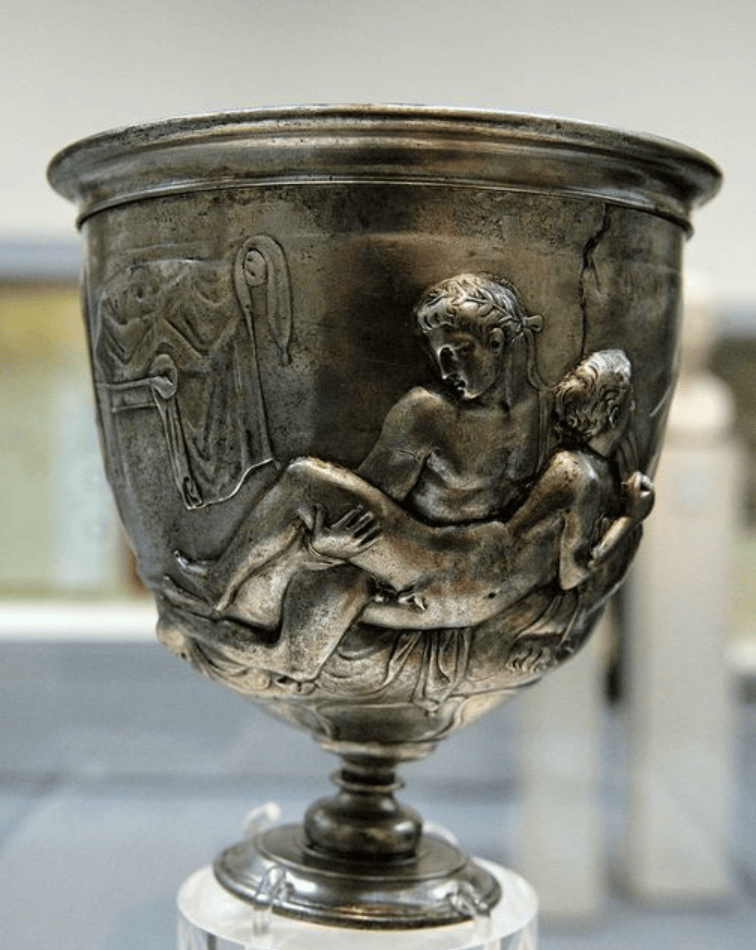
This poem could be addressed as tongue-in-cheek irony; in Roman culture, it could be considered funny to give a “cinaedus” [catamite] hypothetical power that he could never really have. But if his intentions are comedic, would Catullus allude to his relationship with Lesbia so frequently throughout this poem? These allusions give Juventius the same power as Lesbia, the power to dominate and control Catullus, to dictate his thoughts, emotions, and poetry. Ultimately, Catullus 99 brings a new light to Catullus’s views on Juventius, homosexuality, and his use of the puella archetype.
In Catullus 16 and 57, Catullus uses the language of homosexuality in a derogatory manner, calling those he does not like submissive and effeminate. Now, in Catullus 99, power is brought to Juventius, a supposedly effeminate homosexual figure. This is the same power that Lesbia has, the power of the “puella” to make Catullus into a slave of love. Without a doubt, Catullus loves Juventius, and in some manner, respects him as well. In the eyes of the Roman world, Juventius is weak, but he still holds Catullus in bondage.
Catullus’s picture of disarmed masculinity in the face of love reflects the evolution of queer relationships. By depicting a power imbalance between himself and Juventius, he ignores every Roman romantic standard. He can only operate within the rigid gender norms of his time, but this subversion is intentional, and represents the counter-cultural attitude he weaves through his writing. Catullus transgresses the social norms of his time by depicting an earnest, queer romantic entanglement, dismissing Roman notions of conquest and superiority. Echoes of this sentiment are reflected in the current day, where gender norms are subverted, inverted, and deserted. This poem, however rooted in its time, is perhaps, at its best, an augury of queer culture to come.
Bibliography
Brooten, Bernadette J. Love Between Women: Early Christian Responses to Female Homoeroticism. Chicago: University of Chicago Press, 2009.
Ehrman, Bart. “Why Romans Crucified People (the Story beyond the Cross & Nails).” The Bart Ehrman Blog, May 1, 2022. https://ehrmanblog.org/why-romans-crucified-people/.
Garrison, Daniel. The Student’s Catullus, 4th Edition. University of Oklahoma Press, 2012.
Hubbard, Thomas K. Homosexuality in Greece and Rome: A Sourcebook of Basic Documents. Berkeley: University of California Press, 2003.
Moore, Stephen D. God’s Beauty Parlor and Other Queer Spaces In and Around the Bible. Stanford, CA: Stanford University Press, 2001.

