On the surface, Cartoon Network’s Over the Garden Wall is a simple, cut-and-dry fairy tale: Two brothers get lost in the woods and must find their way out. On the way, they encounter animal companions, transfigured humans, and many other fairy tale figures. Yet the show also differs in many ways from traditional fairy tale structure: the reason the boys have ended up in the otherworld isn’t revealed until the end, the step-parent isn’t evil, and the protagonists don’t quite fit into the archetypes expected of them. Thus, Over the Garden Wall may be called a modern fairy tale rather than a traditional fairy tale. Through its adherence to and subversion of common fairy tale motifs and archetypes, the show examines how the perception of fairy tale conflicts has persisted and evolved.
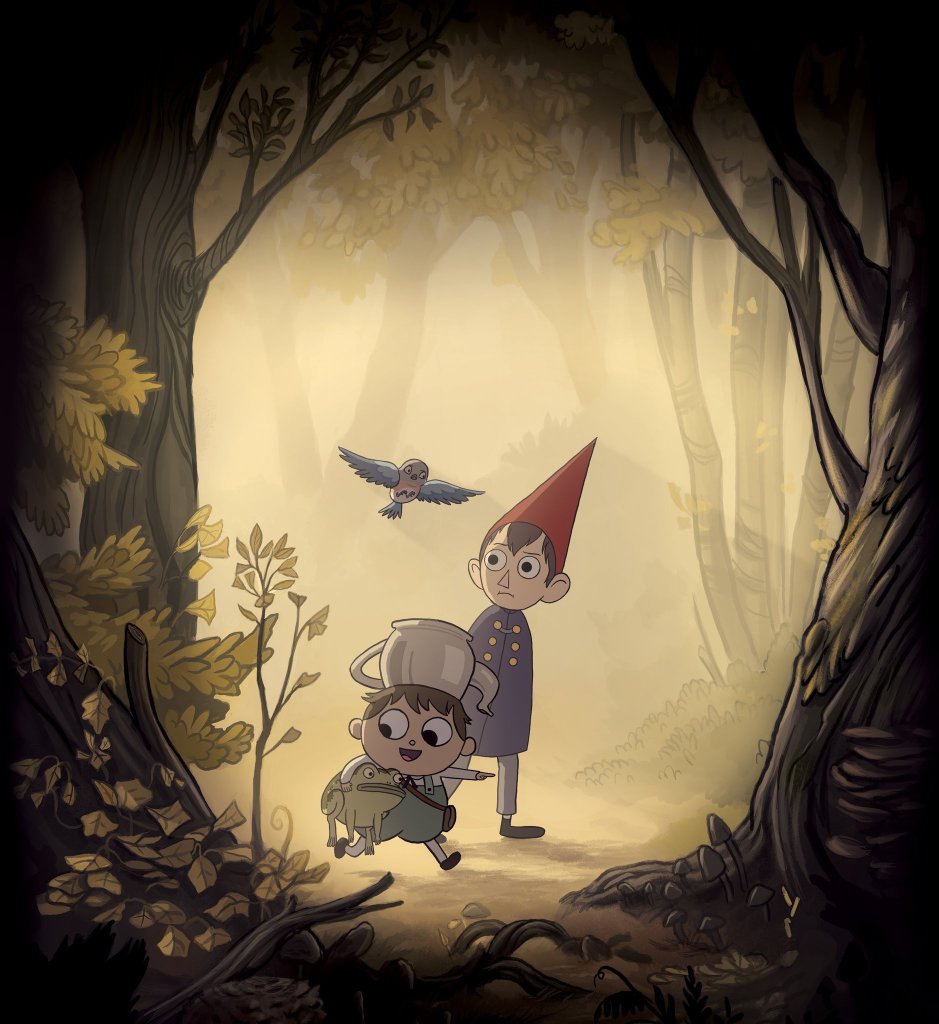
Over the Garden Wall was a 10-episode limited-series that premiered on Cartoon Network in November 2014. It was created by Patrick McHale and stars Elijah Wood as Wirt, Collin Dean as Gregory, and Melanie Lynskey as Beatrice. The story follows half-brothers Wirt and Greg as they travel through “The Unknown”, a forest that exists somewhere in “the clouded annals of history” as is said in the opening narration. Throughout the brief 10 episodes, the brothers encounter many different characters that seem straight from a fairy or folk tale. There is a woodsman, an Edwardian school teacher who dreams of teaching animals how to write (and whose fiance has gotten stuck in a gorilla suit and has been accidentally terrorizing her students), a tavern full of archetypes, and a woman who has been turned into a bird. The animation is reminiscent of cartoons from the 1920s and 1930s which elevates the dreamlike, fairy tale feeling of the story.
From the beginning, the series presents itself as a traditional fairy tale, following a traditional fairy tale structure. The first episode opens with the two brothers realizing they’re lost in the woods; an immediate sign that the two have entered a fairy tale. The forest is often used as an otherworld that the hero must cross to return home. Wirt, the elder brother, is much more concerned about the situation than his brother Greg, who quickly accepts that they’re in the woods on their way home and goes back to deciding on the name for the frog he is carrying with him.
However, while evoking the beginning of a fairy tale, the first episode also quickly upsets traditional fairy tale story structure. Yes, the boys are lost traveling through the woods trying to get home, much like many fairy tale characters before them, but we haven’t yet been acquainted with the brothers’ status quo. We know that it’s not these woods, otherwise, Wirt would not be so concerned, but we’re given very little information about what their home is like, other than that it must be similar to our world given Wirt’s comment on the scientific impossibility of birds talking. This lack of establishment of a status quo before we are whisked off to the otherworld also serves to highlight another feature of fairy tale beginnings that is missing from this first episode: that the characters must be motivated by the presence of evil or a lack of good (Tatar 62).
In Over the Garden Wall, it’s not immediately clear why the children are in the otherworld. The inciting incident that led them to the woods isn’t made clear until the penultimate episode. There, it is revealed that the reason they are in the otherworld is because they’re drowning in a lake. However, when looking at the story through traditional fairy tale motifs, it could be argued that the real reason is that Wirt needs to accept how his family situation has changed and the responsibility he has as an older brother and teenager. In turn, Greg learns the importance of honesty and leadership as he ultimately ends up sacrificing himself when Wirt loses hope.
In Over the Garden Wall, we enter the fairy tale in the middle. The story structure is there, however it has been shuffled around and updated to modern sentiments. The beginning of the story that establishes the status quo is moved to the end. In the fourth episode, it’s revealed that Wirt, like many fairy tale characters before him, has a step-parent and that Greg is his half-brother. However, the step-parent isn’t a threat or an evil that must be overcome; instead, they’re a person that the protagonist must come to terms with and accept as part of their life. In fact, we never see Wirt’s stepfather. The conflict is about Wirt’s interpretation of his presence, not about the stepfather’s character as it is in many fairy tales. Another modernization is that Wirt’s step-parent is his father, not his mother as it would be if this were a traditional fairy tale. One example is “Hansel and Gretel,” which Over the Garden Wall is arguably an adaptation of.
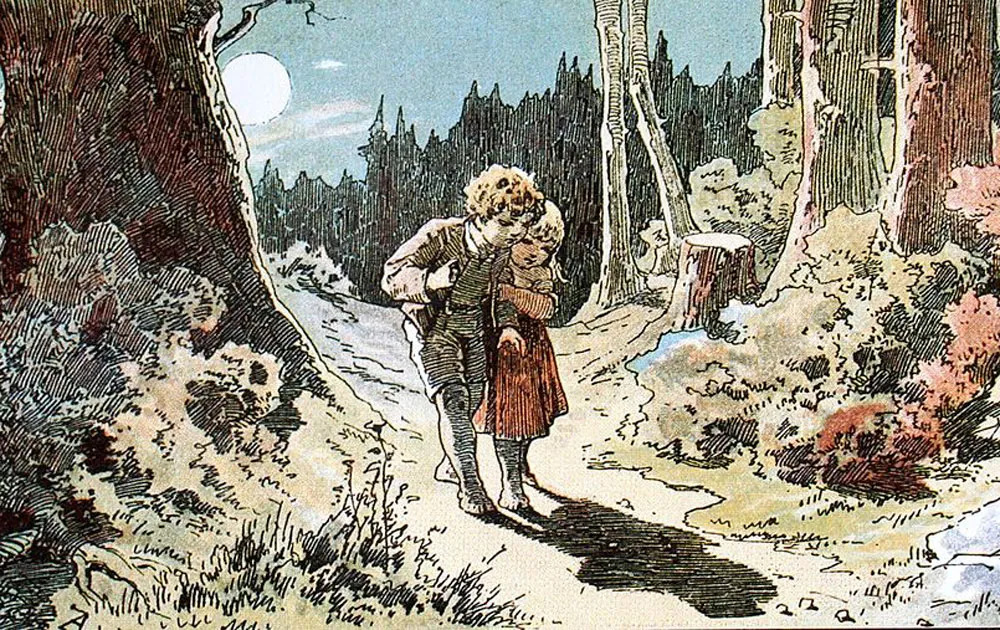
Much like “Hansel and Gretel,” Over the Garden Wall follows two siblings who have found themselves lost in the woods due to a conflict with a step-parent. In an attempt to find their way home, one sibling leaves a trail of an edible substance (in “Hansel and Gretel” it’s bread, in
Over the Garden Wall it’s candy). Both pairs of siblings find themselves at a home owned by a reflection of their step-parent. However, the role of this reflected step-parent differs greatly between the two stories. In “Hansel and Gretel” the stepmother is an evil witch who uses a guise of generosity and care to hide a horrible cannibalistic tendency. In Over the Garden Wall, however, the stepfather is not evil: Wirt simply perceives him to be so. His reflection is originally considered by Wirt to be a threat (and there is a shot of the Woodsman in front of a fireplace that is quite reminiscent of the witch’s fate in “Hansel and Gretel”) but is then revealed to simply be a troubled man who wanted to help. The real monster in the first episode of Over the Garden Wall, though, does still parallel the witch in “Hansel and Gretel,” as it is a monstrous wolf who had gobbled up the trail of candy (like the candy house). At the end of the episode, it is revealed that the wolf wasn’t originally a wolf, but a dog who had been turned into a monster by eating a piece of the candy trail. This is reflective of Hansel and Gretel eating the house of candy and so being punished by being captured by the witch.
Over the Garden Wall also comments on its structure as a fairy tale. In the fourth episode, “Songs of the Dark Lantern,” the brothers and a talking bluebird named Beatrice find themselves at a tavern in the woods. Everyone occupying the tavern fulfills some sort of archetype: the tavern keeper, the tailor, the toymaker, the master and his apprentice, the baker, the butcher, and the highwayman. Each of these characters is very comfortable in their roles, even singing a couple of songs about what they do. They’re perplexed, however, when they ask Wirt what he is and he cannot answer. While Wirt may be a fairy tale protagonist, he’s not a fairy tale character. Fairy tale characters are flat and their personalities are fleshed out by the decisions they make to further the plot rather than any insight into their internal workings. What follows is a story reminiscent of the central conflict in N.D. Stevenson’s Nimona, where the fairy tale protagonist is expected to also be a fairy tale character and thus conform to being an archetype created through centuries of folk narrative tradition. But Wirt, much like Nimona, Blackheart, and Goldenloin in Nimona, is not a character created by the folk; he is the product of the mind of Patrick McHale and therefore is allowed the complexity that traditional fairy tale characters are not. While Over the Garden Wall may be a fairy tale, these inconsistencies emphasize that it is not a Fairy Tale. It has not been written under the assumption that it will need to be able to survive centuries of oral tradition. It’s a fairy tale, but it’s not a folk tale in the way traditional fairy tales are folk tales. It’s a story that has been written by a small group of people, rather than one that has evolved over centuries of being passed through oral tradition. Episode four serves to make sure the audience knows that.
Despite all this, Over the Garden Wall is still a fantasy; it simply isn’t presented in the traditional structure. Two kids end up in an otherworld due to their immaturity and inability to understand each other (which Tatar would refer to as an “absence of good” or “lack” (62)). In the other world, they face challenges that reflect the ones they face at home. The Woodsman in episode one is a reflection of Wirt’s step-father. Beatrice reflects Wirt’s responsibility to his family as she herself is trying to right a wrong she has committed against her own family. In the end, Wirt must accept his role as older brother in order to escape the otherworld. The journey in the otherworld, like it is in any good fairy tale, is inarguably real: the bell that Greg’s frog swallowed while in the Unknown can still be heard after the brothers are rescued and recovering in the hospital. There’s even an odd religious twist at one point. Gregory falls asleep and is sent to the Kingdom of Clouds (Heaven) which is populated by angels and terrorized by the Old North Wind who ends up trapped in a bottle like many devils in folk tales. Over the Garden Wall takes the fairy tale structure and twists it. In doing so, it emphasizes how fairy tales are relevant in the modern day as well as how sensibilities may shift them. Step-parents still appear in the story, but the attitude toward them has changed from a definite evil to an uncomfortable change that must be adapted to. Heroes still mature, but their maturity may be more of an internal struggle than a plot-driven one. Yet there are still motifs that have carried through nearly unchanged. Animal companions and humans that have been transfigured into animals continue to be compelling. Most importantly, the woods are still a magical and scary place where children will forever get lost.
Bibliography
Stevenson, N.D. Nimona. Quill Tree Books, 2015.
Over the Garden Wall. Created by Patrick McHale, Cartoon Network Studios, 2014.
Pullman, Philip, translator. “Hansel and Gretel.” Fairy Tales from the Brothers Grimm: A New English Version, Viking Penguin, 2012, pp. 75–85.
Tatar, Maria. The Hard Facts of the Grimms’ Fairy Tales. Princeton University Press, 2019.

