Kamana’okekai Lattig
When King Louis XIV created the court of Versailles in 18th century France, he solidified a monarchical reign where the king had absolute ideological control over his nobles. The creation of Versailles brought forth an era of court intrigue and scandal amongst the elite aristocrats that were allowed to live at the palace.
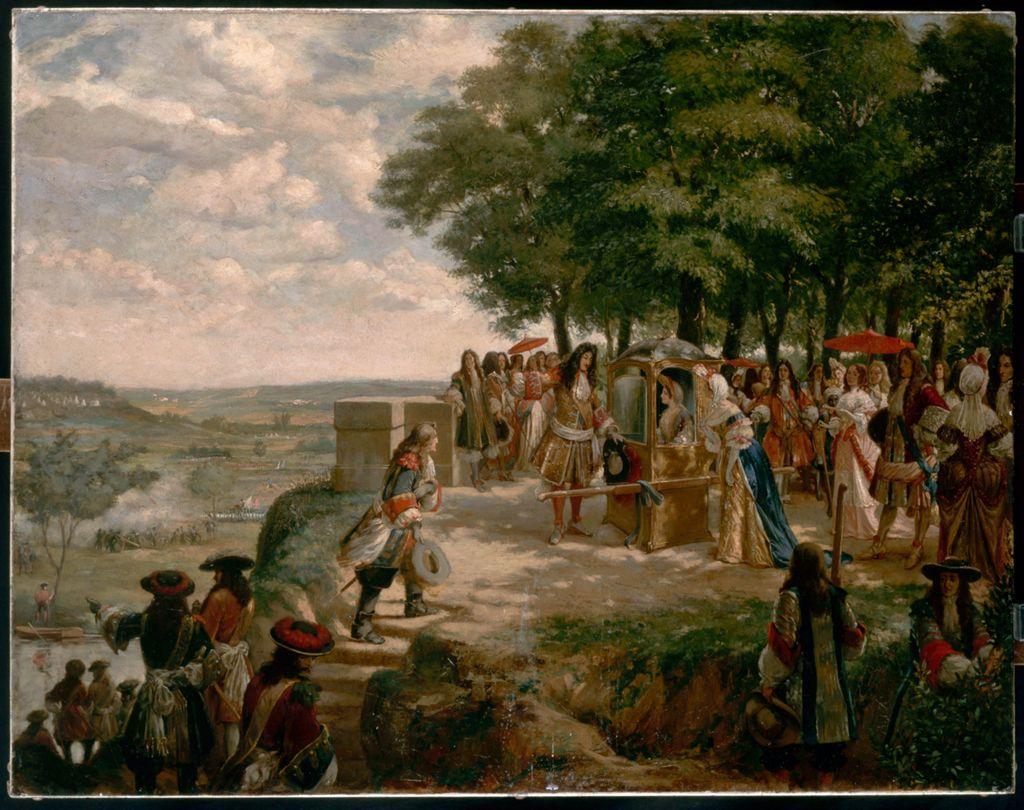
However, within this era of absolutism also came a newfound emphasis on the arts, which King Louis XIV was passionate about from a young age. This paper specifically addresses Molière, a widely acclaimed French playwright under Patronage of the King’s brother, and his most infamous play, Le Tartuffe, or, Tartuffe. Though he was deeply respected by the King, Molière was beholden to the same censorship standards as the rest of the playwrights in this era: he was required to uphold Louis’s morals and uplift the King. Tartuffe went through several revisions before it was accepted by the King, and only under specific conditions. After years of controversy, the finalized version of the play that was approved included an important character: the King himself. Molière’s use of the King as a character in Tartuffe demonstrates Louis XIV’s absolute power in Versailles-era France, while secretly hinting toward years of conflict between playwrights and the court’s jurisdiction of theatrical censorship.
REIGN OF XIV:
King Louis XIV came into power in 1643 at five years old, but the highlight of his reign began when the royal court moved to Versailles in 1682. Versailles was originally the Bourbon family’s hunting lodge before Louis transformed it into the majestic palace that still exists today. “The Palace and its surrounding buildings rapidly became symbols of an age when the nobility were prepared to go to any lengths to be close to the King, who respected the royal tradition whereby the monarch had to be accessible to his courtiers” (Palace of Versailles 2024). The creation of Versailles itself was a show of wealth, commanding the respect of the King’s loyal nobility. King Louis XIV had another hidden agenda; the Palace was also created to prevent nobility from plotting against him. Versailles put all of his nobles in one place in a terrific display of monarchical power. King Louis XIV was not the first or last monarch to try to control his loyal followers, but was certainly the most successful at doing so.
Louis was a paranoid man who held onto his power with a tight grip. He believed, like many European Monarchs before him, that he was given the Divine Right to rule. The Divine Right refers to power given by God and is largely a Catholic-stemmed belief. Louis received his political ideology from Catholicism itself and the Roman Empire, due to his mother’s relationship with the Catholic Church (Riley 1973 20-21). Both were initially more constitutionalist but eventually leaned into absolutist doctrines and practices. Church and state were intertwined due to the Holy Roman Empire and the Pope’s control over the European world. This is not a case of secular absolutism, which manifested separately. King Louis XIV justified his rule by declaring that it came directly from the Catholic God. This is why his alleged statement, “L’État, c’est moi,” or in English I am the State, was so important; it was meant to encapsulate complete monarchical power coming from a man who has been given jurisdiction by God himself (Fox 1960, 128-42). Though absolutism existed before Louis XIV’s reign, his case is significant because it marked the beginning of royal decadence that eventually caused the collapse of the French Monarchy. The control that Louis exerted was stifling and all-encompassing. He called himself “Le Roi Soleil,” translated to the Sun King to represent his heavenly rule. King Louis is often studied as a symbol of European power and influence, whose socio-political authority transcended that of the French kings before him.
LOUIS AND THE ARTS:
King Louis was a well known patron of the arts. He had an appreciation for music and dance, favoring art forms like opera that emphasized the spectacle of such performances. In a comparison of theatres during Louis XIV’s reign, Barbara Coeyman (1990) explains, “Louis XIV in particular employed these and similar art-forms extensively not only to entertain the noblemen in his court but also to promote his own self-image and the gloire of his country.” An important part of showing his power was through high-quality productions in his court— reflecting his initial goal with Versailles. He commissioned several theatres to be made in France, including one in 1660 called Théâtre des Tuileries, or more commonly known as Salles des Machines for its innovative stage machinery designed by Gaspare Vigarani (Coeyman 1990, 23). Louis was an avid supporter of theatrical endeavors, often funding performances and enjoying the performances that happened in the court. Many actors became closely associated with court members, often being patronized by nobles (Smith 1973). The court especially favored classical pieces and references to classic literature, as neoclassicism was still favored during his reign; he even included the sun motifs as a reference to Apollo, god of the sun and the arts. He saw his social life as a performance, allowing his loyal court followers to watch him get dressed in the morning (Palace of Versailles).
Louis has been credited with the theatrical accomplishments that happened during his reign, as the stability and order that he established helped theatre flourish. He aimed to unify theatre “through the creation of artistic academies” (Smith 1973, x). The theatre practitioners with close relationships to the court influenced the themes and elements that were drawn upon to write plays. Costumes were very clearly influenced by the court, as the actors wished to appear in court with the styles that were popular amongst court members. The sets were also extravagant, favoring spectacle over realism (Smith 1973, xii). The court wanted to see actors who put on a magnificent and flashy performance, not a realistic one. King Louis XIV’s patronage, as well as the patronage of other important nobles, allowed theatre practitioners to afford such performances.
Regardless of how supportive King Louis XIV was of the arts, he still had creative restrictions on what was allowed to be created and especially performed. He was very specific about art upholding the moral values that he held dear, which were heavily influenced by the Catholic Church. Toward the middle of his reign, King Louis XIV tightened his grip yet again on the ideologies of his people by starting moral reforms. The most intense moral reforms happened in Paris, which was known for its wildness and frequent promiscuity. In 1661, the Company of the Holy Sacrament started to purge Paris of sin “by imprisoning vagabonds, reforming prostitutes, and proselytizing” (Riley 1973, 29). Though the company itself dissolved eventually, members of the company were closely connected with the government and their goal aligned well with King Louis XIV’s. His ethics and morality became more and more reinforced by those of his wife, Madame de Maintenon, whose strict moral rigor mirrored those in the Company of Holy Sacrament (also referred to as dévot, or devotees to the Holy Sacrament). He even banned the Italian Commedia Dell’arte troupe from performing for satirizing Maintenon (Riley 1973, 21). Louis’s need for moral control mixed with his paranoia of the members in his court changed what he allowed to be seen in theatres and behavior of his court.
MOLIERE AT COURT:
The first time King Louis saw a performance by Molière was in 1658, when he was brought to the Louvre to perform The Doctor In Love. Molière had been patronized by Duc D’Orlean, the King’s brother and another avid appreciator of the arts, and invited the troupe to perform at court. The aptly named Troupe de Monsieur became quite popular at court and received a theatre at the Petit-Bourbon palace. A year after L’Amour medecin was performed for Louis XIV’s nobility, Les Précieuses ridicules, another play that Molière wrote, was performed at that same theatre. It was also massively successful. The following years would see Molière attacked with an onslaught of criticism by his enemies, many of whom created personal attacks against him. Other theatre practitioners refused to take him seriously for his knack for farcical comedies. Significantly, he did not seem to follow neoclassical values either, but could get away with it because his plays were purely comedic and favored by the king (Leon 2009, 54).
Despite the criticism he received from peers, “Molière’s company was favored at the court: twenty-eight of his thirty-two plays were performed there” (Leon 2009, 55). He remained in the King’s good graces for the majority of his career, performing in festivals and receiving awards for his work in theatre. King Louis XIV had a thriving relationship that benefited Molière’s theatre company. Eventually, the troupe was renamed “Troupe de Roi,” as they were patronized by the King himself. Molière’s relationship with Louis was both personal and professional, as the king himself became the godfather for his son, even named his son “Louis” out of admiration for the king (Leon 2009, 56). Because he was respected by the king, he was respected by the rest of the court.
THE SCANDAL OF TARTUFFE:
The original draft of Tartuffe was performed in front of the King in 1664 at Versailles. At the time, it was a three act play that was titled Tartuffe, ou l’Hypocrite. Unlike many of Molière’s previous works, Louis enjoyed the play but asked Molière to revise it for the sake of the court. It rejected many of the tropes that were already set in stone in French theatre, opening the play with Madame Pernelle rather than with Orgon, who seems like he should be the strong father figure. Instead, Orgon is revealed to be a weak father figure who falls to Tartuffe’s evil temptations immediately. At the end of the play, Orgon even betrays his family to Tartuffe and gives him all of his money and his whole estate, exhibiting reckless behavior that should not be seen in the character representing the strong father figure. Because Tartuffe was meant to be a comedy, it could get away with a few non-neoclassical elements, but it took five years for Tartuffe to be approved for performances at all (Gossman 1970, 906).
Another contention from Tartuffe stemmed from the aforementioned dévots, who believed that the play itself was completely anti-religious. There is very little evidence of what the King initially disliked about the play, but scholars hypothesize that one of his main critiques was the character Tartuffe’s relationship with religion. In the version of Tartuffe that was approved and produced, Tartuffe parades as a devoutly religious man whose piety is admired by Orgon. However, the original Tartuffe may have been portrayed as a priest, which would be considered unacceptable to a devoutly religious audience (Chill 1963, 154). King Louis XIV did not want to upset his main audiences and thus advised Molière to change it. The play was banned for three years and Molière suffered personal criticism once again, the dévots unwilling to let go of his offensive portrayal of piety. The implication of having a priest play the evil liar subverted societal expectations of piety. I argue that this instigated the idea that a religious leader could manipulate and lie to people in a way that the dévots refused to accept; if someone acted pious, then they were trustworthy.
The battle for Tartuffe demonstrated the strict control that the King and his court had over the production of theatre. Though Molière was often allowed to do what he pleased with his productions, it was evident that there were specific standards that even he needed to follow. Molière fought against the censorship laws for five years, attempting to find ways to work around the restrictive moral values that were imposed by the King and his courtiers. He wrote another play, Don Juan, which “portrayed piety as a fool rather than a bigot” (Chill 1964, 155). The play was mildly successful before it, too, caught the eye of dévots and was forced to shut down. Molière was attacked by critics for his portrayal of religion in both Don Juan and Tartuffe, and eventually went back to revising Tartuffe.
‘THE KING’ IN TARTUFFE:
In the finalized version of Tartuffe, Molière uses a “Deus ex Machina” figure, pulled from the Greco-Roman tradition of inserting a god into the end of the story to save the day. This figure was not a god in the literal sense, but the King— a godlike figure that swoops in and solves everyone’s problems. Instead of having to pay the price for his foolish actions, Orgon is absolved of guilt as the King forgives him for his reckless actions. He is not depicted as a character, but an officer arrives in his stead to symbolize his importance. The officer states:
I owe an explanation, but not to you.
[to ORGON] Sir, all is well; rest easy, and be grateful.
We serve a Prince to whom all sham is hateful,
A Prince who sees into our inmost hearts.
And can’t be fooled by any trickster’s arts.
His royal soul, though generous and human,
Views all things with discernment and acumen;
His sovereign reason is not lightly swayed,
And all his judgments are discreetly weighed.
He honors righteous men of every kind,
And yet his zeal for virtue is not blind,
Nor does his love of piety numb his wits
And make him tolerant of hypocrites (Molière 1664, 242).
The officer’s monologue implies that the King can see through the fake piety of Tartuffe, even though Orgon could not. The monologue itself, however grandiose and favorable to the King, is almost hyperbolic in the way that it has been written, over exaggerating the officer’s words. It flatters the King and is meant to be a comedic show of Kingly power. Regardless of how comedic and random the officer’s appearance might seem, having a character that is representative of the King and not literally the King himself allows some distance between Louis and works of literature created in this time period. This makes this character and scene extremely purposeful and important. Louis is still an omnipresent figure that can swoop in and save the day without even needing to be there, but his presence is felt as a Christ-like figure in Tartuffe. By referring to King Louis XIV as the Prince, this passage could evoke the power of Louis as the power of Christ. He can see past all lies without needing to be in the scene at all. It succeeds in capturing the absolute power that King Louis XIV likely wanted from theatre of this time, if not in a way that pokes fun at King Louis’s own grandiosity.
However, looking back on the incident with Madame Maintenon indicates that the King did not take very kindly to attempts to satirize the royal family, so it is unreasonable to claim that Louis XIV was completely aware of the satirical nature of the King’s mention in Tartuffe. The same argument can even be made using various other examples of satire in the King’s court and life. He was a sensitive and paranoid man who made an entire palace ensure that his nobility did not plot against him. Whether or not the King realized it, this character was created to point out the pretension in the monarchy. Thus, the “Prince” and the officer who represents him fulfill two main functions: to demonstrate King Louis XIV’s power of the state and subtly ridicule King Louis’ grandiosity.
In the preface to the final version of Tartuffe, Molière argued, “If the function of comedy is to correct men’s vices, I do not see why any should be exempt. Such a condition in our society would be much more dangerous than the thing itself; and we have seen that the theater is admirably suited to provide correction. The most forceful lines of a serious moral statement are usually less powerful than those of satire; and nothing will reform most men better than the depiction of their faults. It is a vigorous blow to vices to expose them to public laughter” (Simonds 1977, 87). He believed wholeheartedly that everyone should be able to be criticized, and the bold use of the King to prove this point was exceptionally dangerous. This is an underlying theme that Molière makes sure to not outright say, which allows him to still make this point. More important is the message of hypocrisy, in which the holy man must act the way that he speaks. The King is more of a divine spectator than a human being in this play, and is able to fulfill his duty of protecting his people via the use of absolute power.
The King as a vehicle for divine intervention in Molière’s Tartuffe is used to demonstrate the power that the monarch held during the reign of the Bourbon family in France, but he also represents Molière’s struggles as a playwright fighting against censorship laws. Ultimately, Molière was still able to explore the themes of religious and upper-class hypocrisy, but it is doubtful that he was able to do so to the full extent that he wanted to. Molière was heavily favored by the King and court and was still unable to write what he wanted, giving us a deeper understanding of how influential censorship was in this time period. Scholars still try to make sense of how absolutism manifested systematically, and a good way of doing so is by looking deeper into the arts as a vessel for monarchical power.
Bibliography
Chill, Emanuel S. “Tartuffe, Religion, and Courtly Culture.” French Historical Studies 3, no. 2 (1963): 151–83. https://doi.org/10.2307/286028.
Coeyman, Barbara. “Theatres for Opera and Ballet during the Reigns of Louis XIV and Louis XV.” Early Music 18, no. 1 (1990): 22–37.
Fox, Paul W. “Louis XIV and the Theories of Absolutism and Divine Right.” The Canadian Journal of Economics and Political Science / Revue Canadienne d’Economique et de Science Politique 26, no. 1 (1960): 128–42. https://doi.org/10.2307/138824.
Gossman, Lionel. “Molière and Tartuffe: Law and Order in the Seventeenth Century.” The French Review 43, no. 6 (1970): 901–12.
Leon, Mechele. “History: Rewriting the Story of Molière and Louis XIV.” In Molière, the French Revolution, and the Theatrical Afterlife, 49–73. University of Iowa Press, 2009. https://doi.org/10.2307/j.ctt20mvfqd.7.
Molière. Tartuffe. Translated by Richard Wilbur. France: HarperCollins, 1968.
Palace of Versailles. “Louis XIV,” February 19, 2024. https://en.chateauversailles.fr/discover/history/great-characters/louis-xiv.
Palace of Versailles. “Molière,” February 17, 2023. https://en.chateauversailles.fr/discover/history/great-characters/Molière.
Phillips, Henry. “Molière and Tartuffe: Recrimination and Reconciliation.” The French Review 62, no. 5 (1989): 749–63.
Riley, Philip F. “Louis XIV: Watchdog of Parisian Morality.” The Historian 36, no. 1 (1973): 19–33.
Simonds, P. Muñoz. “Molière’s Satiric Use of the ‘Deus Ex Machina in Tartuffe.’” Educational Theatre Journal 29, no. 1 (1977): 85–93. https://doi.org/10.2307/3206505.
Spingler, Michael. “The King’s Play: Censorship and the Politics of Performance in Molière’s ‘Tartuffe.’” Comparative Drama 19, no. 3 (1985): 240–57.
Smith, Elizabeth G. “The Influence of the Court of Louis XIV in the French Theatre of the Seventeenth Century.” Masters of the Arts, University of Houston, 1973. chrome-extension://efaidnbmnnnibpcajpcglclefindmkaj/https://uh-ir.tdl.org/server/api/core/bitstreams/52968b04-050b-42c2-8157-46d78e7acb98/content.

