Sarah Borchert
Jesus is known for his miracles: turning water into wine, feeding massive crowds with a few loaves of bread, and walking on water. Beyond Jesus’ most famous miracles is a lesser known one, Jesus expelling demons from the Gerasene demoniac. This episode occurs in all three synoptic gospels, but this paper will focus on the gospels according to Matthew and Mark.
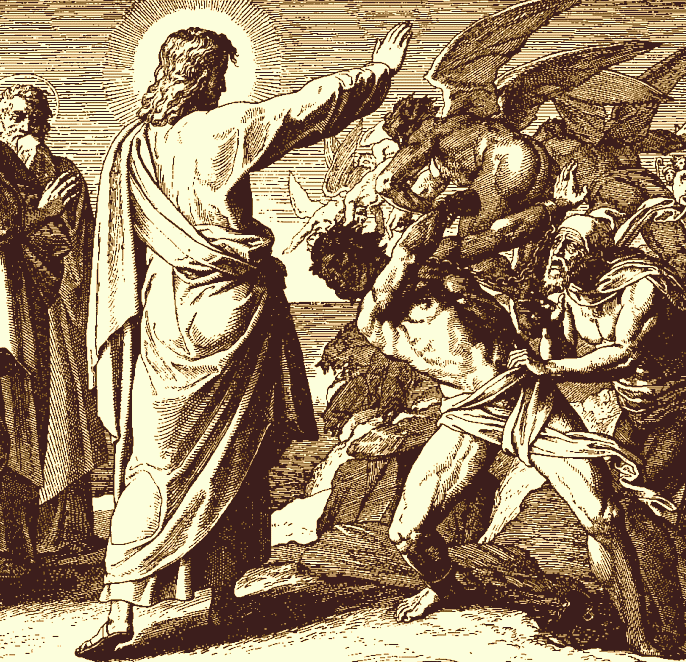
In this paper, I refer to the authors of the gospels as “Matthew” and “Mark,” even though in reality, the authors are unknown. When using a redaction critical approach to analyze the Gerasene demoniac passages from Matthew and Mark (Matthew 8:28-8:34 and Mark 5:1-5:20), it becomes clear that the early church preferred Matthew over Mark because Matthew is less provocative against the Romans, and hence will keep the early church safer from Rome’s imperial project.
First, I am going to establish the troubled relationship between the early church and Rome by looking at “The Martyrdom of Polycarp,” a letter from the church at Smyrna to the church at Philomelium circa 167 (Lightfoot, Harmer, and Holmes 222). As the title of the letter suggests, it details the story of a bishop named Polycarp being martyred by Rome for believing in Jesus as the son of God (Lightfoot, Harmer, and Holmes 233). This, of course, is not the only example of Roman violence against early Christians, but it is effective in demonstrating that people were killed simply for their faith in Christ. The Roman imperial project required the worshiping of the emperor and the Roman gods, and Christianity did not fit that standard. Matthew had primacy in the early church because it did not antagonize the Romans, protecting Christian lives. New Testament Scholar Dale Martin confirms that “The Gospel of Matthew, from the second century on, has been the most popular gospel” (Martin 93).
Despite Matthew being the favorite gospel of the early church, I am going to lay out the Markan version of the Gerasene demoniac story first because it was written before Matthew (Sanders and Davies 54). Mark’s version of the Gerasene demoniac story is quite long and detailed. Despite being very detailed, Mark provides no context on the country of the Gerasenes where this story takes place. New Testament scholar Warren Carter explains that the Gerasenes is a region “inhabited by Gentiles” (Carter 143). Further, he cites Stephen Moore who argues “that the Hebrew root of the name Gerasa (grš) means ‘banish,’ ‘drive out,’ ‘cast out’” (Carter 143). This background provides interesting context to why Mark might have chosen this particular region as the setting for this story. The Gerasenes being inhabited by Gentiles meant that Jesus was spreading his miracles more widely, and Gerasa meaning “cast out” thematically matches the tone of the story.
Mark begins the story by describing the man Jesus encounters in the Gerasenes as having “an unclean spirit” (Mark 5:2) and being unrestrainable “even with a chain” (Mark 5:3). This description functions to show readers how powerful the demoniac is. He is very strong and cannot be overpowered with human tools. Mark continues to describe the demoniac: “Night and day among the tombs and on the mountains he was always howling and bruising himself with stones” (Mark 5:5). This further communicates the non-human nature of the demon. It is abnormal behavior to howl and hit oneself with stones so the demon is characterized to be in an unwell headspace and actively harming the human body it is occupying.
After characterizing the demoniac, Mark shifts into an interaction between the demoniac and Jesus. When the demoniac first sees Jesus, there is immediate recognition. He says: “What have you to do with me, Jesus, Son of the Most High God? I adjure you by God, do not torment me” (Mark 5:7). Both the recognition of Jesus and the fear of torment speak to Jesus’ power in the divine world. He is not just known by humans, but also by demons, and further, he is feared by demons which implies that demons understand Jesus’ ability as Son of God. Jesus, then, asks the demoniac his name, to which he replies: “My name is Legion; for we are many” (Mark 5:9). The use of the name Legion is very interesting because it may refer to the Roman military. Popularly, the name Legion “refers to the central unit of the Roman army comprising in the late first century around fifty-four hundred troops divided into ten cohorts” (Carter 144). Drawing a parallel between the demoniac and Romans is very politically charged because the implication is that the Romans are evil and actively working against the kingdom of God. It “mocks Roman power as an out-of-control, demonic, militaristic, and (self-) destructive masculinity and fantasizes Rome’s defeat as womanly weakness at Jesus’ superior commanding, masculine hands” (Carter 140). Rome, as represented by the demoniac, is subordinate to Jesus in this story, creating a gendered story of Jesus as the paragon man and the demoniac as the “unman.”
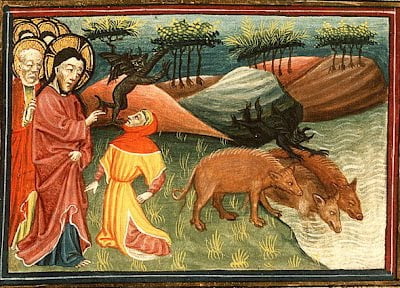
Jesus then expels the unclean spirits into a herd of swine, and the swine rush into the sea and drown (Mark 5:13). Both Jesus and Legion are happy with the outcome of the unclean spirits entering the swine.
It is “a win-win bargaining situation for exorcist and demons” (Carter 140) because entering the pigs mirrors “imperial-military scenarios of entering, occupying, and defeating an enemy space” (Carter 149) for Legion and results in saving the man who was previously occupied by demons for Jesus. Pigs are considered unclean in Judaism so expelling the demons into the herd of pigs was a strategic move for Jesus. He combined the unclean spirits with the unclean pigs. Besides representing military occupation, entering into the pigs can also be read as “a sexual innuendo for…rape” (Carter 149) which would also be a “win” for Legion because it puts him in a powerful masculine role over the feminized pigs.
After the townspeople heard news of this event, “they began to ask Jesus to leave their neighborhood” (Mark 5:17). One would think that Jesus would have been met with a positive reaction after saving a man and the community, but that is not at all what he receives. The town’s reaction only makes sense when keeping in mind the comparison between the demoniac and the Roman legion. They are begging Jesus to leave out of fear of Roman retaliation. The story ends with the man who Jesus expelled the demons from asking Jesus to stay (Mark 5:18), and Jesus replies “Go home to your friends, and tell them how much the Lord has done for you, and what mercy he has shown you” (Mark 5:19). With that, the story ends on a hopeful note–the man is grateful to be free of demons, and Jesus is proud of the work he did.
Matthew’s version of the Gerasene demoniac story, which was written after Mark’s, is much less detailed. Nevertheless, Matthew made the conscious decision to keep the story of the Gerasene demoniac in his narrative, signifying that he still found it important. Besides just being much shorter, there are a couple obvious differences between Matthew and Mark’s Gerasene demoniac stories: it has two demoniacs instead of Mark’s one and the demoniacs do not name themselves Legion. Matthew describes the demoniacs as “so fierce that no one could pass that way” (Matthew 8:28), but the description of the demoniacs stops there. Like in Mark, the demoniacs recognize Jesus. They shouted at him, “What have you to do with us, Son of God? Have you come here to torment us before the time?” (Matthew 8:29). Again, the demoniacs know Jesus and fear his torment, highlighting Jesus’ power.
The demons then beg Jesus to cast them into a nearby herd of swine, and after he does, the herd rushes into the sea and drowns (Matthew 8:31-32). Similar to Mark’s version, “the whole town came out to meet Jesus; and when they saw him, they begged him to leave their neighborhood” (Matthew 8:34); though this time, the town’s distrust towards Jesus cannot be explained away by fear of the Romans. The subtext in Mark that the demons are representative of a Roman legion establishes necessary context for why the town wants Jesus gone: fear of the Romans. Without this context, it is difficult to understand the town’s motives for begging Jesus to leave the neighborhood.
Given the fact that the gospel according to Matthew was written after the gospel according to Mark, and Matthew almost certainly used Mark as a source, it becomes clear that the changes Matthew made were intentional. Matthew made a conscious decision to shorten the story of the Gerasene demoniac in his gospel, decreasing its importance. To shorten the story, Matthew had to make redactions. The first noticeable redaction is the limited characterization of the demoniac. In Mark, there is much greater detail that serves to establish the demoniac as non-human. Matthew’s description is much more concise; it still gets the point across but in a less impactful way. Something that Matthew does make clear is that there are two demoniacs, not just one. Perhaps this could be to intensify the story and further emphasize Jesus’ power–he is able to simultaneously expel demons from two men which is a greater feat than just one. It could also be to remove the Roman associations from the text even more. In Mark, the demon says “for we are many” (Mark 5:9), but taking away the “many” and replacing it with two leaves no room for comparison to a Roman army since an army cannot be made of only two.
Another cut, of course, is the exclusion of the name Legion in Matthew which immeasurably alters the meaning of the text. Instead of being discourse on Roman legions, the text becomes merely about Jesus expelling demons. Matthew’s text still serves a theological purpose: establishing Jesus’ power over demons, but the political purpose is stripped away. Looking at Matthew’s Gerasene demoniac in conjunction with Matthew 8:5-13 completely abolishes the possibility of an anti-Roman undertone in the text. Matthew 8:5-13 revolves around a Roman centurion’s interaction with Jesus. The interaction is completely positive, flexing the Roman centurion’s faith and humility. Jesus even tells the centurion: “Truly I tell you, in no one in Israel have I found such faith” (Matthew 8:10). This encounter boasts a positive relationship between Jesus and the Romans. The Gerasene demoniac episode comes shortly after this story so if a reader is reading Matthew front to back, there is no reason to read into the episode anything negative about Rome.
A final difference between Matthew and Mark’s Gerasene demoniac stories is the ending in Mark that doesn’t exist in Matthew. Mark’s story is tied into a neat little bow with the interaction between Jesus and the man who the demons occupied when Matthew’s story ends after the town begs Jesus to leave. This perhaps plays into the criterion of embarrassment. It is embarrassing to have Jesus received in such a negative way without explanation and without resolution. Thus, Matthew’s inclusion of the townspeople’s displeasure with Jesus and the lack of hopeful resolution makes Matthew’s story maintain believability.
There are also many similarities between the two texts that are important to keep in mind since Matthew deemed them important enough to keep in. The first of these similarities is that the demon recognized and feared Jesus’ torment in both versions. As I laid out earlier, this functions to establish Jesus’ importance in the spiritual world. Matthew’s inclusion of this element further emphasizes the necessity of developing Jesus’ importance. Jesus is far above the demoniac in the hierarchy of divine power: “It is plain that in his thought demons were of small account. There is nowhere in his teaching a suggestion that his disciples have anything to fear from demons” (Gilbert 352). Another similarity is that both versions include Jesus casting out the demons into a herd of swine that then runs into the sea and drowns. The act of expelling demons speaks to Jesus’ power as Son of God.
The gospel according to Matthew was the preferred gospel of the early church (hence it coming first despite being written second), and the Gerasene demoniac story can be used as an example to understand why. Matthew’s version of the story is kept short and sweet, but the theological function to show Jesus’s power over demons is still kept intact. What is not kept intact is the political message in Mark’s version of the Gerasene demoniac. Mark compares the demoniac to the Romans by naming him Legion. This comparison makes a political claim that the Romans are evil and anti-God. The early church preferring the version without this political message points to a claim that the early church feared antagonizing the Romans. The gospels are very authoritative in both Christianity in ancient times and today, and Matthew being given primacy in the early church results in it coming first in the New Testament. Matthew is still the gospel that people turn to first in a world without the Roman Empire as a consequence of its lack of anti-Roman rhetoric.
Censorship and redaction are very contentious issues now, just as they were in the early church. The early church gave primacy to Matthew because it better aligned with the early church’s political agenda, as demonstrated by the story of the Gerasene demoniac. Similarly, in some states today, books are banned when the subject matter of the book does not align with the political agenda of a governing body, whether that be the state government or a private school board. Banning books is harmful because it prohibits access to information and molds readers in a particular way rather than allowing them to be free thinkers. Writing is a powerful political tool, and redaction and censorship is how governing bodies undermine that power.
Works Cited
Carter, Warren. “Cross-Gendered Romans and Mark’s Jesus: Legion Enters the Pigs (Mark 5:1–20).” Journal of Biblical Literature 134, no. 1 (2015): 139–55. https://www.jstor.org/stable/10.15699/jbl.1341.2015.2685.
Gilbert, George H. “Demonology in the New Testament.” The Biblical World 18, no. 5 (1901): 352–60. http://www.jstor.org/stable/3136751.
Lightfoot, J.B., J.R. Harmer, and Michael W. Holmes. The Apostolic Fathers: Greek Texts and English Translations of Their Writings. Grand Rapids: Baker Book House, 1992.
Martin, Dale B. New Testament History and Literature. Yale University Press, 2012. http://www.jstor.org/stable/j.ctt1nq081.11.
Sanders, E.P., and Margaret Davies. Studying the Synoptic Gospels. Philadelphia: Trinity Press International, 1993.

