Megan Bogner
It is important first, in a discussion of art in a “primitive” culture, to understand what ‘art’ is in this context – where the line lies between compensating for a traditionally Eurocentric view of ‘art’ and a genuine recognition of other culture’s functional religious artifacts. For a comprehensive discussion on this matter, I turn to H. Gene Blocker’s article “Is Primitive Art Art?”. My use of ‘art’ in quotes may seem like an unusual and perhaps unnecessary choice in an essay for an art history class, in which it seems to be easy to assume that everything we study would be classified as “art.” However, Blocker brings up a point about the classification and qualification of “art” that I find it necessary to touch on in my own clarification of art history. Blocker states the following in a discussion of West African wooden votive statues:
I do not mean that [these wooden votive statues] fail to have the visible marks and features which qualify objects in my society to be artworks or that they are not good enough to be works of art. I simply mean that the people who make and use such objects themselves do not themselves regard them in ways that are sufficiently similar to the ways in which native English speakers indicate they regard them by calling them “works of art.” My refusal to call them works of art casts reflection more on the traditions and institutions of the people than it does on the objects themselves.
In this, it is clear that ‘art’ is not merely defined by one culture’s concept of it – rather, ‘art’ is a varied and changing concept shaped both by the culture which created it and the culture who is perceiving it. Art cannot be removed from the culture and context it was created in without losing some of its meaning.
Blocker argues that “as human beings, we can never escape entirely from our own point of view” (Blocker 90). In other words, it is important to recognize and acknowledge our own biases in the study of other cultures. Humans are formed from our backgrounds; our beliefs and morals are formed by our social and physical environments. Thus, in examining Mesoamerican cultures through the lens of their ‘art’ we must keep in mind that not only are our opinions of them shaped by our backgrounds and cultural contexts – but their opinions of themselves are also shaped by their backgrounds and cultural contexts.
One of the most important examples of this idea is the multiethnic culture of Teotihuacan. Teotihuacan was inhabited by multiple ethnic groups throughout hundreds of years, and archaeology suggests that large, diverse groups flocked to the city to take part in its rich, flourishing city life. And yet, despite this clear diversity, Teotihuacan was a hegemonic, unified culture where even the architecture itself reflected the collective social identity. Aspects of the city, such as the grid planning, uniformity of apartment structures, and symmetry around the north-south axis, further emphasize unity and a uniform collective. This unity is in part based on the religious beliefs of the inhabitants of Teotihuacan. In “The Natural World as Civic Metaphor at Teotihuacan,” Esther Pasztory writes, “Teotihuacan, the Aztec name for the city, means ‘Place of the Gods,’ because the Aztec could not imagine that human hands could have built the pyramids. In myth, they associated the site with the gods and the creation of the world” (Pasztory 135). Teotihuacan was viewed as a divine, sacred place, created by the gods as an earthly paradise for humans. The citizens saw it as a sacred privilege for them to live in a place so blessed, and in representations of the city, gods are shown as the rulers – not humans. In reality, Teotihuacan was ruled by theocratic priest-kings who used the rhetoric of Teotihuacan as a god-created paradise to keep their hold on power and to quell any potential uprisings from the diverse lower class.
One of the main strategies employed by the rulers of Teotihuacan to enforce a collective social identity was the use of anonymity through masks. Masks are a prevalent kind of creation at Teotihuacan, such as the piece Mask, c. 200 BCE – 600 CE. This mask is a particularly exquisite form of the works from Teotihuacan, carved from stone and inlaid with jade, stones, and shells. The mask is made in an abstract geometric style, with the head itself forming an inverted triangle, the nose an additional triangle, and the eyes and mouth mirrored, slitted crescents.
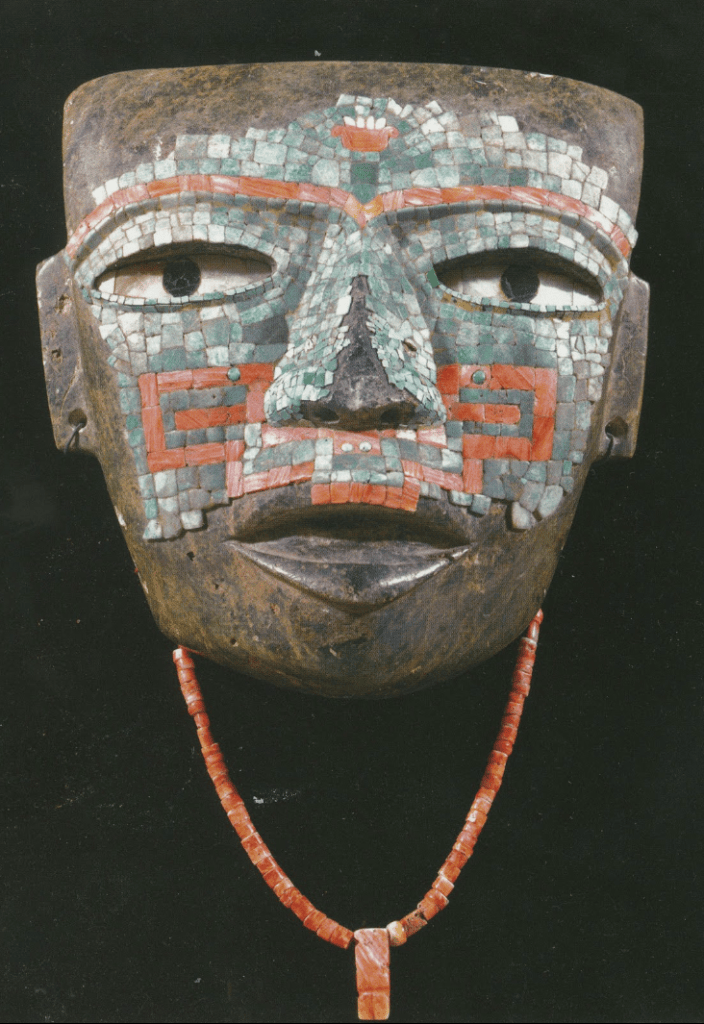
The mask is not naturalistic and instead emphasizes the symmetry and geometric shapes of the face it represents. This mask is not a representation of a particular individual; instead, it is representative of the hegemonic, collective identity of the inhabitants of Teotihuacan. Instead of differentiating the wearer, it hides their identity and allows them to represent the higher ideal of a figure. This mask may have been worn by the priest-kings of Teotihuacan during ceremonies. Wearing a mask during religious ceremonies, and thus being transformed from an individual into a symbol, works to uphold the idea that the priest-kings are not the rulers of Teotihuacan – the gods are.
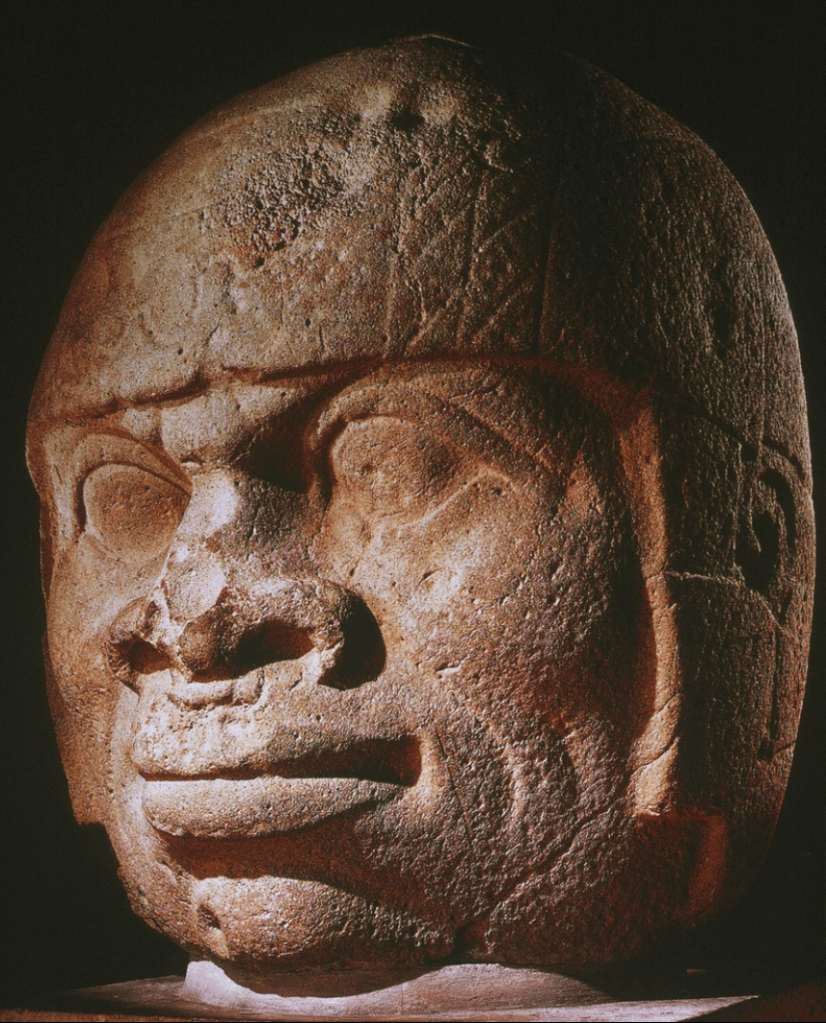
In contrast to the anonymized identity of the rulers of Teotihuacan, rulers of the Olmecs were explicitly venerated in a cult of personality. As Mary Ellen Miller writes in The Art of Mesoamerica, works throughout Mesoamerica “emphasizes the human head, a practice that began with the Olmec, and is evident [especially] in… the colossal heads… that characterized Olmec religious imagery” (Miller 44). One of the best and most extant examples of these colossal heads is Colossal Head (Monument 9), 900-800 BCE.
Typically, these heads varied in size between 8-10 feet; this one is made out of basalt, a hard, durable stone. The amount of effort needed to quarry, transport, and carve such a hard, heavy stone proves how important these colossal head monuments were to the Olmec cultures. The use of stone to carve this monument may also be a reference to the Olmec spiritual belief of the creation of humans, in which humans were born from the earth and crawled into the world through divine caves. Olmec rulers, such as the one depicted in this monument, were seen as divine because they were thought to be descended from the original humans who were born from the earth. Olmec rulers were treated very differently from the priest-kings of Teotihuacan; though Olmec rulers had a strong connection to their gods through their assumed divinity, that assumption hinged on their individual identity as a descendant of the original humans – and as such, the monuments created for them are individual and naturalistic.
Colossal Head (Monument 9) depicts a man who is most likely an Olmec ruler. He stares straight ahead, and his expression is fairly neutral. The face features a flat nose, wide lips, lidded eyes, and wrinkles around the eyes and mouth, creating a clear picture of an individual ruler. The head is also topped with a tight skullcap decorated with geometric patterns of circles and squares. This union of rounded and pointed shapes represents the Olmec belief in the union between dualistic forces. Another Olmec creation myth is that of the coupling of a human woman and a jaguar deity; despite their differences, their union birthed the human race. This union of dualistic forces – such as male/female, human/animal, earth/sky, and earthly reality/spiritual reality – is often found in Olmec works as a reference to this creation myth, as it is found here. The skullcap also has a cleft in the top, just as a jaguar has a cleft in the top of its skull, further adding to the references to this creation myth. This Colossal Head is one of many such examples, each one of them bearing the likeness of a different ruler. This suggests that the Olmecs made a new monument head for each new ruler, using their likeness as the new figurehead for the cult of personality they formed around each ruler. Some of the heads show signs of damage, perhaps done in a ritual to symbolically “kill” the old ruler to clear the way for the new one.
Despite the differences, Olmec and Teotihuacan depictions of rulers do share similarities. Both share a strong sense of symmetry, which represents their belief in a higher divine order of the universe. Both also focus heavily on the concept of the head as the center of a ruler’s imagery: the Olmecs saw it as the site of a ruler’s individual divinity, and the Teotihuacan culture saw it as something to be hidden in order to emphasize the rule of the gods. This difference may be attributed to the different anthropological theories surrounding the creation and maintaining of their cultures. The Olmecs, and by extension, the personality cult surrounding their rulers, can be defined using the sociological term of conflict theory. Conflict theory is the “overt expression of conflict between cities and of social hierarchy between cities, [in which] aggressive images [can] perhaps [be used to] reinforce social distance through implied threats” (Pasztory 137). In other words, the Olmecs emphasized the individual importance of their rulers so thoroughly in order to maintain their empire which had been created by military force. The rulers acted as a uniting figurehead around which the Olmecs could gather and work together to support. In contrast, Teotihuacan can be viewed with the integration theory of sociology and anthropology, in which a culture is subject to a more benign social contract where lower classes are willingly subjugated to the upper classes in order to gain a higher standard of living. Since Teotihuacan was viewed as an earthly paradise, and the anonymity of the rulers worked to uphold that, Teotihuacan naturally grew as more people moved to it to be part of the divine city, whereas the Olmecs grew their empire through military conquest.
Art is explicitly shaped both by the culture who created it and the culture of the viewer who is perceiving it. In Mesoamerica, this was used to the advantage of the Teotihuacan and Olmec rulers to craft the image of the culture they wanted to uphold. In the modern day, we must also be conscious of our own cultures when viewing what we perceive to be “art” – and we must know that it might not truly be “art” in the eyes of the culture who created it, and thus we must recognize the Eurocentric bias inherent in our view of “art.” We must be open to the idea of multiculturality and, in an age of ‘political correctness,’ understand that there is more than one set of political lenses with which to view art.
Bibliography
Blocker, H. Gene. “Is Primitive Art Art?”. Journal of Aesthetic Education, vol 25, n. 4, 1991, 00. 87-97.
Miller, Mary Ellen. The Art of Mesoamerica. Thames & Hudson, 2019.
Pasztory, Esther. “The Natural World as Civic Metaphor at Teotihuacan.” The Ancient Americas: Art from Sacred Landscapes, edited by Richard F. Townshend, Institute of Chicago, 1992.

