Anissa Mendez
From adaptations made for modern audiences that place characters in the modern world to stageplays that honor the integrity and details of the original script, William Shakespeare’s works still hold a prominent place in today’s popular culture. However, adapting Shakespeare’s works now proves difficult as they were written in an era where patriarchal and racist doctrine was far more accepted and unchallenged.
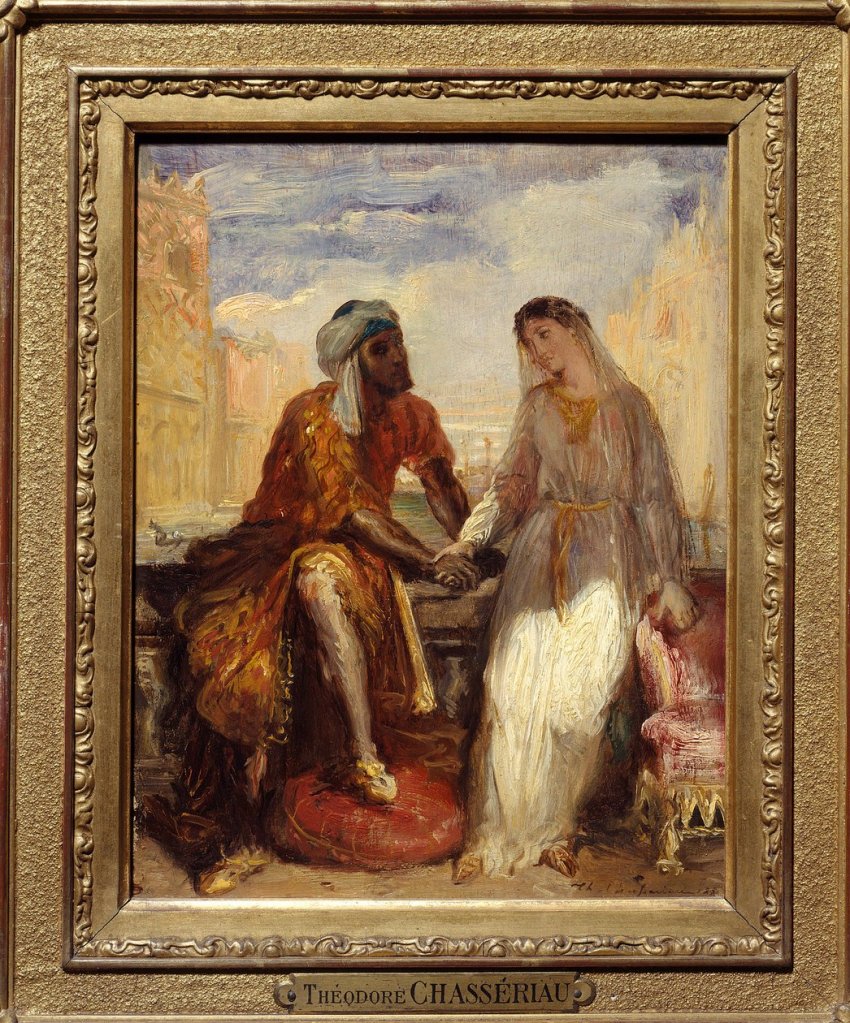
Performing such plays may isolate the actors portraying marginalized characters, or further perpetuate these stereotypes to an audience which lacks a nuanced understanding of the play. By studying the influence of Elizabethan and Jacobean English societal beliefs on Shakespeare’s portrayal of Othello, a black man, we can assess the validity of performing classical plays that harbor outdated prejudiced rhetoric. Shakespeare’s Othello follows the titular character, Othello, as he becomes trapped in a revenge plot orchestrated by Iago after Othello promotes Cassio to the post of lieutenant over Iago. Over the course of the play, Iago convinces Othello that his wife, Desdemona, has cheated him, ultimately leading him to tragically murdering her before turning the blade on himself. Reflected in the rhetoric and actions of Iago and various other characters, Othello reinforces racist and religious doctrine that asserts blackness as being a visual indicator of sin, ultimately creating the narrative that black people possess an inherent immoral nature that cannot be changed or separated from them. Because of this, Othello and other plays by Shakespeare that contain problematic narratives based on outdated beliefs should be adapted in ways that uplift the voices of the marginalized groups they depict, as well as provide context for the harmful ideologies present in the work in order to avoid perpetuating them further.
In a selection from A True Discourse of the Late Voyages of Discovery by George Best, the author argues that blackness is a visual indicator of inherent sin. After disputing what, at the time, was a common belief that climate was the reason for a darker complexion, Best comes to the conclusion that “…this blackness proceedeth of some natural infection of the first inhabitants of that Country, and so all the whole progeny of them descended are still polluted with the same blot of infection” (192). He then turns toward a biblical explanation for such an infection, asserting that one of Noah’s sons, Ham, betrayed his father by participating in “carnal copulation” with his wife and conceiving a child because he believed the first-born son among him and his brothers would, by natural law, inherit the world (Best, 193). He states that this first-born son, Chus, was made by God to be black to indicate the sin of his father, an inherent sin that would curse and follow all generations born from him. As Best puts it, God created Chus to be “so black and loathsome that it might remain a spectacle of disobedience to all the World” (193). From this, we can conclude that the stigma surrounding darker complexions and blackness originates from a belief that it is an indicator of a sinful individual, especially one who is selfish and lustful, as Ham gave into his “carnal” desires out of a want to rule the world. Furthermore, Best focuses on how this curse will persist through generations, implying that such immoral behavior is “natural” for black people and cannot be changed or separated from them.
By being associated with non-Christian religions and the devil, blackness further became stigmatized and connected to immoral behavior, especially in a religious context. In “The Vocabularies of Race” chapter of Shakespeare, Race, and Colonialism, Ania Loomba discusses the relationship between race and religion, first by pointing out that “in 1594, Richard Hooker asserted that the English were ‘the people of God’ and also the ‘race of Christ’” (26). Notably, this assertion makes only English people out to be holy rather than just white people in general, meaning that at this time, the English viewed any form of culture outside of their own as “other” and being wrong in a spiritual or moral way, even if the individuals of said culture were of a fairer complexion. Loomba then goes on to say that religions besides Christianity, especially Judaism and Islam, were “treated as the handiwork of the devil” (27). She also states that because of this, “popular culture depicted Muslims, Jews, and the devil as black,” and that explorers such as Thomas Herbert referred to the natives of Africa as “Devilish savages” or “Devils incarnate” upon returning to England (Loomba, 27). The conflation of non-Christian religions with specific races and complexions further affirmed the belief of black people to be inherently sinful, as these religions were perceived to be worshiping false deities because they did not believe in the Europeans’ image of God. Furthermore, the association of the devil with the color black adds a new layer to the belief of blackness being an indicator of inherent sin, as it now puts this inherent sin on the same level as the most sinful creature of all.
In the opening scene of Othello, Iago utilizes animalistic and religious terms that dehumanize Othello and emphasize his skin tone in a manner similar to the ones discussed in Best and Loomba’s works in order to manipulate Brabanzio into believing Othello to be a malicious figure. In Act 1, Scene 1, when Iago means to let Brabanzio know that Othello and Desdemona have eloped, he calls out to Brabanzio, “Awake the snorting citizens with the bell, / Or else the devil will make a grandsire of you” (1.1.79-81). Instead of referring to Othello as a Moor here, as we see throughout the rest of this scene and the play as a whole, Iago chooses to call him a devil because, as aforementioned, the term devil both encapsulates the association of blackness with sin, but also elevates that sin to the highest degree of malevolence imaginable. Because he wants Brabanzio to awaken with an urgent concern for his daughter and the purity of his lineage, he chooses the term “devil” to exaggerate the situation of Desdemona marrying Othello and to erase any honor or merit that “valiant Othello” possesses. Iago instills even more panic about a pure bloodline into Brabanzio by stating that if he allows their marriage to go unchallenged, that “you’ll have your daughter covered with a Barbary / horse, you’ll have your nephews neigh to you” (1.1.113-114). Iago states that if Othello and Desdemona stay together, Desdemona and the lineage that will come from her will forever be tainted, so much so that future generations will “neigh” to him, a sign that it may not even be recognized as human anymore. Both of these sentiments reflect the beliefs present in Best and Loomba’s works; the tainting of the bloodline relates to Best’s assertion of blackness being an “infection” and that the sinful nature and complexion will permeate the lineage, while this likening of future generations to animals calls back to the English people viewing themselves as what humans should be, and all other cultures as “other.” While never directly stated that Othello is sinful, the devices Iago employs to work Brabanzio into a panic clearly pull from the racist beliefs present in England at the time of the play’s writing, creating the problematic implication within the play that Othello cannot be trusted or considered honorable simply because he is black.
The specific use of the word “devil” in Act 5 of the play further racializes sinful and immoral behavior, connecting such a nature to blackness. Following Othello’s smothering of Desdemona, Emilia calls him a devil twice, saying “O, the more angel she, and you the blacker devil!” (5.2.140) as well as “thou art a devil!” (5.2.142). The first line in particular is of interest, as it very clearly underscores the supposed inherent nature of Othello by pointing out that he, a devil, has killed Desdemona, a being of innocence. Though he has, in fact, murdered the innocent Desdemona, the immorality of his actions becomes racialized when he is speaking to Lodovico moments before his death. Othello pleads with him, saying, “Will you, I pray, demand that demi-devil / Why he hath ensnared my soul and body?” (5.2.306-308). The use of the word demi-devil to describe Iago is especially notable, as the prefix “demi-” implies that Iago is only part devil as opposed to a whole devil, as Othello has been made out to be. It is curious to refer to Iago, whose own irrational jealousy and need for revenge drove him to influence Othello to commit such a murder, as less than a devil as him, especially since he orchestrated the events leading to Desdemona’s death and is the mastermind behind Othello’s madness. However, if we play into Best’s religious arguments and pull from the Bible itself, Iago is proven to be the worse of the two, as Galatians 6:7 states, “Do not be deceived: God is not mocked, for whatever one sows, that will he also reap.” God will hold individuals accountable for all of their actions, and since Iago has sown the seeds of madness and jealousy within Othello, he is also just as responsible for Desdemona’s death as Othello is, and he must reap the consequences of what he has influenced others to do. Therefore, with his own sins combined with Othello’s, Iago is the greater devil of the two. And yet, he is still referred to as only being part devil. Best and Loomba’s works both explain why Iago is a lesser devil than Othello. Best’s discussions about blackness being an “infection” and linked to sin combined with Loomba’s statements about how the English viewed themselves as God’s people can be used to infer that because sinful and deceitful nature was so heavily associated with blackness to justify colonization, Iago could not be as much of a devil as Othello because of his fair complexion.
Iago being referred to as a “demi-devil” further highlights the morality associated with whiteness and blackness because the racialized term is used to ostracize him and make him othered by society. In Othello, Iago is the only primary character whose name is of Spanish origin, whereas all the other characters have names of Italian origins. This automatically creates an ethnic divide between Iago and the rest of cast, which is significant if Richard Hooker’s assertion that English people were the ‘race of Christ’ is considered (Loomba, 26). As aforementioned, this assertion creates an ethnic superiority that holds English culture and lifestyle as being “correct” in both spiritual and moral ways. Because they were chosen by God, any other culture or ethnicity is considered inferior. If this view is applied to Othello and the characters of Italian origins are considered to be substitutes for English people, since they are the majority in the play, then it is evident that even Iago’s sinful nature is a result of an ethnic difference and origins that make him impure. Like Othello, Iago was accepted as a member of Venetian society until he exhibited behavior that affirmed their beliefs of his “true” nature. Thus, the term “demi-devil” applies the biblical historical context, inherent sin, and general stigma of blackness associated with the term onto Iago once his schemes are exposed in order to show how corrupt of a being he is. As a Spaniard, Iago was already considered to not be a son of God, but through the use of the racialized term “devil,” he is now lowered to be on the same level as the people believed to be the children of the devil. This develops the problematic connection between Othello’s blackness being the reason for his sins even more, as the gravity of Iago’s misdeeds can only be conveyed by comparing him to a race that is considered to possess a great inherent evil within them. Ultimately, this term being applied to Iago upholds the racist ideology of black people being naturally immoral while also underscoring an ethnic superiority of English people, two beliefs that promote white supremacy.
The harmful ideologies within Othello can cause actors portraying Othello to feel isolated, belittled, or otherwise humiliated, showing that Shakespeare’s plays continue to harm minority groups and perpetuate problematic stereotypes. In an interview with the Folger Shakespeare Library as part of the organization’s Critical Race Conversations series, Tyler Fauntleroy, an aspiring African-American actor, discussed his experiences acting in adaptations of Shakespeare’s plays, stating that he “couldn’t forget [his] blackness even if [he] wanted to when it comes to Shakespeare.” If Fauntleroy’s statement is related back to the ideologies and stereotypes present in Othello, it can be inferred that the reason black actors are constantly reminded of their race while performing is because blackness is such a central aspect of the play, as it is viewed by the other characters in the play for the reason behind Othello’s madness and murder of Desdemona. Furthermore, if the director chose to cast actors based on race, then all other members of the cast would be white, something that could exacerbate the play’s themes and make the racist sentiments feel as though they exist outside the bounds of the play, ultimately leaving Othello’s actor to feel isolated. Even if this is done without malicious intent, this can still cause the actors to feel targeted or even relive their trauma associated with discrimination they have faced, revealing how these ideologies can still harm the minority groups they once worked to oppress.
The obvious solution would be to enact non-traditional casting and allow other characters to be black or people of color, but such casting can erase commentary on the experience of being a black person in white-dominated spaces that spark important conversations about racism in modern society. Keith Hamilton Cobb’s American Moor contains a scene in which a black man auditions for the role of Othello, and he calls the play’s protagonist a “prodigious and powerful Black man” (Cobb, 16). After several pages of internal reflection on the white director trying to dictate how Othello should act, the actor thinks toward the director, “pick the actor that scares you the most. Because that’s what Othello does…You ain’t gotta pick me. But you’re gonna respect that walkin’ through that door, purely by virtue of being born Black in America, I know more about who this dude is than any graduate program could ever teach you” (Cobb, 24). The actor holds Othello in high regard, potentially finding empowerment in his status as a respected Venetian military commander despite being a black man in the late sixteenth century because it is a clear defiance of a system that oppressed black people. His expressed connection with Othello because he, too, was born a black man in an oppressive society highlights the importance of Othello’s blackness further, as it shows that black people view Othello’s experiences as a reflection of their own. Therefore, performing Othello is a way for them to convey their reality to other racial and ethnic groups, especially white people. If non-traditional casting is practiced in a play like Othello, though, then the message about black experiences in a white-dominated society is lost, as the emphasis is no longer placed on Othello’s race if other primary characters are portrayed by black actors, or if Othello is not black. This outcome can be even more harmful than performing the play as it is written because it makes it seem as though the discrimination Othello faces is not of significant importance, when in fact, it is integral to how Iago is successful in orchestrating his downfall. Additionally, a portrayal of Othello that lacks racist bigotry would be inauthentic, and only serves to expunge a history of prejudice from both Shakespeare’s works and Western culture and society. Such erasure would make it easier to deny that certain aspects of modern society are systemically racist, as the origins of such oppression would no longer be evident or accessible.
Retiring Shakespeare’s works from being performed or adapted causes them to only be consumed in an educational setting, ultimately leading back to the issue of historical evidence of racism and other prejudices being inaccessible. If the presence of problematic ideologies and bigotry in Shakespeare’s works isolate actors from the affected minority groups, but the absence of them undermines the gravity of their experiences with oppression, then the next obvious solution would be to stop performing or adapting the plays altogether. This would mean that Shakespeare could still be taught in high schools and universities, along with the historical and societal context needed for the readers to develop a nuanced understanding of the plays. Though the risk of minority groups reliving their trauma still exists in this setting, providing the context surrounding the harmful ideologies can cause them to not feel attacked, given that the educator opens up a space for discussion on how these ideologies were used to oppress, and how they are still evident in today’s society. However, this creates a similar problem of the origins and evidence of systemic oppression being inaccessible to the general public, as only people who pursue education past high school would receive the materials necessary to understand the plays in such a way. But according to the American Council on Education, approximately 45 percent of undergraduate students in the United States are people of color, with only about 15 percent being black or African-American. This means that in addition to this information being largely inaccessible to the public, it would also be gatekept from the groups it affects the most. The actor in American Moor addresses another issue with this when he tells the director, “…you think it’s acceptable for you to sit there on your little, narrow, privileged, lily-white, MFA ass, and judge a Black man on what a Black man is supposed to be” (Cobb, 23). Gatekeeping Shakespeare’s works and other works like it would place the control over the historical narrative back in the hands of the oppressors, which can be belittling for black people when white people believe they know more about their own experiences simply because they are educated. Overall, ceasing production and adaptations of all Shakespeare plays would further harm marginalized groups by making historical evidence of their oppression inaccessible, and placing even more power and pride on their oppressors.
This depiction of Othello echoes the problematic themes surrounding race and other sensitive topics in Shakespeare’s works; by utilizing Othello as a case study for how harmful racist and religious ideologies impact the characters of the play, and how those effects can carry over into the reality of black actors, it can be concluded that the answer to whether or not Shakespeare’s works containing problematic themes should still be adapted for modern audiences is not an easy one. Based on the previous paragraph, not performing the plays is not the best course of action, but performing them exactly as they are written while taking no precautions is not the solution, either. Though there is not one clear answer, I believe that the best course of action is to create a space in the production that is safe for actors belonging to these marginalized groups to discuss when they are uncomfortable, and if they believe anything in the play should be altered. The best input on how to handle such sensitive content will come from the people it affects the most. Additionally, it would be best to provide the audience with brief summaries about the historical context and the ideologies that form the play. Though this could be done during the play’s talk-backs, there is no guarantee that the audience will stay for them, so this would best be done in the playbill, or as an introductory message in the few minutes before the play starts. Ultimately, the goal should be to listen to the voices of marginalized groups and make information about the play’s background more accessible so that the modern production is not simply reintroducing these harmful ideologies to the audience.
Bibliography
Loomba, Ania. “The Vocabularies of Race.” Shakespeare, Race, and Colonialism, Oxford University Press, Oxford, 2013, pp. 22–44.
Best, George. “A True Discourse of the Late Voyages of Discovery.” 1584.
Shakespeare, William, et al. “Othello.” William Shakespeare: The Complete Works, Oxford University Press, London, 2005, pp. 873–907.
“Shakespeare and Race in Performance.” Folger Shakespeare Library, Folger Shakespeare Library, 10 Dec. 2020, https://www.folger.edu/research/featured-research-projects-and-initiatives/critical-race-conversations/critical-race-conversations-shakespeare-and-race-in-performance/.
Cobb, Keith Hamilton. American Moor. Methuen Drama, Bloomsbury Publishing, 2020.
“Race and Ethnicity of U.S. Undergraduates.” Race and Ethnicity in Higher Education,American Council on Education, 9 Oct. 2020, https://www.equityinhighered.org/indicators/enrollment-in-undergraduate-education/race-and-ethnicity-of-u-s-undergraduates/.

