Sophia Auron
Like many tourists, I visited Père Lachaise cemetery when I was in Paris, France. This cemetery is home to many famous graves, such as those of musical legends Frédéric Chopin, Édith Piaf, and Jim Morrison. As I walked through the cemetery, I was struck by the objects left and the traditions surrounding them. I will focus on several examples of graves I saw to analyze how society interacts with celebrity death: the graves of Jim Morrison, Oscar Wilde, and Victor Noir.
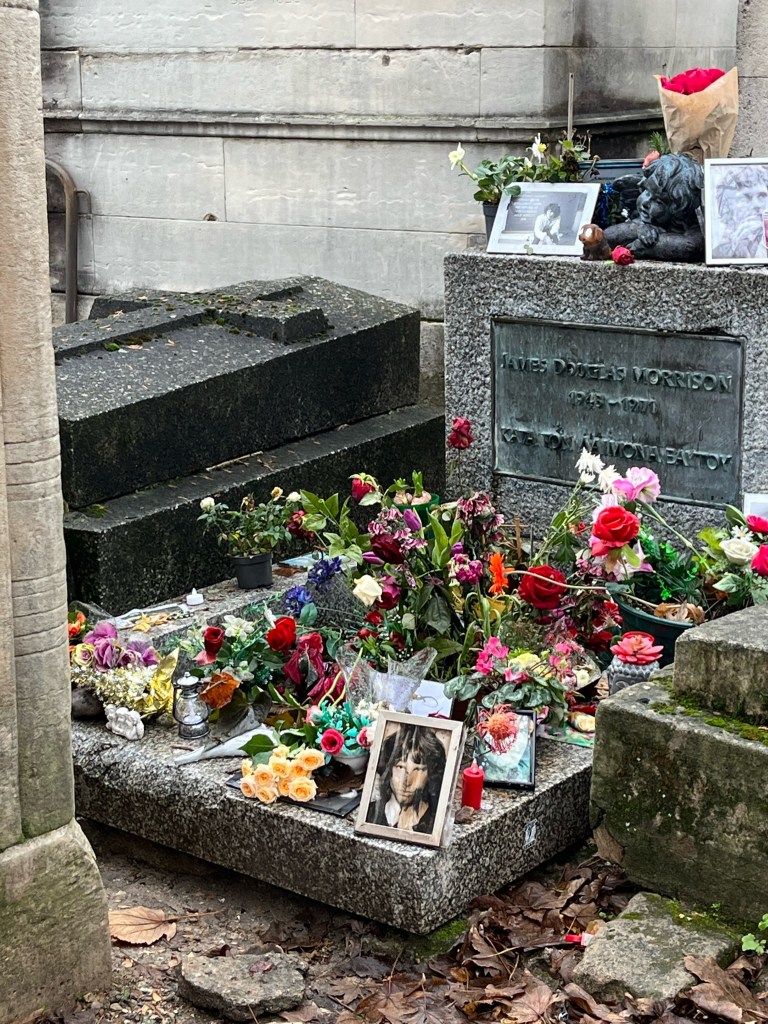
Although the distance in relation to the dead impacts the ability of visitors to these sites to interact with death, traditions surrounding celebrity gravesites in Western culture mirror the death rituals practiced for loved ones to honor the dead and demonstrate an intense care for celebrities that continues into death.
The amount of care taken with famous gravesites symbolizes the cultural importance of the person. The grave of Jim Morrison, a famous musician, is covered with flowers, photographs, and other objects. Visitors to writer Oscar Wilde’s grave have a long-time tradition of leaving lipstick kisses on the headstone, to the point where it has been surrounded by glass to prevent damage. It is typical to leave flowers and other items on loved ones’ graves, but it doesn’t happen on the grand scale that it does to famous people. Robert Hertz describes death as a space left behind in the community. He describes how this plays out among groups he studied in Indonesia. The death of a chief creates a big stir in the community, but “On the contrary, the death of a stranger, a slave, or a child will go almost unnoticed; it will arouse no emotion, occasion no ritual” (Hertz 76). Celebrity deaths are like that of a chief. They often arouse strong emotions in fans, even those who were not personally familiar with the person. They are a loss to the community of fans. Traditions at famous gravesites, like leaving photographs of them while they were alive, create space for people to celebrate the lives of these celebrities.
These traditions represent the collective grief at the loss of the person. Beth A. Conklin studies this collective grief through the example of the Wari’ people of Brazil. The Wari’ had a tradition of endocannibalism in which the mourners play different roles based on their degree of closeness with the dead. Consanguines, who are blood relatives of the dead, encourage the affines, who are relatives by marriage, to participate in the consumption of the flesh (Conklin 71). While many fans of celebrities are not as close as either consanguines and affines to the dead, the situation can be compared with social obligations dictating grieving rituals. Fans mourn a loss in their community, whether it’s a fandom or the global community. By participating in rituals like visiting graves, they are playing their unofficial role in mourning. It is expected that a grave being taken care of will be visited and given flowers, and strangers from around the world step into this role. It allows individuals to contribute to the collective mourning and honoring of the dead and feel connected to their community.
These practices adapt to become popular traditions, and the desire for many fans to partake influences how they work. Many fans desire closeness to the deceased celebrity. They feel a need to honor the dead. Traditions, like those at Père Lachaise, are born from this desire. Cemeteries have had to change policies to deal with these traditions, such as adding glass around Oscar Wilde’s headstone and a metal barrier around Jim Morrison’s. Despite this, visitors continue with their traditions. The glass is covered in lipstick marks and objects are still left for Morrison. Another interesting tradition at Père Lachaise is the grave of Victor Noir, which features a statue of Noir with the crotch area rubbed shiny from many visitors touching it. It is said that rubbing it gives the visitor good luck in fertility and love. This sort of practice would be odd at a grave of a loved one and could be seen as disrespectful. I felt a bit uncomfortable with it because it felt inappropriate to do that to a human figure. Yet through the creation of this practice, the grave has become a popular site for visitors who don’t feel a close connection with Noir and simply want to take part in the ritual. It is common for touching certain parts of statues to be seen as good fortune, so Noir’s grave has been enmeshed in this practice that is not necessarily part of mourning. In this way the practice is distanced from his death.
Mourning someone who wasn’t personally close to us can change the practices we participate in. People feel distant from celebrities, and don’t have direct duties to care for them. Yet even caring for close family members can depend on evolving societal norms. Anne Allison wrote about changing burial practices in Japan, where there is a decline in people tending to and visiting cemeteries. For example, Allison’s friend visited her aunt and uncle in a columbarium a couple times a year. Her other friend is considering this practice because she will have no one to take care of her grave after her death (Allison 7). These new methods of burial show the care that can go into the physical space of the dead. Cemeteries like Père Lachaise require a lot of upkeep, and not all cemeteries get as many resources as Père Lachaise does. Its fame means it receives a high level of care, but many people buried in other places do not. People continue to want to practice mourning rituals for celebrities, while many less famous individuals are forgotten. In that way the person’s influence while alive, as well as the people who care about them, determines how they are remembered after death.
The contrast between being a cemetery and being a tourist site demonstrates complicated relationships with death. Visiting Père Lachaise felt like a different experience than other cemeteries I’ve been to, because I had read about it in travel books and there were many other visitors. There was also a map directing you to the more famous graves, so it felt like a tourist site. Part of why it felt different was likely also that I didn’t personally know any of the people buried there. Maybe I had learned about them in school, but it wasn’t like visiting a family member. Despite a lack of connection, I still felt a sense of grief at their graves. Being at a cemetery, a place symbolic of death, gave me a feeling of the collective grief of visitors who have been there. It still felt like somewhere to be somber and respectful. I felt almost guilty experiencing it as a tourist, but I couldn’t help my desire to see the most visited graves. In Western culture, death is a taboo subject that people often avoid. Conklin experienced this with the death of her brother, writing, “When I talked about losing him, I felt guilty, as if being the bearer of bad news were shameful, contaminating” (Conklin 225). Discussing death brings the mood down and can even make people feel a sense of fear. Yet there’s also a fascination with death and respect for the dead that makes places like Père Lachaise into tourist sites. This contradiction is shown in how people interact with the graves, as they both view it as a box to check off on their travel checklist to practice lighthearted traditions to celebrate celebrities’ lives, but also feel sadness and want to respect their deaths.
Despite the experience being more distant with celebrity death, the practices created by people visiting celebrity gravesites demonstrates a human desire to express grief and honor the dead. Visitors to Père Lachaise created rituals based on the person’s life, such as leaving objects that remind them of the person. Celebrity gravesites represent the importance of the dead because they bring in many visitors, even long after the deaths. Celebrities continue to have a large space to be celebrated and mourned by their fans, creating a system of care for the upkeep of graves. Many people crave being remembered after their death and would appreciate this honor. Yet sometimes these practices can go too far. Fans can have parasocial relationships with celebrities where they feel entitled to a celebrity’s attention and information. Recently, social media was flooded with conspiracy theories about Kate Middleton not having been seen in public in recent months. She was forced to share that she had been diagnosed with cancer. Fans also frequently swarm celebrities in public to get a selfie or signature. This type of behavior is mirrored in tourists wanting to leave their mark on celebrity graves, even if it is invasive and damaging to the graves. These rituals are part of the human experience of dealing with death, and will not likely be going anywhere anytime soon. In the future, we will continue to draw on traditional mourning practices to create our own ways to remember the dead, and we should be sure to conduct these practices with respect.
Bibliography
Allison, Anne. Being Dead Otherwise. 2023. Durham, NC: Duke University Press.
Conklin, Beth A. Consuming Grief: Compassionate Cannibalism in an Amazonian Society. 2001. Austin, TX: University of Texas Press.
Hertz, Robert. Death and the Right Hand. 1960. Abingdon, UK: Routledge.

