Kamana’okekai Lattig
Introduction
When I asked my mother what traditional Hawaiian clothing was, it took her a few seconds to answer. “Well, we don’t really have traditional clothing,” she said, “But I guess it would be a muʻumuʻu.” I did not ask what she meant at the time, but I grew more and more curious about Hawaiian dress. Why do we not have “traditional clothing?” What is the significance of having (or not having) traditional clothing? After doing baseline research on what a muʻumuʻu is, I consulted multiple members of my family. Both my mother and grandmother agreed that the garment was implemented by royalty as a form of diplomacy in the west; a gesture of good faith that demonstrated the Kānaka Maoli’s, or Native Hawaiians’, willingness to join a modern world. My aunt, however, offered a contrary opinion. She believed that the muʻumuʻu was used by foreign missionaries to enforce western body constraints and “clothe the natives.” Neither side could come to a unanimous consensus; the answer to their question is much more complicated than they imagined. The nature of the muʻumuʻu is extremely fluid, as it was enforced as a social standard but worked as a blank slate for migrants to imprint their own cultures on. The muumuu, initially part of a wider movement to Christianize Native Hawaiians, was adapted to fit the needs of Hawai’i’s multicultural population.
Christian Missionaries and the Mother Hubbard
When American missionaries first had contact with Kānaka Maoli, they were greeted by authority and power that they didn’t expect from indigenous peoples. In fact, King Kamehameha engaged frequently in trade. The relationship between early western contacts and Kānaka Maoli was seen through exchange of ideology and material goods (Thigpen, 12). Hawaiians were not passive victims of colonization; the people of Hawaiʻi welcomed foreigners with open arms and shared their culture with people who wanted to learn about it. The first Europeans to reach Hawaiʻi were looking to involve themselves in foreign trade. It was not until the early 1800’s that Christian Missionaries from America came in hopes of enforcing Christian moral standards. These missionaries were looking to “civilize” Kānaka Maoli on behalf of their religious ideals. Missionaries spoke freely with eloquent Hawaiian royalty, and they exchanged such religious beliefs, along with livestock, weapons, and clothing– the most well known being variations of the muʻumuʻu. Traditional Hawaiian clothing did not exist before missionaries because of a lack of unified identity. The push for westernization and colonial pressure to participate in the global playing field created an ambiguous identity for Hawaiʻi: an identity that was defined not by ethnicity, but by solidarity between natives and migrants.
The muʻumuʻu has been an integral part of the Hawaiian identity since the late 19th century, but started as a vastly different garment. In her analysis of early 19th century dress, Linda B. Arthur describes the original dress that missionaries adapted: “This dress was called the holokū, and the missionaries gave the queens chemises (slips) to wear underneath; the Hawaiians called the chemises muʻumuʻu (Thigpen, 12).” However, the muʻumuʻu that my family talked about was a stand alone dress, while my mother explained the holokū as “a muʻumuʻu with a train.”
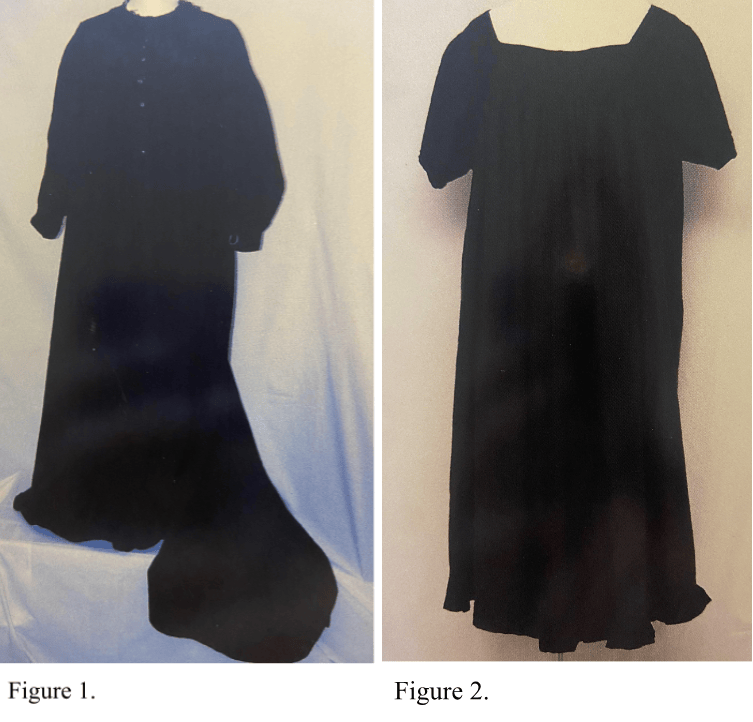
Figure 1 is an example of a holokū from the 1890’s, an original prototype brought in by the missionaries (Arthur, 10). Figure 2 is a muʻumuʻu/slip from the same time period, both of which derived from the original “Mother Hubbard” and traveled from America (Arthur, 12). These dresses are identifiable by having a square yoke at the top, from which fabric flowed into a loosely fitted dress.
Compared to the tight-corseted fashion that was popular in America and England at the time, the Mother Hubbard was a much less restrictive alternative. Gray states, “The garment’s departure from fashionable styles reveals the tension between fashion and function, formality and informality that marked women’s dress in the last quarter of the nineteenth century and became increasingly important in the next” (Gray, 29). These dresses started out as womenʻs leisurewear, worn only around the house. Variations of this dress spread across the United States: they were called “prairie dresses” in association with the western country and occasionally associated with childhood innocence, as the name comes from the Mother Hubbard nursery rhyme. It did not make it to the Pacific until the early 1800’s.
Though the intentions of the missionaries seemed well-meaning, the muʻumuʻu aided the movement to westernize Kānaka Maoli. In her analysis of the early 19th century, Linda B. Arthur asserts, “Dress was the first issue undertaken… Naked torsos offended the missionaries, and they worked hard to coerce Hawaiians into western style clothing (Arthur, 12).” Hawaiian royalty did not wear western style clothing until participating in global trade. Initially, non-royal Hawaiians only wore missionary clothing on certain occasions. In their analysis of missionary clothing implementation, Sandra Lee Evenson and David J. Trayte state: “Because missionaries demanded that less-revealing clothing be worn by women visiting the mission, many Hawaiian visitors wore holokū at the mission, but changed back into traditional dress on returning to their village” (Evenson and Trayte, 97). At this point in time, Kānaka Maoli did not consider the holokū as part of their wardrobe, but something to help them fit in with the western standards of dress. The missionaries considered natives to be uncivilized savages, using dress to change them to civilized members of a westernizing world.
The connotations of the holokū shifted when it was adopted by Pacific Islanders. Gray notes that women of all walks of life wore Mother Hubbards, and that it was a universal style of informal dress (Gray, 30). It was significantly more modest compared to the lack of clothing that the Kānaka Maoli were accustomed to, but it was still an informal style compared to what was seen as modest in Europe or America. Mission wife Jessie Ackermann wrote in her journal, “Because of the heat, she [a Kānaka Maoli woman] and her daughter had adopted the dress– commonly called a “Mother Hubbard” – worn by all the Christian natives of the South Seas. This careless and almost untidy fashion of dress detracted from the dignity of the wife of a genius” (Ackermann, 66). The dress also came to be associated with prostitution, as a loose dress was equated to having loose morals (Gray, 49-50). Gray states, “As a visitor to Hawaii in the 1890s pointed out: ‘native women wearing the holokū, or world-famed Mother Hubbard … throng the wharfs, apparently heedless of the fact that the wind swishes the wide, loose garment at will, now revealing, not concealing contours that would make a professional model green with envy’” (Gray, 50). The perception of Kānaka Maoli has been tied to dress since early missionary interactions, and the exotification of Kānaka Maoli bodies started with these interactions and was informed by their unwilllingness to adhere to Euroamerican fashion trends. Not only were they unwilling, but they were unable to; the climate of Hawaiʻi is unforgivingly hot. Wearing corsets and layers was unfeasible. Regardless, the native people of Hawaiʻi were encouraged to wear holokū to control the external body, in hopes that it would also control their internal body.
Multi-ethnic Motivations
The muʻumuʻu did not become a standalone dress until the 1940’s, and at that point, it was a vastly different garment. It stayed in Hawaiian culture as it moved toward statehood. Instead of merely being a slip, it took a more tightly-fitted form.
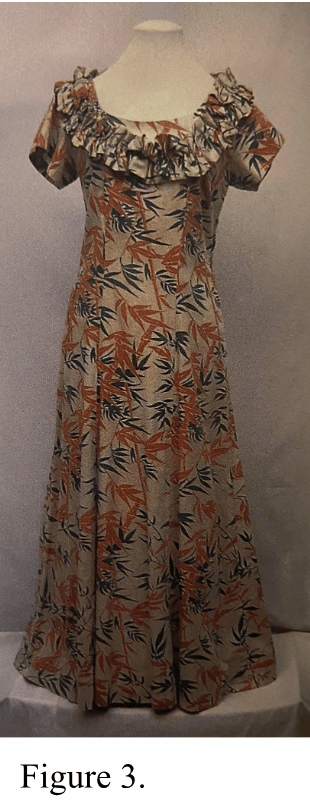
Figure 3 is a cotton muʻumuʻu from the late 1930’s, donning a pattern reminiscent of what most people would recognize as a Hawaiian motif (Arthur, 28). However, what was considered ‘Hawaiian’ in the 1930’s-40’s was rapidly changing. Hawai’i is extremely diverse due to the migration of workers during the early 19th century. The plantations that missionaries built were staffed by a variety of different ethnicities from all over the Pacific and Asia. Because the plantations were created and run by white settlers on the land, they implemented a mercantilist system that would export exotic goods to America, thus promoting Hawai’i as a tropical paradise. Other European powers and colonies sought to join this industry; Portuguese and Puerto Rican migrants came to Hawai’i as well, in search of economic opportunities. The most prominent ethnic groups are Asian, with Chinese and Japanese cultures being the most imprinted onto a new ‘local’ culture (Lind, 517-518).
Local culture became a unique fusion of the migrants, missionaries, and indigenous Hawaiians. Many laborers did not speak the same language, and a new language emerged: Hawaiian Creole English, or a language commonly referred to as Hawaiian Pidgin. The language was used to talk about the oppressors (American plantation owners) without them understanding. “Belonging to this new socially constructed identity became known as ‘being local’” (Lind, 519). This new identity was not associated with Europeanness, and was in many ways a resistance to statehood. However, being ‘Hawaiian’ now meant being ‘local,’ which indicates that the Hawaiian identity was no longer attached to being indigenous to Hawai’i. A new local identity also contributed to the racial ambiguity of Hawai’i. Many Hawaiians today are mixed with at least one other race. Hawaiʻi has since been commodified as an exotic paradise with no definitive racial features, mostly based on the large variety of mixed race Hawaiians. In an article about tourist shows, Jane Desmond says, “When targeted at a European or European-American audience, shows like the commercial Hawaiian lū’au both require and feature the visible display of bodies perceived as ‘native’ or ‘Hawaiian’ by the mainlander viewing audience. In fact, however, given the complexities of genealogical histories in the islands, many of the performers may have very little, if any, Native Hawaiian ancestry” (Desmond, 84). The image of the “Native Hawaiian” projected by the tourism industry was created by the multitude of ethnicities that reside in Hawai’i.
The mixture of cultures in Hawaiʻi created a unique sense of fashion. While American missionaries did have a lot of influence on the structure of the Hawaiian economy, social standards, and dress, the large number of Asian migrants that came to Hawaiʻi also brought elements of their culture to Hawaiʻi. The muʻumuʻu was still used as a basis for clothing, but it was altered in ways that fit the other racial groups living in Hawaiʻi, mainly being Japanese and Chinese. In the early 20th century “immigrants of both sexes wore clothing they brought with them from their native countries and continued to wear that traditional dress for both casual dress wear and for weddings” (Arthur, 18). The general silhouette of the garments changed ever so slightly. Much like the development of a new language, local culture stimulated even more variations of the muʻumuʻus and holokūs.
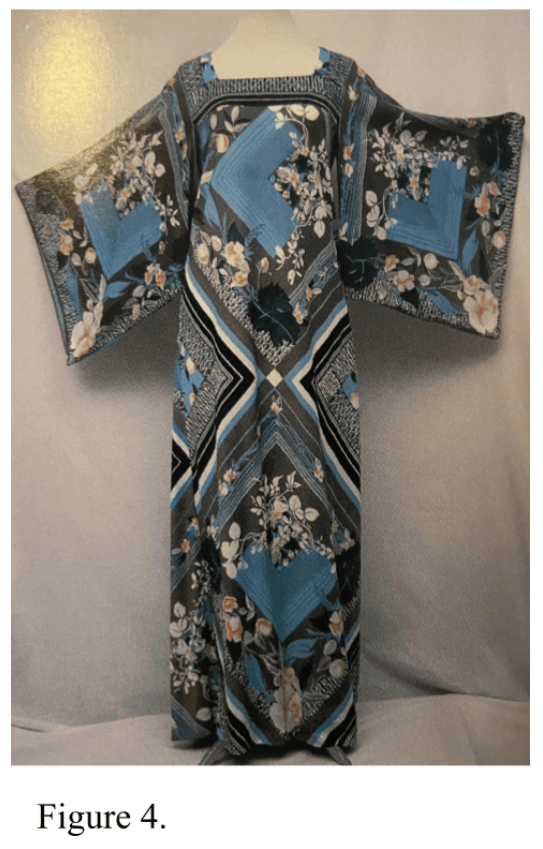
In a sociological article of the Japanese assimilation into Hawai’i, a rural Japanese woman reported, “We [women] made ‘kanakagi’ [holokū] from a cheap, thin cloth that we called ‘kanakin’ which was sold at three yards for 25 cents … . They were long, baggy things and the bottoms dragged on the floor. It took 8 yards to make one dress” (Lind, 204). The Japanese kimono was also popular in Hawai’i, inspiring garments that had similar silhouettes. Figure 4 demonstrates a muʻumuʻu that still has the square yoke and loose fabric, but uses the sleeves of a kimono instead of the typical muʻumuʻu sleeves (Arthur, 90).
The 1950ʻs brought in Chinese-style silhouettes: “Leisurewear was a new category; popular styles were tea-timers (Chinese influence pant and jacket set); Hawaiian swimsuits, mandarin-style sheath dresses (modeled after the cheong sam) with Suzie Wong side slips” (Arthur, 67).
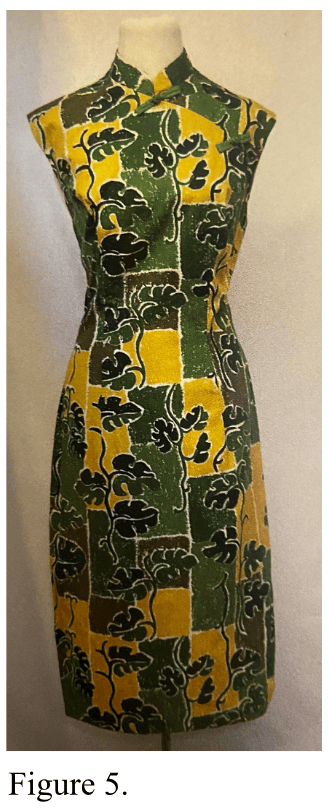
Figure 5 is an example of a Suzie Wong muʻumuʻu from the late fifties (Arthur, 69). It exhibits the differences between the original muʻumuʻu and one that has been adapted to fit preexisting Chinese dress (Arthur, 67). The loose fabric has been replaced by a form-fitted knee length dress. Another changing element of the muʻumuʻu was the textiles used to create it. Some muʻumuʻus had the same silhouette with different textiles and vice versa; the importation of textiles from Asian countries allowed for more versatility. Figure 5 uses leaves and bright colors that are associated with Hawai’i while still having a more Chinese-style silhouette, denoting the multicultural ‘local’ style.
Other muʻumuʻu designers have used Asian motifs within the textiles themselves, establishing that same local style while keeping the integrity of the muʻumuʻu.
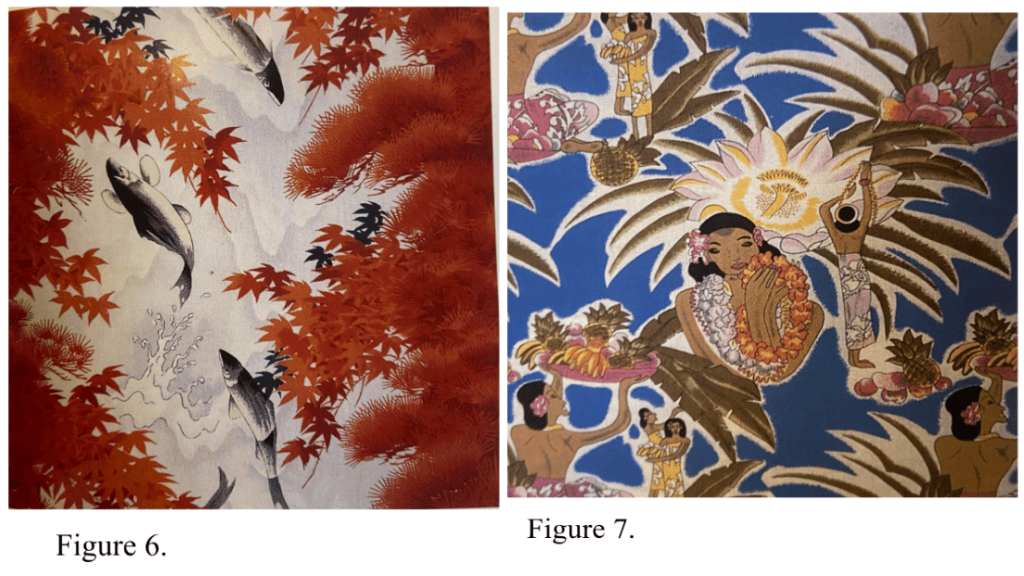
Figure 6 is an example of a Japanese textile. It uses Japanese maple tree leaves, but could have been used for aloha shirts or muʻumuʻu (Arthur, 79). Figure 7 is a textile depicting hula girls– something that is inherently linked to tourism (Arthur, 80).
The pineapples on the textile are not linked to Kānaka Maoli culture, as textiles in this time period were only vaguely related to the indigenous people of Hawaiʻi.
Implications
The muʻumuʻu’s versatility acts as a reflection of the diverse population of Hawai’i beyond its intended purpose of colonization. However, its colonial roots are still apparent in the shape of the dress. The style and textiles of the muʻumuʻu have changed, but the silhouette is still distinctly colonial. Perhaps that is why my aunt still associated it with Christian missionaries.
Figure 8 is an example of a holokū from the 1890’s, before the muʻumuʻu was its own garment (Arthur, 10). The high neck, long train, and long sleeves are all staples of colonial fashion. Pictured on the right, Figure 9 is a muʻumuʻu from the 1970’s (Arthur 109). It is bright and patterned, unlike Figure 8, but it has the same body-less silhouette, high neckline, and long train.
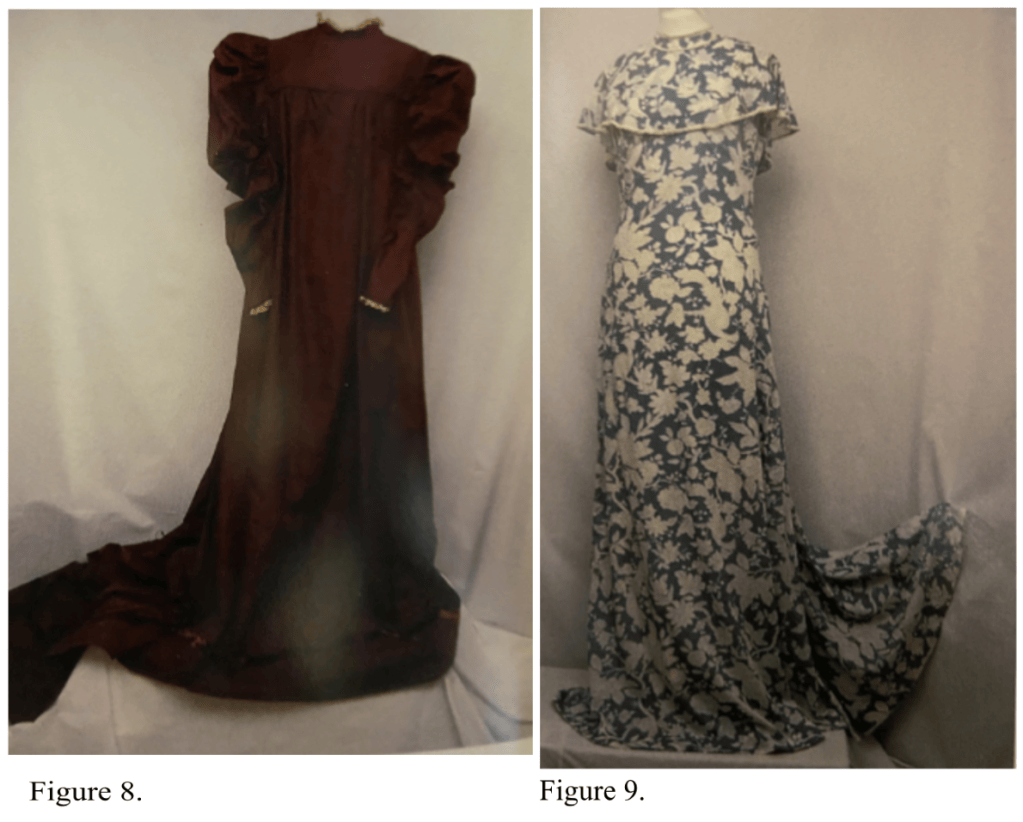
The attempt at modesty is still there despite the natural climate of Hawai’i. Figure 8 is silk and Figure 9 is cotton. While the garment was used for reclamation, it is still the same garment.
The “Mother Hubbard,” “Muumuu,” “Holokū,” and other alternatives all started from the same place. Though the Mother Hubbard was originally revolutionary in Europe, it was restrictive in places like Hawai’i that did not previously have the same standards of dress. Hawai’i is not the first or the last indigenous culture to experience restriction via colonial influence. Evenson and Tayte’s chapter of Religion, Dress, and the Body describes the imposition of Euroamerican Christians on the Eastern Dakota Indians of Minnesota of the 19th century, who attempted to make fundamental changes to Eastern Dakota culture. They write, “In the missionary literature, the transformation of Dakota dress appears as a stated expectation and goal toward this end” (Evenson and Tayte, 105). Evenson and Tayte also mention that feminine Dakota dress at the time was almost equally as modest as the dress of Euroamerican women but significantly different. This suggests that while modesty was weaponized to push certain dress standards, the primary motivation of these missionaries was to Christianize the indigenous people of Minnesota, not to “dress” them. The goal of missionaries was to eradicate Dakota culture by eradicating the clothes that they wore, putting them in clothing that fit a western standard.
In a closer vein to the muʻumuʻu, Anna Paini talks about the Kanak of Lifou and the robe mission, or mission dress, in her chapter “Re-dressing Materiality: Robes Mission from ‘Colonial’ to ‘Cultural’ Object, and Entrepreneurship of Kanak Women in Lifou.” The robe mission dress comes from the same period as the muʻumuʻu and is quite similar. Paini describes this dress as “an introduced garment, which has been appropriated by Kanak women and incorporated into their customary and daily life as a versatile outfit…” (Paini, 2). Like the muʻumuʻu, it was adopted as a traditional gown despite having colonial origins. The idea that colonial garments have outlasted “traditional” indigenous clothing is a pattern seen throughout global indigeneity, and it is only recently being explored because of prioritization of material as a vital part of nonwestern cultures (Hansen, 370). Studying these dress and fashion trends at a globalized level help us understand the greater significance of westernization, notably through religion, and display the detriment of dress restriction on the body.
A frequent consequence that can be seen of globalization is cultural appropriation. Cultural appropriation in dress refers to the exploitation of cultural clothing done by a dominant and oppressive culture. This gets dicey in the context of Hawaiian dress; many elements of local Hawaiian dress have been drawn from ethno-cultural groups from outside of Hawaiʻi. It is, in many senses, a collaborative effort to create a new cultural identity. However, because that cultural identity came from solidarity between non-Euroamericans in Hawaiʻi, local Hawaiian culture can still be (and has been) exploited– just not in a way that most people actually recognize. Mainland “luau parties,” the commodification of hula, local foods, and the travel of the muʻumuʻu across borders have led to inappropriate resale of local Hawaiian culture and has historically had a negative impact on the way Hawaiʻi has been portrayed in popular media. So, next time you bring plastic lei to a “tropical themed party” or decide to buy what you think is “traditional aloha attire,” consider how these garments or accessories impact your understanding of the paradisal Hawaiʻi.
BIBLIOGRAPHY
America Triumphant and Britannia in Distress. Etching, 1782. Library of Congress, Prints and Photographs Division, https://www.loc.gov/pictures/item/2003690789/.
Arvin, Maile, et al. “Decolonizing Feminism: Challenging Connections between Settler Colonialism and Heteropatriarchy.” Feminist Formations, vol. 25, no. 1, 2013, pp. 8–34.
Attallah, Jewan. The Representational Value of America: The Mystery behind the Female Native American Illustrations during the American Revolution.
Barnard, Edward. [Britannia Attacked by Her Enemies]. Woodcut, c 1783. Library of Congress, Rare Books and Special Collections Division, https://www.loc.gov/item/2004676769/.
Britania [Sic] and Her Daughter – a Song. Etching, 1780. Library of Congress, United States, British Cartoons Print Collection, https://www.loc.gov/pictures/item/2004673374/.
Coley, Thomas. The Reconciliation Between Britannia and Her Daughter America. Etching, 11 May 1782, https://www.metmuseum.org/art/collection/search/389044. Library of Congress, British Museum Satires 5989.
Copeland, David A. “Virtuous and Vicious: The Dual Portrayal of Women in Colonial Newspapers.” American Periodicals, vol. 5, 1995, pp. 59–85.
Fleming, E. McClung. “The American Image as Indian Princess 1765-1783.” Winterthur Portfolio, vol. 2, 1965, pp. 65–81.
Green, Rayna. “The Pocahontas Perplex: The Image of Indian Women in American Culture.” The Massachusetts Review, vol. 16, no. 4, 1975, pp. 698–714.
Hall, Lisa Kahaleole. “Navigating Our Own ‘Sea of Islands’: Remapping a Theoretical Space for Hawaiian Women and Indigenous Feminism.” Wicazo Sa Review, vol. 24, no. 2, 2009, pp. 15–38.
Kauanui, J. K?haulani. “Native Hawaiian Decolonization and the Politics of Gender.” American Quarterly, vol. 60, no. 2, 2008, pp. 281–87.
Smith-Rosenberg, Carroll. “Subject Female: Authorizing American Identity.” American Literary History, vol. 5, no. 3, 1993, pp. 481–511.
The Able Doctor, or, America Swallowing the Bitter Draught. Etching, 1 May 1774. Library of Congress, American Women: A Gateway to Library of Congress Resources for the Study of Women’s History and Culture in the United States, https://www.loc.gov/resource/cph.3g05289/.
Westcot, Andrea. Indian Woman And Revolutionary Men: Representing The Body Politic In The Satirical Prints Of The American Revolution. 2007. DOI.org (Datacite), https://doi.org/10.21220/S2-WX0G-FW90.
Wonders Wonders Wonders & Wonders – Dedicated to the Wonderfull Wonderfull Wonderer. Etching, 1782. Library of Congress, The American Revolution in drawings and prints, https://www.loc.gov/item/2004673485/.

