Isabelle Etheridge
The creation of the Ghent Altarpiece began around the 1420s and was completed by 1432 for St. Bavo’s Cathedral in Ghent, Belgium. The altarpiece is attributed arguably to Hubert and Jan Van Eyck, and displays the stylistic shift from Middle Age art to Renaissance Art. Within this polyptych, or multiple panel altarpiece, one can find perhaps the only visual evidence of Hubert Van Eyck’s career. In the current time period, specifically with artificial intelligence, understanding who created the media we are consuming and having critical evidence proving it was made by them is imperative.
The relationship of the Van Eyck brother’s connection to the Ghent Altarpiece has been debated and contested on multiple different fronts since near after the painting was made. Since Jan’s and Hubert’s art careers developed similarly from the same tradition and training, differentiating the work between the two proves difficult (Steyaert et al., 33). Thus, the scientific tools and knowledge of stratigraphy, or analysis of paint layers, is crucial to correctly identifying and understanding the roles of the artists within the panels (Steyaert et al., 33).
One of the keys in discovering each brother’s contributions lies on the lower frames of the altarpiece in a verse, which is now coined ‘the quatrain’ (fig.1) (Steyaert et al., 2).
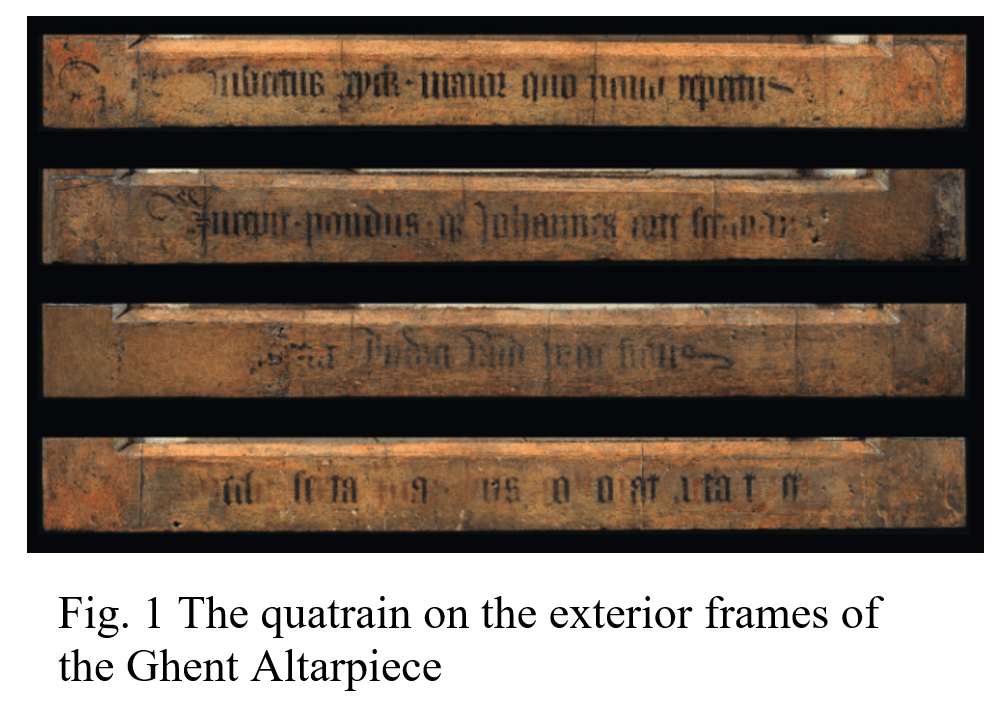
Discovered in 1823, the text reads, “The painter Hubertus Eyck, the greatest who was ever found, began this work, and his brother Johannes, second in art, completed the difficult task in accord with the request of Joos Vijd. With this poem he permits you to view the completed work on the sixth of May [1432]” (Fransen and Stroo Steyaert, 273). There are also records stating that Hubert died in 1426, giving a certain personal weight to the content of the text (Steyaert et al., 2). The validity of this quatrain has been highly debated, and its authenticity seemed to be only agreed upon recently. Elisabeth Dhanens affirms this in her book Van Eyck: The Ghent Altarpiece, as she admits that the quatrains text itself is hard to read and decipher. Dhanens also argues that even though no similar epitaphs seemed to exist during this time, that does not suggest the verse being faked. The imperfect verse also, as Dhanens points out, is another idea that helps strengthen the text’s authenticity, as it would have been normal for such errors to occur due to the education at that time (Dhanens, 28).
As travel notes with witnesses arose, such as Münzer and De Beatise, numerous writers such as Marcus van Vaernewyck began to agree on a general timeframe of the text; as Dhanens puts it, “an unbroken tradition confirming the statement” that both brothers worked on the piece with Hubert van Eyck beginning it, and Jan then contributing later (Dhanens, 42). This was solidified with the new studies done to discover the true authenticity of the quatrain, as Bart Devolder writes in The Ghent Altarpiece: Research and Conservation of the Exterior expressing that “the quatrain was applied simultaneously with the polychromy of the frames,” proving the information was added at the same time the frame was added, thus ensuring the verse is historically reliable (Fransen and Stroo Steyaert, 354).
Apart from establishing the brothers’ relation to the work, there are three pieces of evidence that tie Hubert to Ghent itself: a note of the altarpiece’s creation for the chapel in Ghent, a piece from 1426 relating to the workshop of “master Huybrechts the painter,” and past payment records for the altarpiece and from pupils receiving money from “Master Ubrecht” (Dhanens, 44). Additionally, a tax paid to the ‘heirs’ of Hubert was paid in Ghent the year he died (Dhanens, 44).
Now that Hubert’s previously unestablished involvement within the piece is solidified, it becomes a more challenging task to identify what parts he contributed. As Dhanens repeatedly points out, the true difficulty of identifying Hubert’s hand in the altarpiece stems from the fact there are no true authenticated works by Hubert on record, and thus, no points of comparison (Dhanens, 113). However, it is common for experts to attribute the entirety of the exterior panels to Jan, though it is also suggested that the composition of the Annunciation was created by Hubert, who is thought to have developed part of the Archangel before Jan took over (Fransen and Stroo Steyaert, 233). Though despite many disagreements about which artist contributed to what aspect, it seems relatively agreed upon, as Hugo van Velde notes in his article “The Quatrain of ‘The Ghent Altarpiece,’” that “Hubert is seen mainly in the design and Jan in the execution,” or that “Hubert’s work lies more below the surface, with Jan’s on top” (Velde der, 11).
One can see the development of this literally layered argument through the work done with dendrochronology (a technique for finding the age of items and artifacts) by the KIK-IRPA and the Centre for the Study of the Flemish Primitives in collaboration with Antwerp University. The results of this close analysis gives a timeline of the repainting of the panels which, when paired with the acknowledged true historical timeline of the brothers’ lives at the time, suggests Hubert’s brother carried on and changed or altered the piece after his death (Steyaert et al., 1). As Marie Postec and Griet Steyaert explain in The Ghent Altarpiece Research and Conservation of the Interior: the Lower Register, the work on the Ghent Altarpiece work can be thus broken down into three stages.
The first stage shows a preliminary version of the composition that was largely painted, which has numerous differences from the altarpiece we are familiar with today. The fountain present in the foreground of the Adoration of the Lamb piece is a new addition, as originally there was likely a more minimal natural spring in the meadow with a slight shift in people and the altar and angels being raised higher. Additionally, the architecture present in the background was different, the middle hills having no buildings while those on either side of the meadows were composed of different buildings to what we see today. There was also an abandonment of rays of light that occurred at a higher vanishing point (Steyaert et al., 34).
The second stage shows alterations to the details mentioned above. Here, the fountain appears over the spring and a second meadow covers that of the first. These repaints, as argued by Postec and Steyaert, are the works of Jan. This is likely due to the timeline that matches the separation of the stages, but also due to the different stylistic approaches of the brothers. Jan then is attributed with the addition of three buildings to the middle hills of the meadows, “Utrecht cathedral, the former Abbey of St Bavo’s and a tower reminiscent of Our Lady’s Church in Bruges” (Steyaert et al., 35). There are also a number of botanical additions that suggest Jan van Eyck adjusted or changed the plans for the meadow plants, as many match plants Jan could have seen on his trip to Spain (1430) or a trip to the Iberian Peninsula (1428-29), as numerous of the trees have Mediterranean origin (Steyaert et al., 81). The order that these botanical additions were placed in then suggests that this vegetation present was modified later than the original layer that Hubert worked on.
The third stage seemed to discover something not usually focused upon in the discussions of the brother’s contribution to the piece. In the conservation work on the panel, it was suggested that the lower register of the interior panels was reworked by another artist and, in the words of Postec and Steyaert, “instead of enhancing them, they made them heavier” (Steyaert et al., 35). One of the notable changes was the sky above the meadow, made with a mixture of lead white and ultramarine, which are unique to the layers below. While there is a likelihood this third layer can be attributed to an assistant of the Van Eyck’s, the timeline seems to outdate the original two artists. These “non-Eyckian” interventions make the process of distinguishing between the two even harder (Steyaert et al., 35). However, it is known based on archival evidence that the brothers employed assistants. It is established that Jan had one assistant in 1422, two in 1424, and from 1432-33 an unknown number (Fransen and Stroo Steyaert, 233). So, while this dating proves unlikely, many of the underpaintings or smaller details could possibly also be attributed to workshop assistants.
While it would be nearly impossible to identify the artist or artists involved with the third stage of the altarpiece, it is easier to understand the stylistic differences between the two established contributors through examining detailed images up close. Postec and Steyaert point us to the apostles at the right of the fountain–in comparison with the other figures– as an example of the contributions of more than one painter.
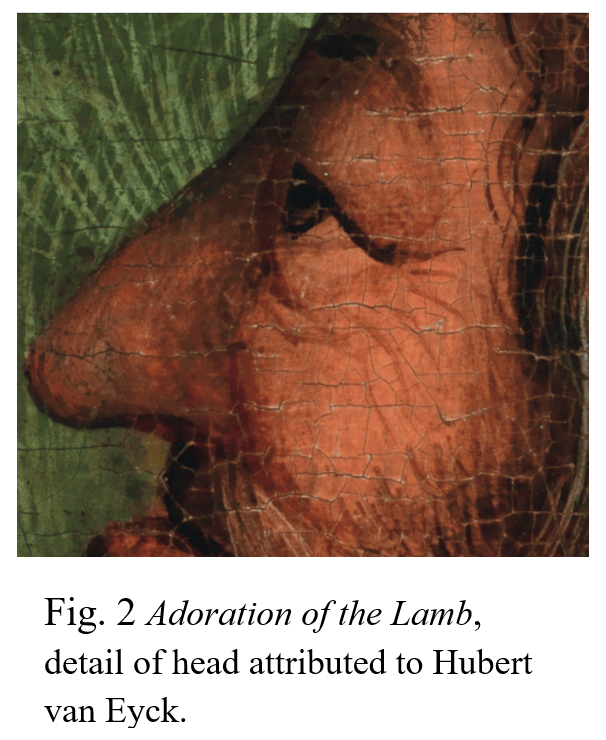
We know, through the analysis presented of the second layer, that Jan Eyck worked around certain figures, such as the first apostle (fig. 2), in his painting of the meadow. If one were to closely examine the eye of this figure, it becomes clear that the artist used a base tone for the entire eye only expressing the eyelid with a dark line which sits unrealistically.
In contrast, while the eyes of St. Anthony (fig.3) began the same, the volume of colors and shapes that express the eyelids presents subtle stylistic differences (Steyaert et al., 151).
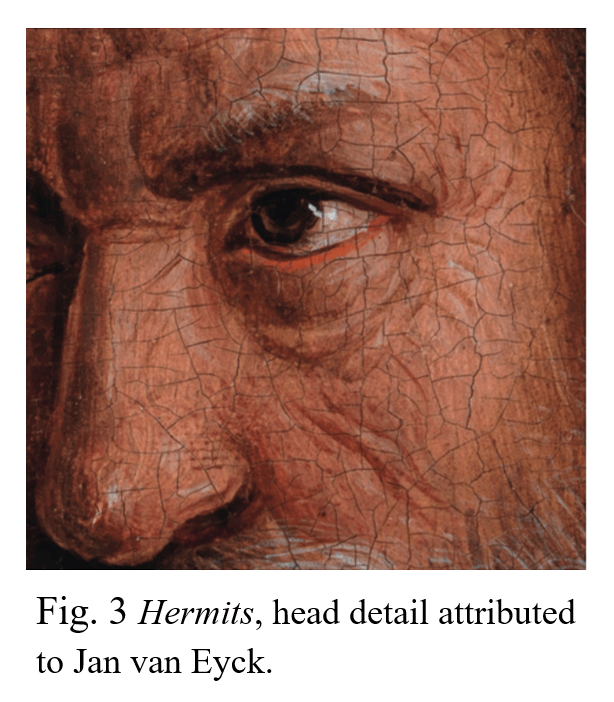
This trend is not singular to these pairs, as the same flatness present in the apostle also appears in the prophet with the red hat and the figure in the blue cap – all of which display, as Postec and Steyaert put it, “features that seem far removed from Jan’s art.” (Steyaert et al., 152). The same St. Anthony patterns are found amongst the hermit and the pilgrim, suggesting that Jan Eyck’s figures are more defined by a more realistic depiction of human skin (Steyaert et al., 152). Not all figures are so black and white in terms of who painted it; however, the eye of one apostle suggests evidence of Hubert’s figures being slightly retouched by Jan. (Steyaert et al., 152).
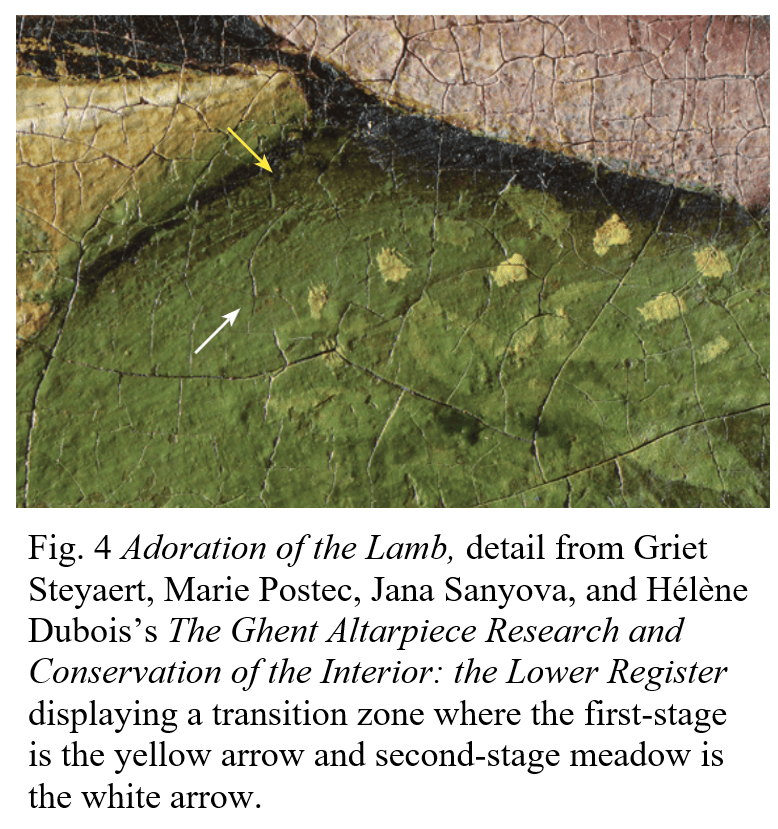
It is also suggested through the layer analysis that the grass shown in the Adoration of the lamb (fig. 4) is done in a less stylized way, suggesting Hubert’s original ground is present in The Knights of Christ (Steyaert et al., 152). This is due to the fact the central panel has a base layer of brown with two top layers of green, whereas this is not the case in the Knights panel. (Steyaert et al., 156).
It is evident the process Hubert used was working from the back to the front, and in terms of figures he began with those nearest to the now nonexistent spring and worked outwards. It is also posited by Postec and Steyaert that “Hubert’s contribution seems to have halted after the execution of the figures in the vicinity of the spring,” as the farther from the center, the more of Jan’s hand we see in the figures (Steyaert et al., 157).
The idea of Hubert working on the first stage or layer of the panel seems to also suggest his contribution to the preparatory stages of the piece, as Jan did not contribute until much of the piece was already established (Steyaert et al., 158). However, this seems to only apply to certain segments of the altarpiece, as divergences to the underdrawings suggest more than one hand contributed. One example of this is the underdrawing of the Adoration of the Lamb, which appears to have more “nervous strokes” that leave a more disordered impression than the likes of Jan’s drawings. Jan’s drawings, as the panel of St Barbara (which is likely attributed to Jan) displays, rarely ever show curving lines, suggesting a distinct difference in planning (Steyaert et al., 158). As Dhanens puts it simply, it appears that Hubert, when creating “monumental compositions,” adheres to the more two-dimensional picture plane and is more bound to tradition. His brother, however, works to show “both space and spoiled form” more similar to the works created in Renaissance art (Dhanens, 121).
Based on the technical analysis of the piece, it seems as if the panel, as it appears today, was developed in three stages, the first painted by Hubert, the second by his brother, and the third post-dating the work of either brother, suggesting non-Eyckian interventions. While there is no current work being attributed to the hands of Hubert van Eyck alone, it is clear that he contributed along with his brother on the Ghent Altarpiece.
The discussion and emphasis on who completed what areas of the piece and if outside hands could have helped complete it, is one we often have today with modern media. As artificial intelligence begins to solidify its place within media, even being used in true crime documentaries on Netflix, there is a specific call for audience members to understand if the media we are taking in is genuine and handmade. This presence within the piece allows us to connect to it in ways that artificial intelligence does not allow. In pieces like the Ghent Altarpiece, when focusing on specific details like the traces of work left behind by Hubert Van Eyck, we are ensuring another artist’s hard work gets the credit, admiration, and respect it deserves.
Bibliography
Currie, Christina, Bart Fransen, Valentine Henderiks, Cyriel Stroo, and Dominique
Vanwijnsberghe, eds. Van Eyck Studies: Papers Presented at the Eighteenth Symposium
For the Study of Underdrawing and Technology in Painting, Brussels, 19-21 September
2012. Vol. 18. Peeters Publishers, 2019. https://doi.org/10.2307/j.ctv1q26whc..
Dhanens, Elisabeth. Van Eyck: the Ghent altarpiece. New York, Viking Press, 1973.
Dhanens, Elisabeth. Hubert & Jan van Eyck. New York, Tabard Press: William S. Konecky
Associates, 1980.
Fransen, Bart, Cyriel Stroo, eds. The Ghent Altarpiece: Research and Conservation of the
Exterior. Brussels: Royal Institute for Cultural Heritage, 2020.
Herzner, Volker. “A Response to Hugo van Der Velden, ‘The Quatrain of “The Ghent
Altarpiece.”’” Simiolus: Netherlands Quarterly for the History of Art 35, no. 3/4 (2011):
127–30. http://www.jstor.org/stable/23350310.
Steyaert, Griet, Marie Postec, Jana Sanyova, Hélène Dubois. The Ghent Altarpiece Research and
Conservation of the Interior: the Lower Register. Brussels: The Royal Institute for Cultural Heritage (kik-irpa), 2021.
Van Asperen De Boer, J. R. J. “A Scientific Re-Examination of the Ghent Altarpiece.” Oud
Holland 93, no. 3 (1979): 141–214. http://www.jstor.org/stable/42711020.
Velden, Hugo van der. “The Quatrain of ‘The Ghent Altarpiece.’” Simiolus: Netherlands
Quarterly for the History of Art 35, no. 1/2 (2011): 5–40. http://www.jstor.org/stable/41407890.

