Allie Konopelski
In her preface to Uncle Tom’s Cabin, Harriet Beecher Stowe claims that:
The scenes of this story, as its title indicates, lie among a race hitherto ignored by the associations of polite and refined society; an exotic race, whose ancestors, born beneath a tropic sun, brought with them, and perpetuated to their descendants, a character so essentially unlike the hard and dominant Anglo-Saxon race, as for many years to have won from it only misunderstanding and contempt (Stowe 3).
This statement exemplifies ‘romantic racialism,’ a popular doctrine in 19th-century America that, while still acknowledging “permanent racial differences,” projected a more flattering image of the African-American, now seen as typically passive, gentle— in short, a natural Christian (Stowe 3). Romantic racialism — which had some purchase with white northern abolitionists — is inevitably embedded in the narrative of Uncle Tom’s Cabin. Indeed, in A Key to ‘Uncle Tom’s Cabin,’ a text published by Stowe following the Southern backlash against her representation of slavery in her best-selling novel, Stowe would reiterate: “The vision attributed to Uncle Tom introduces quite a curious chapter of psychology with regard to the negro race, and indicates a peculiarity which goes far to show how different they are from the white race” (Stowe 464). The “peculiarity” she goes on to describe is a showcase of romantic racialist ideals; she details how Black people are naturally different from “cool, logical, and practical” whites (Stowe 464-465). In this, we see how tempting it was for Stowe to curate and contour the character of Uncle Tom to the romantic racialist standard.
To frame my argument, I deploy two works: George M. Frederickson’s essay ‘Uncle Tom and the Anglo-Saxons: Romantic Racialism in the North,’ and Douglas A. Jones’ book The Captive Stage: Performance and the Proslavery Imagination of the Antebellum North. Frederickson claims that in the early 1840s when the abolitionist movement took root, there was a “heightened consciousness of what were supposed to be white racial characteristics” and that this made “the Negro” into “a kind of anti-Caucasion” (Frederickson 481). This figure became “a vehicle for romantic social criticism” instead of “a human being with the normal range of virtues and vices” (Frederickson 486). The primary traits romantic racialists assign to the African American are molded around the fact that he was a “natural Christian” (Frederickson 483). The traits could as well have used Christ as a model: naturally affectionate, gentle, docile, submissive, grateful, ever turning the other cheek, possessing a child-like innocence, all these making it almost impossible for the slave to be vengeful (Frederickson 483).
In The Captive Slave, Jones analyzes how in effect “northerners cultivated a proslavery imagination with which to maintain, and, over time, widen the gulf between black freedom and full black inclusion” (Jones 2). He argues that white northerners “strove to accommodate the belief in fundamental racial difference…and satisfy the demand for race-based distinctions” in order “to justify and project new forms of black captivity in a white society” (Jones 2). This is of course paradoxical: the “mode of romantic racialism” articulates an “integration…of proslavery premises with antislavery ends” (Jones 109). Commenting specifically on the romantic racialist identification of African Americans with the child, Jones remarks: “Despite their rejection of chattel slavery…white reformers who idealized the African (American) as childlike believed in the propriety and necessity of some form of black captivity” (Jones 110).
Jones’ critique of the romantic racialist viewpoint is transferable to Uncle Tom’s Cabin. Despite Stowe’s strong antislavery sentiments, her representation of African Americans — and specifically Uncle Tom — often serves simultaneously to promote and justify another form of Black captivity. The very terms of her argument against slavery — the African-American is just too childlike to oppress — serve, on occasion, to buttress the practice she attacks: after all, a child does need looking after and perhaps, on occasion, discipline.
Stowe’s narrator characterizes Tom as a natural Christian before he makes a physical appearance in the text. In the first scene, his master, Mr. Shelby, is in negotiations to sell him and tells the slave trader Haley:
No; I mean, really, Tom is a good, steady, sensible, pious fellow. He got religion at a camp-meeting, four years ago; and I believe he really did get it. I’ve trusted him, since then, with everything I have,—money, house, horses,—and let him come and go round the country; and I always found him true and square in everything (Stowe 12).
In this character sketch, Shelby makes a distinction between people (or, more specifically, slaves) who “get” religion — meaning, they understand the message of the Bible and adhere to its morals — and those who don’t “get” it (Stowe 12). Because of what is implied to be a rare, true understanding of Christianity in Tom, he is deemed more trustworthy, and, in a way, superior — or at the very least of an elevated status — amongst slaves in the eyes of his master. But also — it is soon evident — in the eyes of the novel’s narrator.
That narrator claims that what makes Tom’s preaching so influential is “the touching simplicity” and “child-like earnestness, of his prayer” (Stowe 37). Therefore, Tom’s approach to religion — including his unique understanding of it — is intertwined with his child-like nature; his innocence allows him to grasp Christianity and the Bible in the way only a child can. This is an echo of the Christ of the gospels who says “Let the little children come to me, and do not hinder them, for the kingdom of heaven belongs to such as these” (Matthew 19:14). Of course, such a characterization also partakes of the more general Romantic obsession with the innocence of childhood.
But for the purposes of this paper I think it significant that, in a sense, Stowe feels that Tom’s childlike nature is not, in itself, enough. Indeed, fascinatingly, she feels the need to bring in also not only an actual child, but a white child, to mirror Tom and thus exhibit not only how childlike he is but how that simplicity influences his understanding of Christianity. The child is Evangeline St. Clare, daughter of Tom’s second master, and the only actual child — and character — in the novel to be as associated with the power of religious influence as Tom.
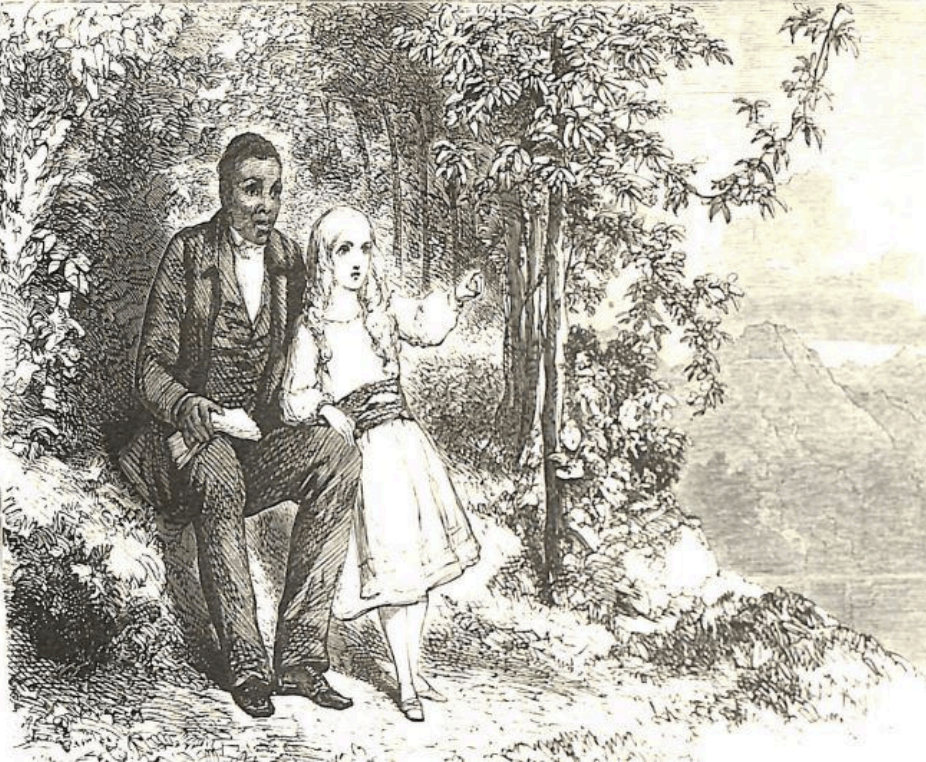
Tom first meets Eva on a ship sailing south while he’s being held by the slave trader, Haley. Tom is allowed special privileges on the ship, having won the trust of Haley, and is “permitted to come and go freely where he pleased on the boat” (Stowe 140). Tom, being such a dependable Christian, will never run away. When Tom befriends Eva, it’s because he has “the soft, impressible nature of his kindly race, ever yearning toward the simple and childlike” (Stowe 143). He watches Eva “with daily increasing interest” and to him, she seemed “almost divine,” and he “half believed” her to be “one of the angels stepped out from his New Testament” (Stowe 143). Before Tom even speaks to Evangeline, she is recognized purely by looks and behavior as pious. She doesn’t just look like an angel, she also acts like one — Eva possesses, like Tom, an inherently kind and generous disposition. Once Tom and Eva speak, it takes one only conversation before Eva decides to ask her father to buy Tom merely because she “[wants] to make him happy” (Stowe 147).
Evangeline — be she an Eve, an angel, or an evangelist — serves as Tom’s double. In Eva, Tom finds his own “touching simplicity” and “child-like earnestness of his prayer” reflected back at him (Stowe 37). The pair are often found with Eva sitting “on [Tom’s] knee, like a chip-sparrow” as she reads him passages from the Bible, and the narrator refers to them as “the old child and the young one” (Stowe 172, 246). Wise beyond her years, Eva helps Tom read his beloved Bible. After two years of being owned by St. Clare, the narrator notes that “The friendship between Tom and Eva had grown with the child’s growth” (Stowe 246). Tom grows to love Eva “as something frail and earthly, yet almost [worships] her as something heavenly divine” (Stowe 246). We learn that “Though a child, [Eva] was a beautiful reader;—a fine musical ear, a quick poetic fancy, and an instinctive sympathy with what is grand and noble, made her such a reader of the Bible as Tom had never before heard” (Stowe 246). Tom looks upon Eva “with a mixture of reverence and tenderness,” like how an “Italian sailor gazes on his image of the child Jesus” (Stowe 246). Although it should be noted — given Eva’s musical ear and poetic fantasy and instinctive sympathy — she also at times might serve as a surrogate for Harriet Beecher Stowe.
When the pale Eva succumbs to death — as all good martyrs do — she is surrounded by a blizzard of whiteness. Her “windows were hung with curtains of rose-colored and white muslin” and above her bed is “an alabaster bracket, on which a beautiful sculpted angel stood, with drooping wings, holding out a crown of myrtle-leaves” (Stowe 269). Dying, Eva has a literal angel watching over her, bestowing upon her a crown of youth, innocence, and love. On the “marble mantle” of her fireplace sits “a beautifully wrought statuette of Jesus receiving little children,” as he will soon receive her (Stowe 270). Nowhere in that death chamber can our eyes settle “without meeting images of childhood, of beauty, and of peace” (Stowe 270). The room Eva dies in is the literal reflection of her piety and child-like innocence — and everyone who enters the room is bathed in it, in a sense reborn. Eva gathers all the household slaves around her deathbed and gives them all a lock of her golden curls, so when they later look upon the strands, they will remember that she loves them and has “gone to heaven,” and wants “to see [them] all there” (Stowe 272). Evangeline hands out a piece of herself — her essence if you will. Like Christ at the Last Supper, dividing up his body and blood amongst his disciples, Eva gives each member of the St. Clare household — every one of whom worshipped her — an immortal token of her physical self. Tom takes this token and keeps it close to his heart — literally. If Eva is read as Tom’s double, her death makes him, in a way, complete in himself. Tom has been sacramentally transformed into the full embodiment of childlike piety, the white Christian child entered the body of a black man. It’s only following Eva’s death that the reader will be wholly convinced of Tom’s natural piety and innocence because Evangeline believed in it. It would seem that for Stowe’s contemporary Northen audience to fully perceive and perhaps accept Tom’s child-like Christianity, those traits first have to be filtered symbolically through his born-again interaction with a childlike Christian whiteness.
In ‘Sentimental Power: Uncle Tom’s Cabin and the Politics of Literary History,’ the essay that put Stowe’s novel back in the American literary canon, Jane Tompkins argues that “the novel functions both as a means of describing the social world and as a means of changing it” (Tompkins 566). Tompkins claims:
[The novel] not only offers an interpretative framework for understanding the culture and, through the reinforcement of a particular code of values, recommends a strategy for dealing with cultural conflict, but it is itself an agent of that strategy, putting into practice the measures it prescribes (Tompkins 566).
In this paper, I have been concerned that this strategy — tinctured as it is by romantic racialism — may indeed describe a social world but, at heart, not serve as a means of changing it. Uncle Tom’s Cabin is both an example of romantic racialism and serves as an advocate for its practice. If Stowe’s was a radical vision — and Lincoln did call her the ‘little lady’ who caused this ‘big war’ — it is also a compromised one. Ultimately, the romantic racialist’s view of the world functions as justification for other forms of Black captivity, a mode of thinking that led white northerners also later to restrict Black Americans from fully integrating into white, northern society as equals. We would perhaps do well to remember that Stowe’s Black characters will in the end die as Christian martyrs or find their freedom by setting sail for Liberia, as missionaries.
Works Cited
Fredrickson, George M. “Uncle Tom and the Anglo-Saxons: Romantic Racialism in the North.” Uncle Tom’s Cabin: Authoritative Text, Backgrounds and Contexts Criticism, 3rd ed., W. W. Norton, 2018, pp. 478-487.
Jones, Douglas A. The Captive Stage: Performance and the Proslavery Imagination of the Antebellum North. University of Michigan Press, 2010.
Stowe, Harriet Beecher. Uncle Tom’s Cabin: Authoritative Text, Backgrounds and Contexts, Criticism. Edited by Elizabeth Ammons, 3rd ed., W. W. Norton, 2018.
Stowe, Harriet Beecher Preface. Uncle Tom’s Cabin: Authoritative Text, Backgrounds and Contexts Criticism, by Stowe, W.W. Norton & Company, New York, 2018, pp. 3-4.
Stowe, Harriet Beecher. “From A Key to “Uncle Tom’s Cabin.”” Uncle Tom’s Cabin: Authoritative Text, Backgrounds and Contexts, Criticism, edited by Elizabeth Ammons, 3rd ed., W. W. Norton, 2018, pp. 458-471.
Tompkins, Jane P. “Sentimental Power: Uncle Tom’s Cabin and the Politics of Literary History.” Uncle Tom’s Cabin: Authoritative Text, Backgrounds and Contexts Criticism, 3rd ed., W. W. Norton, 2018, pp. 554-576.

