Megan Bogner
Throughout history, few women artists’ works have been explored and celebrated as widely as male artists’ works. As will be further explored, this is often not due to a lack of talent or skill, but a lack of opportunity for women to learn the same artistic skills as men, whether through their perceived roles as members of the household or through the impropriety of women studying male nudes. Works by women artists, however, do provide a unique insight into the changing and challenged role of women in society as well as the difference between the male and female gaze. These themes are exhibited through Artemisia Gentileschi’s Judith and Her Maidservant with the Head of Holofernes, Edmonia Lewis’ Forever Free, and Mary Cassatt’s Woman Bathing. Although each of these works is historical, the problem of women’s works not being as widely recognized as men’s is an ongoing problem clearly exhibited in modern times.
In her essay Why Have There Been No Great Women Artists, Linda Nochlin argues that the lack of great female artists is not due to a lack of talent, but rather a lack of opportunity; she makes the case that “it was indeed institutionally impossible for women to achieve excellence or success on the same footing as men, no matter what their talent, or genius” (Nochlin 203). Artemisia Gentileschi is one of few historical women artists who is able to stand out from this point. In the 17th century, Gentileschi was trained by her artist father in his studio in the Baroque style of Caravaggio, and used this formal training to create proto-feminist works of art such as her Judith And Her Maidservant with the Head of Holofernes.
The painting depicts a scene in the story of Judith. Judith was an inhabitant of a Hebrew town that was under siege by the Assyrian army, led by Holofernes. Judith wanted to come to the aid of her people, so she and her maidservant disguised themselves as Assyrian servant girls and snuck into Holofernes’ tent. After plying Holofernes with food and drink to make him sleep, Judith took his sword and decapitated him. The loss of their leader so frightened the Assyrian army that they fled, leaving Judith and her maidservant as the heroes of the town.
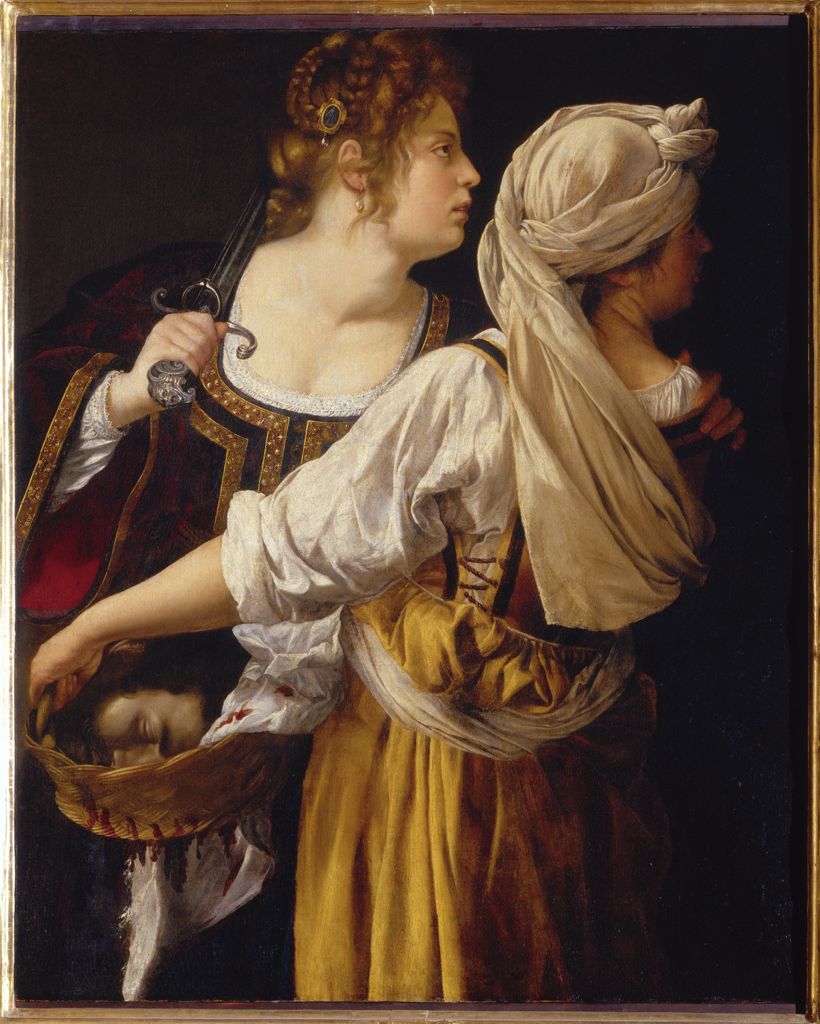
Judith And Her Maidservant with the Head of Holofernes depicts the moment just after Judith has beheaded Holofernes. Her maidservant is concealing the head in a fabric wrap, while both women look out to the side of the painting. The piece has a strong sense of asymmetry as well as a main diagonal line created by the women’s bodies, both of which are traits typical to Baroque art. This diagonal line creates a sense of movement and heightens the tension in the scene. Judith and Her Maidservant with the Head of Holofernes also exhibits an expressive, dynamic design through the movement of the figures within it. Perhaps most striking is Gentileschi’s adoption of Caravaggio’s tenebrism, or the contrast of light and dark created by a single, focused light source—in this case a candle—and a darkened background. By copying Caravaggio’s style, Gentileschi was showing off her own artistic prowess.
The figure of Judith in this painting is that of a strong, confident female lead. Judith is shown as being alert and active; she is an active participant in the scene. She holds a determined expression on her face, exemplifying the fact that she did not accidentally kill Holofernes; she had the strength, power, and cunning to pull off this political assassination. Particularly of note is Gentileschi’s portrayal of both Judith and her maidservant in the scene; it implies that Judith and the maidservant committed the act together, which is in stark contrast to other depictions of this scene. In male society, men compete; however, in female society, women work together. Because Gentileschi is a woman, she shows the power of feminine cooperation and female allyship to challenge male power. Even the way the painting is composed reflects Judith and her maidservant’s solidarity and agency: the two of them fill the painting, forcing the viewer’s eyes up onto them. Judith’s placement is particularly relevant. Her head is at the top left of the painting, meaning that when it is hung at eye level, most viewers would be looking slightly up at her. Judith and Her Maidservant with the Head of Holofernes was painted at a time when most art was viewed by a male audience; and so, most women in paintings were painted nude and seen from above in a direct demonstration of the male gaze. Judith, however, is fully clothed and stands above the male viewer, directly demonstrating her female agency.
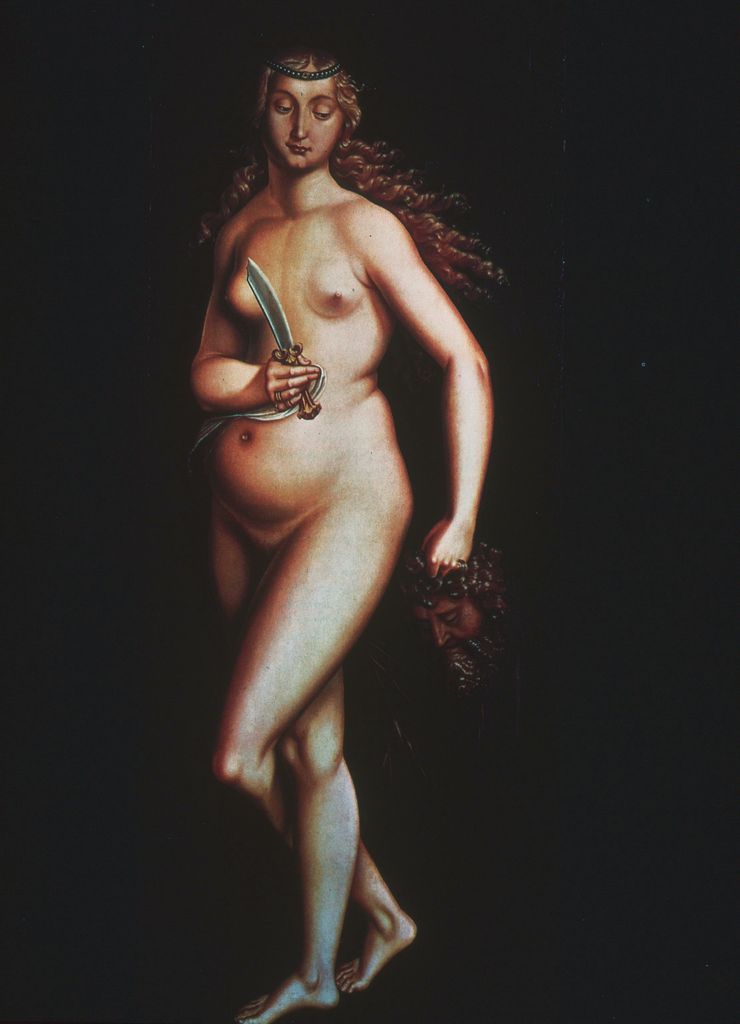
Gentileschi’s proto-feminist portrayal of Judith stands out even more when compared to male artists’ depictions of the same story. In 1525, Hans Baldung, a Northern Renaissance artist, painted the same scene of Judith just having slain Holofernes. Notably absent, however, is Judith’s maidservant; Judith stands alone in the darkened scene. Because this painting was created by a man, it lacks the sense of feminine cooperation present in Gentileschi’s piece. Additionally, Baldung portrays Judith in the nude, standing daintily and coquettishly with her legs crossed and her gaze downwards.
She holds a small knife in front of her body, and Holofernes’ head is tucked behind her, in shade and almost an afterthought. Baldung is playing down Judith’s own strength as well as the implied threat of women against men; Judith does not look like she is capable of inflicting damage on Holofernes, despite the fact that she is holding his head. In fact, the main power that Baldung paints Judith with is the power of her body. Judith is nude, and this eroticism reduces her to an object for male sexual pleasure, catering to the male gaze. Instead of Judith’s story being used as a way to express feminine power, cooperation, and agency, as it is in Gentileschi’s painting, Baldung’s painting is used as a warning to men against women who use the sexual power of their body to control men; in essence, Baldung is reducing Judith’s power down to her nude body.
Another piece of art by a female artist that exhibits feminist themes is Edmonia Lewis’ Forever Free. Lewis was born in 1845 to a Native American mother and an African-American father, but was orphaned early in her life and raised by her mother’s family. She gained a degree from Oberlin College before moving to Rome after the Civil War. While in Rome, Lewis was exposed to the Neoclassical style, which influenced her statue Forever Free. The Neoclassical style brings Greek and Roman Classical statuary into a new, modern context, and Forever Free is no different.
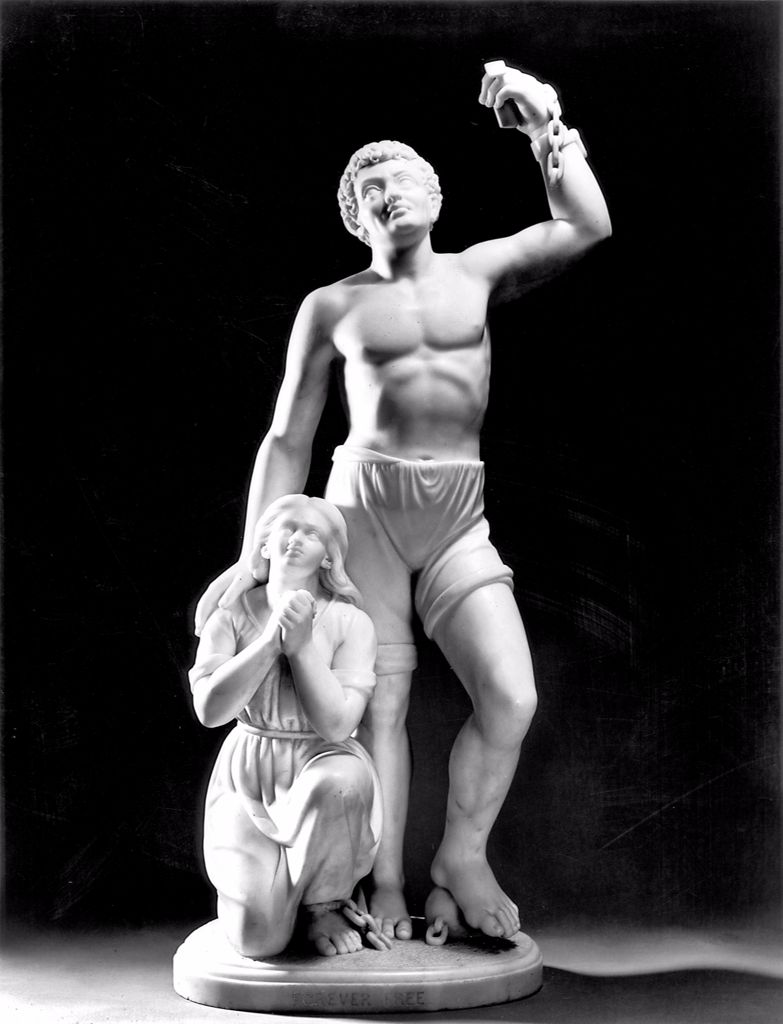
The statue shows two freed slaves: a woman kneeling next to a standing man. The woman clasps her hands in prayer, while the man places one hand on the woman’s shoulder and raises his broken chain triumphantly in the other. Lewis’ Neoclassical style is evident in the contrapposto, or weight shift, of the man’s pose as well as in the idealized, youthful musculature of the man. The naturalistic proportions of both figures, the drapery of the woman’s clothing, and the marble of the statue are all also traditionally Neoclassical elements. Living in Rome exposed Lewis to Roman republican history, which influenced the American democratic system. The statue is a Neoclassical twist on modern, relevant concerns; the statue was made in 1867, just five years after the Emancipation Proclamation. The date this was made is particularly relevant in the context of other uses of Neoclassical style in political history. Most notably, the Neoclassical style was used in France as political propaganda for the French Revolution. Artists such as Jacques-Louis David depicted traditional scenes of liberty and freedom, such as the Roman tale of the Oath of the Horatii, in order to inspire the same feelings during the Revolution. Just like the French revolutionary artists, Lewis uses the same Neoclassical style to promote the equality and freedom of freed slaves in America.
At first glance, the statue does not seem to hold feminist ideas; in fact, it seems to support the opposite. The woman is submissively kneeling by the triumphant man’s side, and all of the racially defining features on the man—his curling hair, for one—have been erased and replaced with gently flowing hair and clothing, in order to make the statue more appealing to a white audience. However, the seemingly submissive pose of the woman reflects the role that women of color were seeking to take on at the time. In her essay The Ideal Works of Edmonia Lewis: Invoking and Inverting Autobiography, Kirsten Buick makes the case that “Black liberation was often defined in terms of the ability of Black women… to become full participants in American life. Ironically, this… also entailed an obligation to live out the gender ideals of American patriarchal society” (Buick 6). While conforming to stereotypical gender roles does not match today’s definition of feminism, in 1867, it reflected a large leap in the status and perception of Black women. Buick adds that while enslaved, the Black “woman lived in the midst of a paradox…as the ideal woman, was ‘a soothing helpmate to her husband,’ [but] she might also need to be ‘wily and physically courageous…able to murder her master, hide out in swamps, and ford rivers’” (6). When freed, a woman’s role then was simplified into its own sort of freedom; no longer having to split their identity into both helper and harmer, Black women were able to reclaim their power as mother and homemaker. Again, while this simplified identity does not reflect modern ideas of feminine power and agency, it does reveal the new agency that Black women were able to have after being freed.
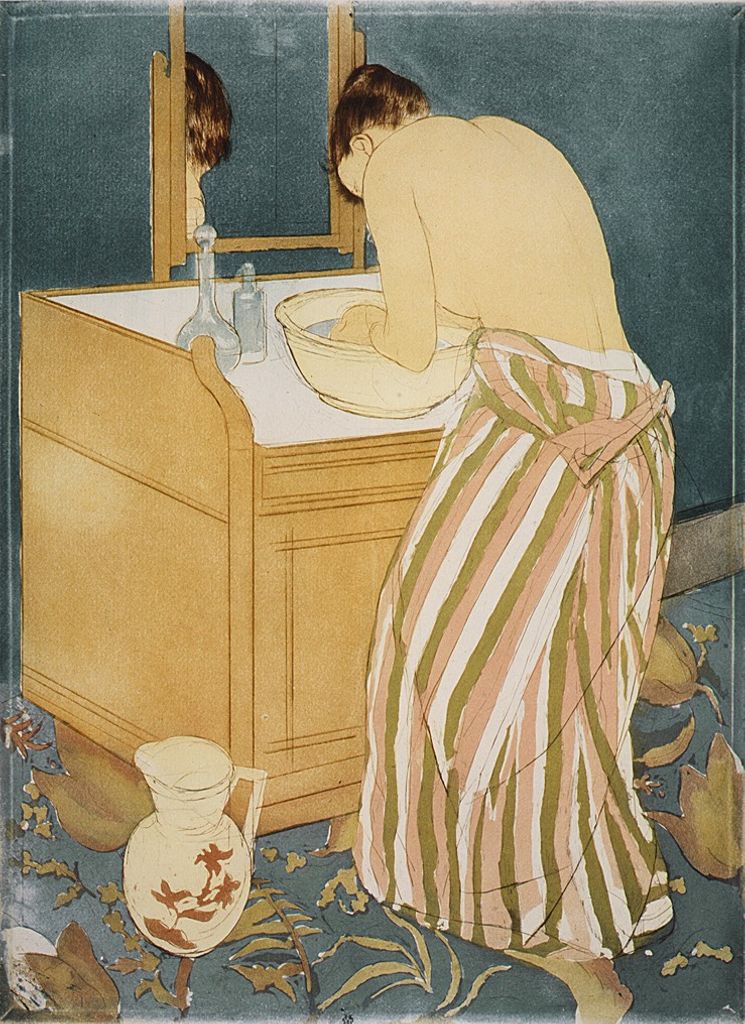
A third piece of art that reflects the feminine psyche and the feminist role of women in society is Mary Cassatt’s Woman Bathing from 1890-91. Mary Cassatt was one of few women officially recognized as part of the Impressionist movement due to her tutelage under Edgar Degas. Cassatt’s painting takes inspiration from Japanese ukiyo-e prints, which is evident through the asymmetric composition and the view of everyday life. Additionally, the perspective is slightly elevated, which flattens the space; the forms in the room are also broad and simple with strong, solid colors.
Most of Cassatt’s work dealt with the private, domestic life of women, and Woman Bathing is no different. The painting shows a woman in her boudoir, standing at a cabinet. She is sponge bathing and is nude from the waist up. While this is an easily sexualized position, Cassatt painted the woman facing away from the viewer; and while there is a mirror reflecting part of the woman’s hair and face, no part of the woman’s revealed skin can be seen in the reflection. Mirrors in art were often used as a symbol of vanity or as a warning against being too absorbed in one’s own beauty; but the viewer is unable to even see the woman’s face reflected in the mirror. The mirror is being used as a tool of the woman, not a symbol of her feminine vanity. The woman is not absorbed; the mirror and her reflection are just physical facts of her being in her own space.
Unlike many paintings of women bathing, of which countless examples could be named, Cassatt’s Woman Bathing is not sexualized in the slightest. The woman’s nakedness is a necessary part of her sponge bath and is not portrayed for the delight of the (male) viewer. Cassatt is directly representing a private moment in the life of a woman. According to John Berger in his essay Ways of Seeing, women are constantly aware of a ‘viewer’ that is watching them, while men simply exist in a space. In other words, “men act and women appear… Thus she turns herself into an object—and most particularly an object of vision: a sight” (Berger 128). However, the woman in Cassatt’s painting has her own, independent existence; rather than existing for the sexual, visual delight of a viewer, she has an autonomous identity in her own private space. This woman has no viewer; she is alone, with only herself, and is dropping the sense of surveyance that Berger mentions. This loss of a sense of surveyance is so clearly portrayed because Cassatt is, herself, a woman aware of men’s gazes, and is therefore conscious of the lack of it in women’s private spaces. Cassatt was a strong supporter of women’s rights; she never married and supported the women’s suffrage movement. Her feminist views are clear in this unsexualized depiction of a woman with personal agency.
Although women artists struggled to gain the same access to art education and models as male artists did, Artemisia Gentileschi, Edmonia Lewis, and Mary Cassatt all managed to create beautifully feminist works of painting and sculpture. Feminism looks different for everyone in every age; for these women, it meant expressing feminine agency, the right to gentle motherhood, and to not be looked at as an object of vanity. In the modern day, feminism can look like those three things, as well as the right to one’s own body, striving for equal pay and treatment in the workplace, and longer maternity leave. Although each of these artist’s three pieces show gender values and radical feminist ideas differently, all three reflect changing and challenged ideas of the role of women in their respective times and, perhaps, in our times as well.
Bibliography
Buick, Kirsten P. “The Ideal Works of Edmonia Lewis: Invoking and Inverting Autobiography.” American Art, vol. 9, no. 2, 1995, pp. 4-19, https://www.jstor.org/stable/3109182.
Nochlin, Linda. “Why Have There Been No Great Women Artists?” Writings About Art, Prentice-Hall, Inc., 1994, pp. 194-205.
Berger, John. “Ways of Seeing.” Critical Perspectives on Art History, Prentice Hall, 2002, pp. 127-131.
Image Citations
Artemisia Gentileschi. Judith and Her Maidservant (Judith with the Head of Holofernes). c. 1612. Artstor, library.artstor.org/asset/SCALA_ARCHIVES_1039779844
Baldung, Hans, d. 1545. Judith with the Head of Holofernes. c.1525. Artstor, library.artstor.org/asset/ARTSTOR_103_41822000649374
LEWIS Edmonia (1843-ca. 1900), artist. Statue. Forever Free.. 1867. Artstor, library.artstor.org/asset/IBWA_DB_10313287580
Mary Cassatt (American, Pittsburgh, Pennsylvania 1844–1926 Le Mesnil-Théribus, Oise). Woman Bathing (La Toilette). 1890–91. Artstor, library.artstor.org/asset/SS7731421_7731421_11239025

