Chieko Dunham
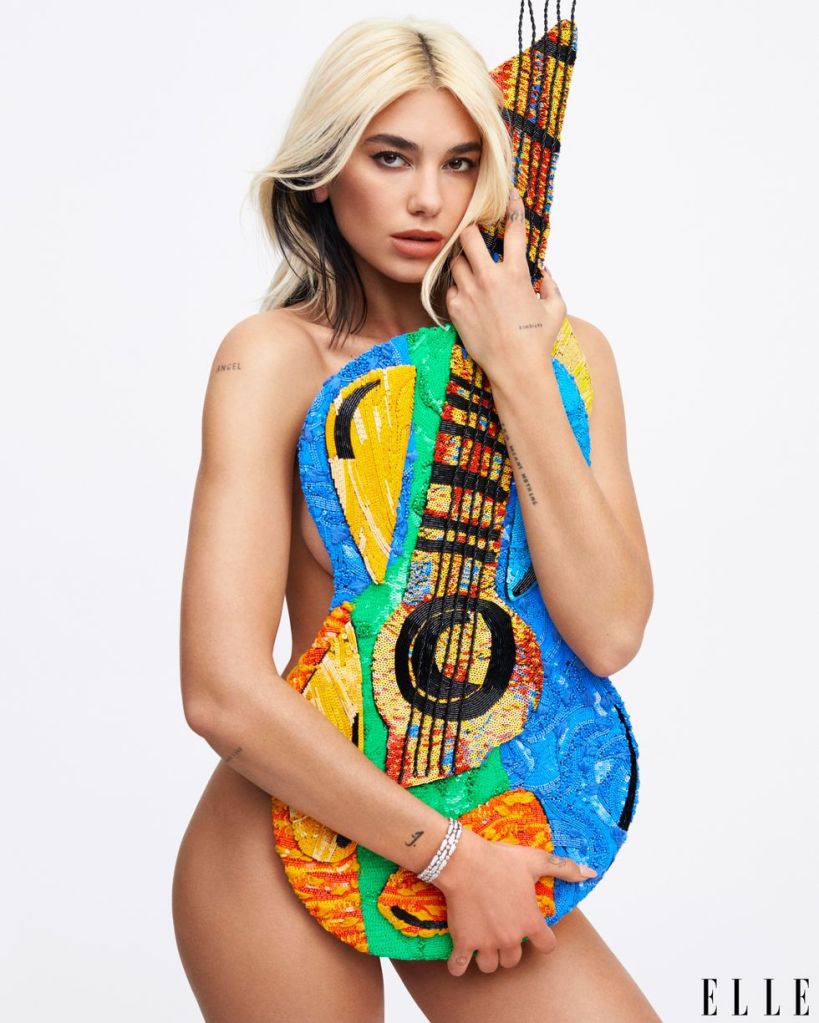
A comparison of contemporary art and that of Classical Greek art chronicles the amazing and vast changes that human society has undergone, leaving room for discussion about the future of art and humanity. Art that is still particularly heavily influenced by the Greek Classical style is art that depicts the human figure, whether it be nude like Doryphoros or clothed like the Peplos Kore. As opposed to the soldiers, mythological figures, and common peoples in reliefs and sculptures that surrounded the temples and worship areas of Ancient Greece, in our contemporary age, many of the figures depicted in art are celebrities, politicians, and now even social media influencers. One such celebrity photographed and posed consistently is Dua Lipa, an American pop star.
In this photograph, Dua Lipa is posing for the popular magazine ELLE for an interview regarding her album “Future Nostalgia” released during the COVID-19 pandemic quarantine. Dua Lipa is shown nude, covering herself with a colorful guitar prop. A bracelet adorns her right wrist and her hair is dyed two different colors atop one another. She sensually looks at the camera, mouth open a little, and her hands are shown clutching the neck and bottom of the guitar in a somewhat intimate manner. On her body are various tattoos but it’s apparent that they are not the prime focus in the photograph, but simply markings that Dua Lipa personally chose for herself.
This depiction of Dua Lipa holds many features that align greatly with the Classical style. Since Dua Lipa is a celebrity, she is an idealized figure. The smooth lines of her body, thinner arms, wider hips and thighs all align greatly with the idealized female frame that a contemporary audience is looking for. While the standards for the “ideal” are different in Classical style versus a contemporary view, they still follow the same principle. While one could argue that the tattoos adorning her skin are “flaws,” tattoos are a common thing nowadays and do not deter from the flawless image of Dua Lipa’s body. The expression that Dua Lipa holds on her face, neutral with some hints of sensuality, are similar to the neutral, contemplative gazes that are held on sculptures like the Doryphoros. Her brows are rested, her nose is contoured correctly, and the lines around her mouth are subtle. Her eye contact with the camera would be similar to looking directly into the eyes of the Doryphoros. However, this is a photograph and not a marble imitation of the human figure, and as such the amazement of these details is not striking as it is on the Doryphoros. Although it is hard to see as her legs are cut off in the frame, it is clear that Dua Lipa has her left leg stretched out while she shifts her weight to her right hip, much like a contrapposto pose. The props in the photo, the guitar and the bracelet, are listed underneath the photograph in the article along with the companies that produced them. The guitar is Moschino Couture and the bracelet is De Beers. These are luxury brand companies, and thus the display of them is a display of status and wealth. This practice of displaying one’s status is not uncommon in the Classical style. Men and women were depicted depending upon their jobs, whether it be senator or housewife. The intention is not the same, however.
What is more obvious in this depiction of Dua Lipa is its contemporary divergence from the Classical style and its tropes. The most striking difference is the way in which nudity is handled within the photo. It is rare in the Classical style that you find figures who are nude while covering themselves with something other than their clothing. Dua Lipa, however, is hiding her nude body behind a colorful guitar. This obstructed view of her body is most certainly a symptom of the contemporary era in which this photo was taken. In the modern age, especially in Western civilization, despite ancient Greek views and styles influencing modern society, views around nudity have changed drastically. Modern people are often uncomfortable with regard to nudity, finding it to be more pornographic than simply a natural display of the power of the human body. Thus, Dua Lipa’s nudeness is done in a scandalous manner. She is posed suggestively as opposed to being posed naturally like most Classical Greek sculptures. The way in which she holds the guitar tight to her body, wrapping her arms around the guitar, is erotic. The closest thing in Classical Greek style that would match this photo is the wet cloth motif found in certain depictions of Greek goddesses. Their clothing would be sculpted as though they were soaking wet, clinging to the outlines of the female body while still being clothed. This practice is erotic in the same way that Dua Lipa is, holding the guitar as some of her breast can be seen, a cheeky wink to the viewer.
Another difference can be noted in the guitar in the photograph. The guitar is brightly colored. The hole at the center meant to amplify the acoustics of the strings is noticeably painted on. The neck of the guitar seems to stop abruptly, leaving the strings to continue to stretch upward with no support. The frets of the guitar, much like the center hole, are hastily sketched on and inaccurate. The guitar is extremely abstract, something you will not find in the Greek Classical style. Considering the guitar is made by a luxury brand, Moschino Couture, it is most certainly an art piece itself, clearly something that is calling to modernism more than ancient Classical Greece.
While there are many similarities between this photo of Dua Lipa and the Classical style of Ancient Greece, there are quite a few differences as well. The differences that can be found seem to be influenced and marked specifically by the social attitudes of the contemporary era rather than some artistic stance against the Classical style. The similarities too, however, reflect an investment into similar ideas that were foundational to the Classical style. Depicting Dua Lipa and her body in such an idealistic way perpetuates her idolized state as a pop star, something one would do during the Classical period to highlight the divinity of a god or ruler. This practice holds much more consequence in the modern age, however, as this ideal that is being depicted is done so using the real human form, an actual person, as opposed to a stone carving of one. Thus, this idolization is cemented in reality in a much more concrete way for those who are viewing this photograph, believing that this ideal state can be realistically achieved. With this idolization also comes with the fact that depicting her in such a way alongside luxury items gives the same status-symbol effect to said items as it does her, much like certain plants and animals are motifs for various themes and gods. Perpetuating these things in the modern age of consumerism when it comes to objects gives way for enticing people to buy these objects to try to reach the same state of idolization, meaning more profit for the companies who sell the objects (whether or not the product is authentic or a knock-off). Alongside profit for the objects, there is profit for Dua Lipa herself. With her being idolized, she perpetuates a powerful image of herself, giving her more power when she advertises her own work, like her album (which was the purpose of this photoshoot). With this in mind, following the Classical style in photographs of celebrities this way is done for greedy intent in the modern age.
Bibliography
Grossman, Zoey. Dua Lipa Is Ready For the Party On the Other Side. 2020, Elle. www.elle.com/culture/celebrities/a31943034/dua-lipa-future-nostalgia-interview/.

